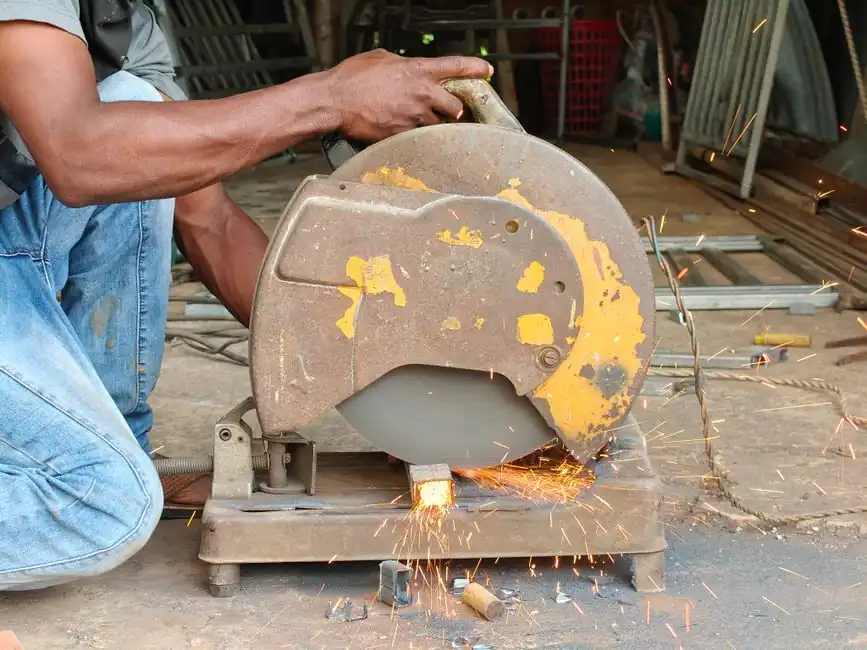
The specified DustBull dust-containment product for gas-powered concrete saws connects to a 2-inch soft hose cuff and requires a 260 CFM vacuum system.
The design applies to concrete and masonry cutting, where respirable crystalline silica can be generated, while installation quality determines whether the nominal port size translates into effective capture at the blade.
What Indoor Compliance Requires
Cutting fiber-cement board with a handheld circular saw can generate respirable crystalline silica because the board combines cement, sand, and cellulose fibers [S1]. The control basis is 29 CFR 1926.1153, Table 1, which addresses handheld circular saws with blades no greater than 8 inches in diameter [S1].
OSHA's fact sheet describes a vacuum dust collection system as an engineering control for cutting fiber-cement board outdoors with a handheld power saw equipped with a blade diameter of 8 inches or less.
For a purpose-built concrete-saw shroud, the more demanding published requirement is a 260 CFM vacuum system [S5]. These figures are not interchangeable. The 260 CFM value applies to the specified DustBull dust-containment product for gas-powered concrete saws.
Choosing the Port and Vacuum
Match the extraction port to the saw and to the extraction system instead of selecting the largest hose that will physically fit. Tools with 4-inch or 2.5-inch dust ports can be connected to a dust collector or dust collection system.
The key airflow comparison is direct. A 2-inch port paired with a high-pressure, low-volume extractor can support concentrated capture at the cut, while reducing a 4-inch collector line to 2.5 inches can sharply reduce performance because the smaller line raises friction and restricts airflow [S4]. A 2-inch tool port should not be treated as a 4-inch collector connection without an engineered extraction arrangement [S4].
For branching networks, keep combined branch capacity from exceeding the main line within the practical limits of the system [S3]. That rule is more relevant to fixed shop collectors than a short dedicated hose, but it still prevents a common specification error: adding several large branches to a trunk that cannot supply their combined airflow.
Shroud, Blade, and Material Fit
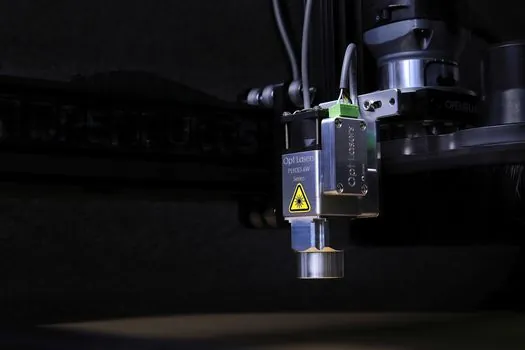
The shroud must place its opening close to the blade zone, because a compliant-looking hose connection has little value if airborne dust escapes before entering it. The DustBull system uses an aluminum shroud, a universal mounting bracket, a bolt kit, and a 2-inch soft-hose cuff for gas-powered concrete saws [S5].
This discrepancy matters for procurement. The buyer should request the manufacturer’s current dimensional drawing rather than treating either web listing as definitive.
For fiber-cement cutting, specialty blades with 4–8 teeth reduce respirable dust compared with standard masonry blades, and polycrystalline diamond tips are recommended for longer cutting life [S1]. The same guidance limits the covered handheld circular-saw configuration to blades 8 inches or smaller [S1].
Concrete-saw shrouds and fiber-cement saw controls should not be treated as interchangeable approvals. One product is designed around gas-powered concrete saws and cites capture of up to 90% when cutting hardscaping material [S5]. The other addresses respirable crystalline silica from handheld circular saws cutting fiber-cement board under 29 CFR 1926.1153 [S1].
Where the System Is Intended to Work
This arrangement is for contractors, workshops, and facility teams that cut concrete, masonry, or fiber-cement indoors where airborne dust cannot be released freely. It is not a universal authorization for every cut-off saw or every indoor task. OSHA's fact sheet describes controls for handheld circular saws with blades of 8 inches or less and states that a vacuum dust collection system can control dust when cutting fiber-cement board outdoors.
For an indoor installation, contain the cut rather than relying on dilution alone. Position the shroud over the blade, connect it before starting, keep the hose short where practical, and avoid sharp bends or kinks [S1][S5]. The hose should have enough capacity to carry the airflow specified by the saw or shroud manufacturer [S1].
A universal mounting bracket may fit many gas-powered concrete saws, but fitment does not establish regulatory compliance by itself [S5].
Maintenance and Failure Modes
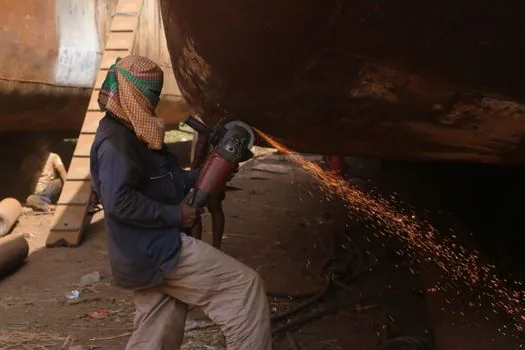
Maintenance failures negate nominal capture performance even when the shroud, port, and filter meet their published specifications. Keep the vacuum hose clear of debris, kinks, and tight bends, and switch the vacuum on and off regularly when it lacks self-cleaning to reduce filter dust buildup [S1].
Change collection bags at least as often as the vacuum manufacturer directs, establish a maintenance schedule, and avoid exposure while changing bags or filters [S1]. Do not use compressed air or blowers to clean surfaces, clothing, or filters unless a ventilation system effectively captures the dust cloud, because the airflow can spread respirable silica [S1].
Do not blow a dust shroud, filter, or collection drum with uncontrolled compressed air. Use a HEPA-filtered vacuum or wet methods where compatible with the material and equipment [S1]. The Angle Grinder Dust Shroud Specs for Concrete Silica Control reference provides a useful adjacent comparison for shroud design and control principles.
Procurement Checklist
Write the requirement as a performance package rather than “with dust extraction.” Specify the saw type, blade diameter, material, port diameter, minimum airflow, filter efficiency, hose length, installation location, and required cleaning access [S1][S5].
A defensible minimum specification for a 2-inch concrete-saw shroud is a 260 CFM vacuum, a 99% or greater efficiency exhaust filter, and a clear 2-inch hose route [S1][S5]. Include a manufacturer statement or objective performance data supporting the claimed OSHA compliance, rather than relying on the word “OSHA-compliant” alone [S5].
Verify the accessory fit before purchase. The DustBull has SKU D1765, a 2-inch port size, a 90-day warranty, and a universal mounting kit intended for most gas-powered concrete saws [S5]. For a 2-inch dust extractor, use the same 2-inch hose class shown in the connection examples for 2.5-inch ports and match the extractor to the port rather than adapting by appearance alone [S6].
The trackable compliance signals are measured airflow at the saw, verified filter condition, and dust-capture performance at the cutting point. A connected hose does not prove either condition, so commissioning records should document the 260 CFM requirement for the cited shroud or the manufacturer’s stated airflow requirement for another system [S1][S5].