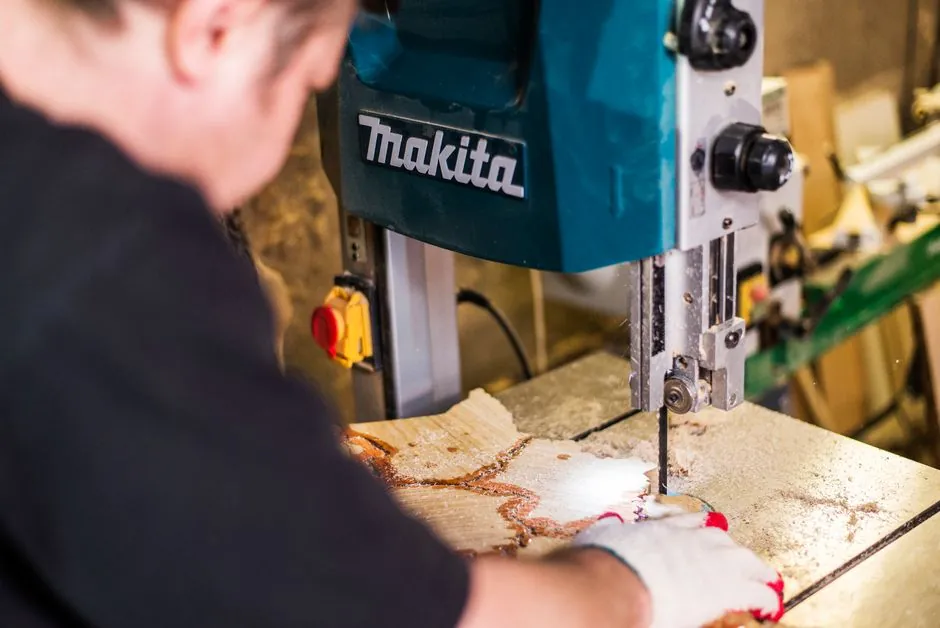
In work environments where noise may be a potential risk, employers are responsible for protecting their employees' hearing and, when necessary, implementing a hearing conservation program.
For an indoor fabrication shop, compare machine sound pressure, task duration, material, diameter, and wall thickness, then verify the complete cutting and tube-handling sequence rather than accepting a catalog dB(A) figure.
What the shop noise rating must represent
Occupational noise exposure poses risks to workers' hearing acuity and safety and is associated with auditory and nonauditory effects. A cut-off machine rating should therefore identify the measurement type, weighting, microphone position, operating condition, and distance. A bare sound-power number is not interchangeable with an operator sound-pressure level.
OSHA lists sound level meters, noise dosimeters, and octave-band instruments among the instruments used to assess workplace noise [S1]. For procurement, a calibrated sound level meter supports an acceptance test, while a dosimeter is better for evaluating an entire shift. Cutting and material handling operations are notable sources of substantial noise in tube and pipe fabricating and producing shops.
That is why a cut-off machine rating alone cannot represent the complete indoor cutting cell.
85 dBA does not define an acceptably quiet shop
In work environments where noise may be a potential risk, employers are responsible for protecting their employees' hearing and, when necessary, implementing a hearing conservation program.
Chronic exposure above 90 dB is associated with permanent hearing loss, tinnitus, communication problems, stress, and fatigue in metal-fabrication environments [S5]. A narrative review included 22 articles and found that most machine areas within the mills reviewed emitted high levels of noise.
The practical acceptance criterion is therefore not “below 85 dBA.” A new machine can exceed the limit during a short cutting burst while the shift average remains lower, or it can remain below 85 dBA and still produce unacceptable impulse noise, high-frequency components, or poor intelligibility. Specify the measured level, exposure time, operating cycle, and hearing-protection assumptions together.
Compare cutting methods by noise behavior
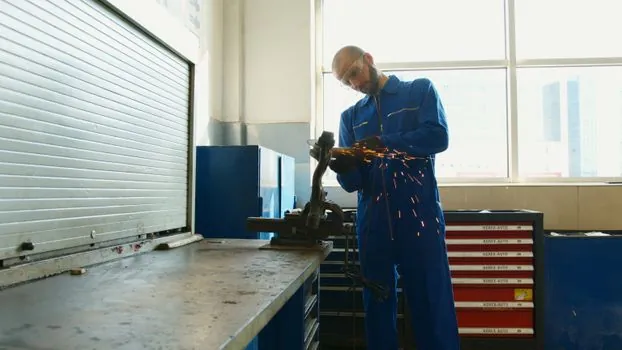
That ranking is more useful than an isolated model rating because it ties process selection to expected acoustic behavior.
A supplier claim such as “85 dBA” is incomplete unless it identifies whether the value is sound power, A-weighted sound pressure, peak level, or an 8-hour exposure estimate.
Specify the measurement protocol in the purchase order
Require the supplier to state the declared noise metric, A-weighting or other weighting, measurement location, microphone height, machine distance, stock specification, cutting speed, wheel or blade specification, guard configuration, and whether the value is continuous, maximum, or peak. These fields are necessary because the research identifies several instrument types but does not provide a universal dB(A) rating for every cut-off machine [S1].
For indoor acceptance, use a sound level meter for the machine test and a noise dosimeter for the operator's shift. Record background noise before startup and include material handling, coolant pumps, conveyors, and impact events when evaluating the work cell. The cut-off machine configuration guide is useful for checking whether the same machine will be used in a fixed production bay or moved between workstations.
Control noise at the source and along the path
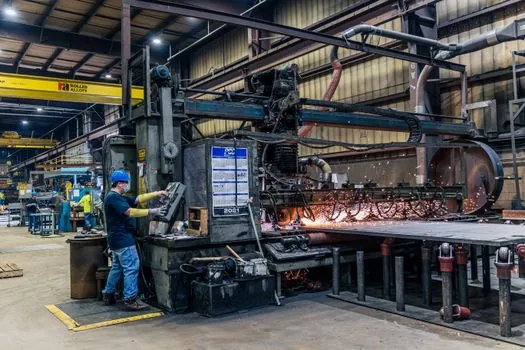
Cutting and material handling are the principal noise sources in tube and pipe fabrication shops [S3]. Cutting and material handling operations are notable sources of substantial noise in tube and pipe fabricating and producing shops. These measures address the release of cut pieces rather than relying only on ear defenders.
Shop acoustics also affect the measured and perceived environment. Hard walls and ceilings reflect sound, while insulation, soft surfaces, and absorption panels reduce reverberation [S4]. Metal-fabrication guidance identifies continuous machinery hum, impulsive stamping or hammering, tonal grinding, and broadband sawing as distinct sources, each requiring a different control response [S5].
Personal protection remains necessary where engineering controls cannot lower exposure, but fitted hearing protection does not correct an inaccurate equipment specification. The hierarchy of control supports source reduction first, followed by isolation and administrative measures, with hearing protection applied to residual exposure [S2].
Acoustic limits and failure modes
The main failure mode is treating a single catalog number as a shop-wide exposure result. Another is ignoring peak and impulse noise, even when the 8-hour average is below the OSHA action threshold. A third is excluding ancillary equipment: high-pitch servo-drive noise, hydraulic-pump whine, coolant-pump whine, compressor thump, and hard-surface reflections can dominate the background or interfere with communication [S4].
Large open shops can amplify noise through reverberation, and delayed reflections can impair speech perception [S5]. Fabrication work can also produce continuous, impulsive, tonal, and broadband noise simultaneously, so no single decibel value captures the full acoustic condition. The appropriate question is whether the machine keeps the operator's measured dose below the applicable limit and whether transients, tonal character, and communication interference remain controlled.
Before accepting a delivery, document the test setup, verify the representative cut, repeat measurements across the machine's adjustment range, and retain the instrument reading with the purchase record. If the shop expects continuous cutting, ask for an extended cycle rather than a short cutting-only sample. If abrasive-wheel or sawing noise is dominant, include wheel condition and material hardness because those variables are not equivalent to the motor's idle sound.