A 10-inch miter saw commonly cuts a 2 x 6 at 90° and a 2 x 4 at 45°, while a 12-inch model commonly cuts a 2 x 8 at 90° and a 2 x 6 at 45° [S1].
The usable adjustment range depends on the saw, miter table, detent arrangement, and workpiece size, so blade diameter alone does not establish the maximum miter angle.
How Miter Angle Adjustment Works
This distinction matters when comparing machines because a wide scale does not necessarily provide firm positional control at every angle.
Compound miter saws can combine a miter rotation with a head tilt, allowing miters, bevels, or both in one cut [S3]. The miter range and bevel range are separate specifications, and a machine with a wide bevel adjustment does not necessarily offer an equally wide miter range.
Selecting for the Required Angle Range
For ordinary 45° trim and picture-frame work, a saw with a 45° miter detent and usable capacity for the stock is the practical baseline. For crown molding, a compound miter configuration is normally required because the molding angle combines a miter across the face with a bevel along the edge [S3].
Nominal saw size indicates blade diameter, not cutting capacity by itself. Common miter-saw sizes include 10-inch and 12-inch blades, while sliding miter saws extend crosscut capacity by traveling along a rail [S3]. A 12-inch model does not automatically accept every workpiece that a smaller slider accepts, because height, depth, and fence geometry remain independent constraints.
For dimensional comparison, a 10-inch model is commonly described as cutting a 2 x 6 at 90° and a 2 x 4 at 45°, while a 12-inch model handles a 2 x 8 at 90° and a 2 x 6 at 45° [S1]. These are useful capacity checkpoints, but they should be matched to the exact manufacturer specification before ordering. The broader circular saw category includes different cutting geometries and should not be treated as a substitute for a miter-saw capacity table.
Comparing Miter Saws by Range and Work

A sliding miter saw adds rail travel for wider crosscut capacity, while its miter table still determines the angular range [S3]. This configuration suits dimensional trim and framing where width, rather than extreme angle coverage, is the governing requirement. The 45° cutting examples for 2 x 4 and 2 x 6 stock show how stock dimensions interact with blade size [S1].
A compound miter saw adds a bevel range by tilting the saw head, making it suitable for crown molding and similar workpieces that require two angular references [S3].
Some miter saws slide along a rail to allow greater cutting capacity for wider boards, and most miter saws are compound miter saws that can cut miters, bevels, or both at the same time. Maximum angle, cutting capacity, and cut quality are separate selection criteria, and a machine with the widest nominal scale may require more careful calibration.
Accuracy Depends on Alignment, Not Scale Range
A miter saw can indicate 45° accurately and still produce an inaccurate joint if the blade is not square to the table or the fence is not square to the blade [S4]. Adjust the saw blade and fence to help ensure straight and accurate cuts.
The saw blade and fence should be adjusted to help ensure straight and accurate cuts. Adjusting the blade to be square to the table and the fence to be square to the blade can help ensure straight and accurate cuts. The manufacturer manual for the exact model remains the controlling document for adjustment procedure and safety.
Working Beyond the Standard Miter Range
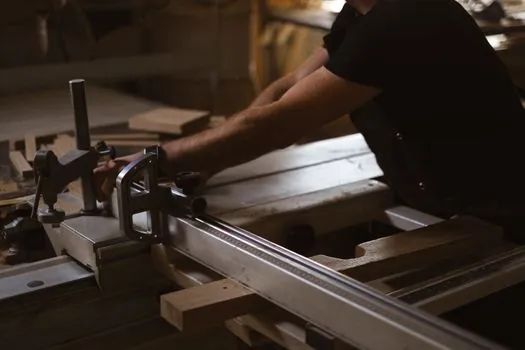
Cutting beyond the saw’s normal angular range can be addressed with an auxiliary 45° backstop placed tightly against the factory fence [S2]. That arrangement creates an added reference surface for workpieces that cannot be held accurately against the original fence at the desired compound orientation [S2].
The auxiliary method adds tolerance to the reference system. Contact along the backstop, workpiece support, and original fence must be stable, or the added angle will reproduce the same alignment errors rather than correct them [S2]. It is a controlled workaround for a defined cutting problem, not evidence that the machine has a larger factory adjustment range.
For production procurement, document the required positive angle, negative angle, bevel, maximum stock dimensions, and acceptable joint tolerance. Then compare those values with the saw’s miter scale, detent locations, and cutting-capacity specification [S1][S4]. If the required angle exceeds the indexed range, evaluate a saw with the correct range before relying on a fixture or backstop.
Who Needs a Wide Miter Adjustment Range
Wide-angle adjustment is appropriate for installers and fabricators who repeatedly cut compound crown molding, picture frames, trim returns, and angled framing members. It is also relevant to shops producing multiple joint orientations from the same material, where frequent movement between 22.5°, 45°, and other indexed positions reduces setup changes [S4].
The feature is not a priority for operators limited to 90° crosscuts or standard 45° miter joints. A fixed saw with reliable 0°, 22.5°, and 45° detents may provide better consistency than a more complex compound machine when bevel cuts are not required [S4].
Industrial buyers should also distinguish miter adjustment from bevel adjustment and from blade capacity. A 12-inch blade designation, a 2 x 8 capacity at 90°, and a 45° miter stop are three different catalog facts [S1][S3]. Treating them as one range figure can produce a machine that reaches the angle but cannot hold the required section size.
Sourcing Specifications That Can Be Verified

A purchasable specification should state blade diameter, maximum cutting height at 90°, maximum cutting width at 90°, maximum miter angle to the left and right, bevel range, available detents, and whether the saw is fixed, sliding, or compound [S1][S3][S4]. These fields allow an apples-to-apples comparison across manufacturers.
Request the machine manual or manufacturer capacity chart with the quotation. Confirm the listed 10-inch and 12-inch capacity examples against the exact model rather than treating them as universal limits [S1]. For workflow analysis, cutting machine selection criteria should include the required angle and workpiece envelope, while the actual miter range must come from the nominated saw model.
Trackable procurement signals are simple: whether the supplier states separate left and right miter limits, identifies detent angles such as 22.5° and 45°, and publishes stock-size capacity at 90° and 45° [S1][S4]. A quotation that supplies those values is easier to validate than one labeled only as a heavy-duty miter saw.
A saw may cover the required range, but parts must still meet the specified joint angle after accounting for blade squareness, fence alignment, and workpiece support [S4].