
A handheld spirit level tops out at roughly ±0.5 mm/m resolution and is operator-dependent, whereas an LVDT displacement sensor hits ±0.2% linearity (better than ±0.01 mm over a 5 mm stroke) per the DwyerOmega LD620 datasheet (2025-08) [S8]. Foam tolerance work below ±0.1 mm sits firmly in LVDT territory; spirit levels only make sense as a gross-fixture check before any critical measurement.
This article lines both tools up against five engineering criteria (resolution, range, environment, integration, cost) and walks through where each one earns its keep on a foam-machining or foaming-fixture job. The supporting facts are pulled from manufacturer datasheets, sensor-engineering references, and integrator blog posts published or updated within the past six months [S1]-[S10].
What each tool actually measures
A spirit level is a gravity-referenced tilt indicator: a vial of liquid with a bubble whose position is read against a graduated scale. The read-out is angle, not displacement; converting tilt to linear offset multiplies the bubble's resolution by the lever arm, so a 1 m reference beam at ±0.5 mm/m = ±0.5 mm at the far end. LVDT, in contrast, is an electromechanical device with primary and secondary windings on a tubular former; a ferromagnetic core sliding through the windings changes mutual inductance and produces an AC voltage proportional to core position [S4][S9].
The LVDT signal chain is typically 4-20 mA or 0-10 V DC after an onboard oscillator/demodulator, and the body is hermetically sealed with the tracing pin decoupled from the target via a low-mass contact [S1][S7]. That contact is the single largest source of mechanical difference: a level is purely non-contact and gravity-bound, an LVDT is a contact device unless specified as a "gaging" probe variant.
Five-criterion comparison for foam work
Resolution: a quality machinist's level reads to 0.02 mm/m divisions; sub-division reading by eye is unreliable in a foam shop where lighting is uneven and the part is soft. LVDT bodies in the LD620 / LD630 / induSENSOR DTA families are specified at better than ±0.2% of full stroke with travel from 5 mm to 150 mm [S8][S10]. Over a 10 mm LVDT stroke, ±0.2% FS = ±0.02 mm, an order of magnitude better than the level even when both are read by a skilled tech.
Range: a 300 mm precision level is the practical ceiling for fixture work; LVDT strokes of 100-150 mm are standard catalog items and multi-stroke probes can be stacked [S1][S6]. Environment: levels are indifferent to dust, foam dust, and stray EMF, but they cannot be read remotely. LVDT units with IP67 stainless housings tolerate coolant mist and shop air, and the 4-20 mA loop is noise-immune over long cable runs [S8]. Integration: a level is a manual tool with no electrical output; an LVDT drops directly into a PLC analog input, a CNC probe routine, or a Statistical Process Control (SPC) chart. Cost: a precision level runs $80-$400; an industrial LVDT probe plus signal conditioner lands at $600-$2,500, and a high-accuracy lab-grade unit climbs above $4,000 [S1][S8].
When a spirit level is the right answer
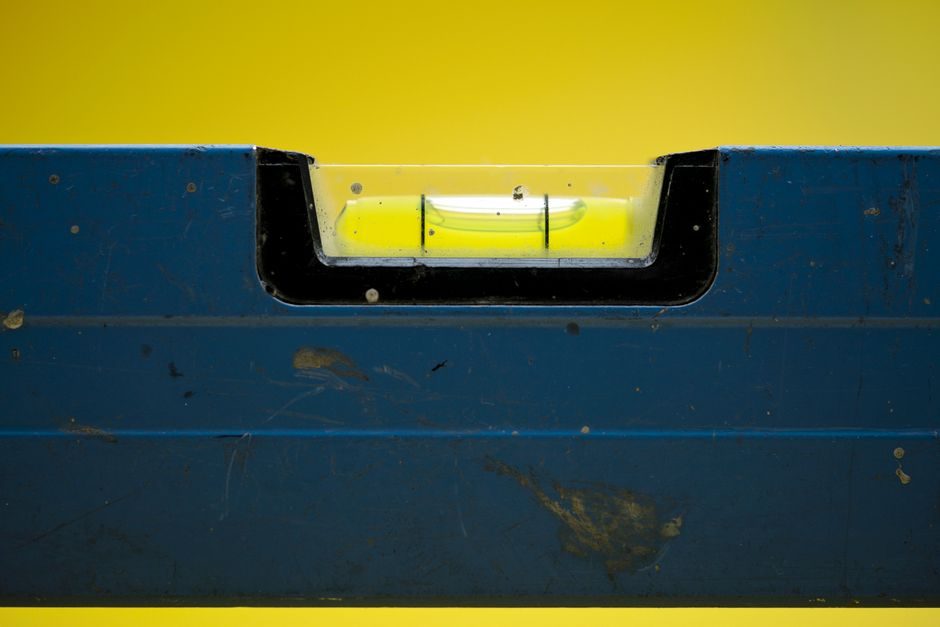
For first-off fixture setup on a foam-trimming fixture, a spirit level still pulls its weight. The fixture's long axis is checked against a granite reference plate in under a minute, no wiring, no calibration file, and the operator can hand the level to a second person for a cross-check. Foam-block squaring, vacuum-table flatness sweep, and rough CNC bed tram are all level-friendly tasks where the target tolerance is ±0.25 mm or wider. [S1]
The level also wins on portability and zero infrastructure: no 24 V supply, no shielded cable, no PLC tag. In a mobile foam-cutting bay or a job-site spray-foam application, that matters more than the lost resolution. The watch-out is that bubble reading is parallax-sensitive; a mirrored vial or an electronic inclinometer is a cheap upgrade if ±0.1 mm tilt is required.
When the LVDT is the only honest choice
Foam density-gradient mapping, closed-loop height control on a hot-wire cutter, and SPC on molded EVA blocks all sit below ±0.1 mm. An LVDT probe with a 10 mm or 25 mm stroke, mounted on a pneumatic touch-down, feeds a 4-20 mA signal straight into the machine's PLC and tracks part-to-part variation in real time. The hermetically sealed, low-mass tracing pin puts negligible force on the foam - critical because polyurethane and closed-cell EVA compress measurably under any spring-loaded contact above ~0.2 N [S1].
For sub-micron work, the LVDT still has to be paired with a stable reference: a granite stand, a temperature-controlled shop floor, and routine re-zero against a certified gauge block. The LVDT does not fix vibration, thermal drift, or fixture flex; it just reports displacement more honestly than a level can.
Failure modes and shop-floor pitfalls

Spirit levels fail silently: a vial can be dented and still read "in tolerance" within a few divisions, an out-of-calibration reference plate skews every reading downstream, and a 1 m aluminum beam flexes under its own weight past 0.5 m unsupported span. LVDT failures are louder: a worn tracing-tip bearing shows as rising hysteresis, a contaminated bore causes the core to bind and read stuck, and a damaged cable shield lets 50/60 Hz mains noise ride on the 4-20 mA loop [S3][S7].
Magnetostrictive transducers are sometimes proposed as a drop-in alternative and do deliver comparable accuracy, but they are also priced higher and the float-based variants are aimed at liquid level, not foam-stacked solids [S3]. For tight-spaced multi-point probing, a contact-type LVDT head can be clustered closer than laser triangulation or eddy-current probes, which is the only reason Keyence markets them for "measurement in tight spaces" [S2].
Standards, sourcing, and what to verify on the datasheet
No single ISO or IEC standard governs spirit-level or LVDT selection for foam tolerance, so the spec sheet carries the weight. The data points worth pulling are: linearity expressed as % of full stroke (not % of reading), repeatability, IP rating, temperature coefficient in ppm/°C, and the stated contact force at full extension [S8][S10]. The Micro-Epsilon induSENSOR DTA installation manual gives the mechanical envelope (17 mm housing, 9 mm radial cable exit) for layout work, and the LD620 / LD630 datasheets confirm 19 mm OD stainless bodies with travel from 5 to 150 mm at ±0.2% linearity [S8][S10].
For traceability, ask the vendor for a factory calibration certificate traceable to a national metrology institute; without it, the published linearity is a spec, not a measured number. Also confirm the connector pattern (axial vs radial cable, M12 vs pigtail) so the probe drops into the existing pressure sensor bracket if the fixture is already wired for analog I/O.
Track the next round of LVDT datasheet revisions - several vendors have flagged 2026 Q3 firmware updates for the digital conditioner modules (per the induSENSOR manual revision history) and watch for a foam-industry update on closed-loop hot-wire height-control retrofit kits scheduled for the 2026-09 Foam Expo preview.
Related: pressure transmitter.