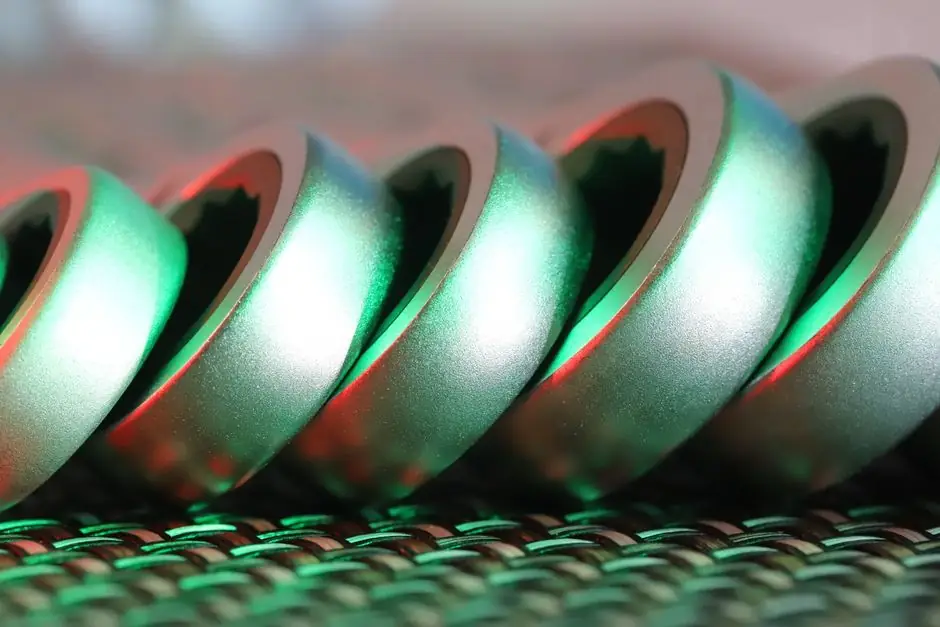
Spring washer tolerances for thickness and outside diameter are governed by series-specific tables in ANSI/ASME B18.21.1 for helical split lock washers and by DIN 2093 (also published as DIN EN 16983) for disc springs, with no single "industry default" tolerance across washer types [S2][S7]. A 1/2" Regular split lock washer is held to 0.125 in section thickness (T, the average of inner and outer material thickness) against a maximum OD of 0.869 in, while the Extra Heavy Duty variant at the same nominal size jumps to 0.162 in section thickness at 0.935 in OD max [S2].
Spring washers share the same three base dimensions as flat washers, inside diameter (ID), outside diameter (OD), and thickness, but add a fourth: free height, which sets the working deflection range under load [S1]. Specifying all four on a drawing, rather than just nominal bolt size, is the fastest way to avoid a wrong shipment from a non-spring-washer SKU. For more on the base dimensions and how they map to load distribution, see the spring washer reference page.
Helical Split Lock Washer Tolerances (ANSI/ASME B18.21.1)
ANSI/ASME B18.21.1 defines four series of helical split lock washers, Regular, Heavy, Extra Heavy Duty, and Hi-Collar, each with its own OD, section width (W), and section thickness (T) limits per nominal washer size [S2]. Section thickness T itself is defined as the average of inner-edge thickness (ti) and outer-edge thickness (to), expressed as T = (ti + to)/2, which is the most useful single number to spec on a print for a helical spring lock washer [S2].
For No. 10 (one of the most common small-fastener sizes), the Regular series is held to 0.334 in OD max with 0.062 in W and 0.047 in T, while the Extra Heavy Duty at No. 10 climbs to 0.434 in OD max, 0.112 in W, and 0.068 in T [S2]. Across the full table, OD maxima scale roughly linearly with nominal size, from 0.172 in at No. 2 to 2.419 in at 1-1/2, a 14x range, while section thickness T scales by roughly 18x over the same nominal range in the Regular series (0.020 in to 0.375 in) [S2]. Procurement should match series to the bolt's preload and vibration environment, since Extra Heavy Duty adds mass and OD that can interfere with adjacent hardware in tight stacks.
DIN 2093 / DIN EN 16983 Disc Spring Tolerances
DIN 2093, also published as DIN EN 16983, sets tolerance bands for disc (Belleville) springs in stepped ranges by outside diameter, not by nominal bolt size, and inside-diameter tolerances are tabulated separately from outside-diameter tolerances [S7]. The standard breaks the OD range into bands: 3 mm to 6 mm, 6 mm to 10 mm, 10 mm to 16 mm, 16 mm to 25 mm, 25 mm to 40 mm, and so on, with each band carrying its own plus and minus limits in millimetres [S7]. Engineers should pull the DIN 2093 table for the exact OD and ID bands of the chosen disc spring rather than applying a single tolerance across the full size range.
Free-height (unloaded) tolerance for disc springs is also banded in DIN 2093 and is independent of the OD/ID tolerance bands, which matters because free height directly controls deflection and load at a given working height. The combined tolerance stack on a disc-spring assembly (OD + ID + thickness + free height) is the reason disc-spring stacks in series or parallel are typically paired and matched at the factory, not mixed across lots. For related spring-steel material and corrosion-coating selection that interacts with thickness tolerance, the Spring Steel vs Stainless Spring Washer comparison covers the downstream trade-offs.
Flatness, Parallelism, and Thickness-Variation Limits
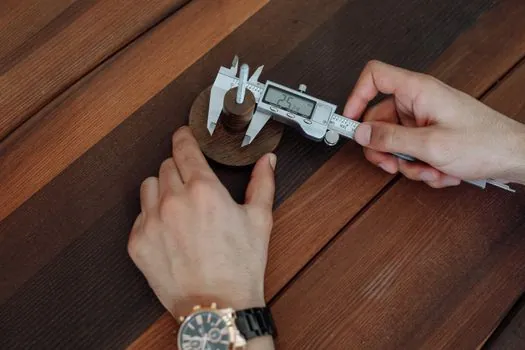
Beyond OD and nominal thickness, three geometric limits routinely appear on spring-washer drawings: flatness, face parallelism, and material-thickness variation [S3][S6]. For Type B flat washers (the common non-spring standard), the standard flatness limit is 0.005 in for basic outside diameters up to and including 0.875 in, and 0.010 in for larger outside diameters, which is the reference a buyer should expect a precision-ground spring washer to meet or beat [S3].
Seastrom's standard-washer spec pushes parallelism tighter, requiring washer faces to be parallel within 0.002 in/inch of thickness, with the caveat that relatively thin parts relative to OD may be subjected to additional flatness requirements on a per-drawing basis [S6]. For spring washers specifically, WCL notes that normal operating tolerances in material thickness and composition can produce variations in load-bearing characteristics, so thickness tolerance is not just a stack-height number, it directly drives spring-rate scatter in a lot [S5]. The practical floor on incoming inspection: measure thickness at three points around the OD (0 degrees, 120 degrees, 240 degrees), and reject parts where the max-minus-min spread exceeds the spec by more than the measurement uncertainty, typically 0.001-0.002 in for small helical lock washers.
Helical Lock Washer vs Disc Spring vs Wave Spring: Selection Criteria
Selection between the three main spring-washer types comes down to four criteria: load-deflection profile, OD envelope, installation space, and standards coverage [S2][S7][S8]. Helical split lock washers (ANSI/ASME B18.21.1) are the lowest-cost, most widely stocked option, and the only spring-washer type with a US governing standard that explicitly covers four series at the nominal-size level [S2]. Disc springs (DIN 2093 / DIN EN 16983) deliver much higher load per unit OD and offer a predictable linear-to-progressive load curve, but require tighter incoming inspection of free height and thickness [S7]. Wave springs (no dominant single governing standard in the research material) are chosen when axial space is tight and a gentle, near-linear deflection is acceptable, but they are typically the most expensive per piece.
OD envelope is often the deciding constraint in retrofit work: a helical split lock washer at 1/2" nominal needs at least 0.869 in OD (Regular) to 0.935 in OD (Extra Heavy Duty) of clear space, while a DIN 2093 disc spring at the same bolt size can be specified down to roughly its ID (around 0.260 in for 1/4" nominal) plus a 3-6 mm radial working rim, fitting where a lock washer will not [S2][S7]. For load profile, helical split lock washers give a sharp peak-then-decay response that works for vibration anti-loosening but is poor for preload take-up, while disc springs can be stacked in series (for longer travel) or parallel (for higher load) to tune the curve. Wave springs split the difference with a smooth sinusoidal response, at higher unit cost. Procurement specifying by part number rather than nominal size remains the dominant error source: a "1/2 spring washer" call on a PO will arrive as the cheapest stocked Regular series and may be undersized for the design intent.
When Tolerances Are Not the Real Problem
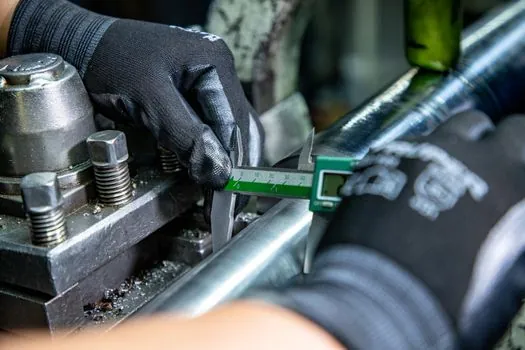
Tolerance-stack issues in spring-washer applications are most often misdiagnosed as a dimensional problem when the actual root cause is material, plating, or lot-to-lot spring-rate scatter [S5]. Normal material-thickness and composition variation in a production lot of carbon-steel spring washers will shift the load-deflection curve more than a typical OD tolerance band shifts the fit envelope, so a fastener joint that loosens in service is more often a spring-rate problem than a dimensional-tolerance problem [S5]. Specifying a thicker or higher-series washer (e.g. moving from Regular to Heavy, or from Heavy to Extra Heavy Duty) raises the load but does not necessarily tighten the spring-rate distribution inside the lot.
The other common failure mode is a non-spring washer being substituted for a spring washer on a print, since the two share the same ID/OD/thickness callout convention, a "1/2 x 1-1/16 x 0.095" washer can be sourced as either Type A Narrow flat or Regular helical lock, and the two have very different working behaviour under vibration [S1][S2]. The cleanest fix at the print stage is to call out the standard (e.g. "per ASME B18.21.1, Regular series") and the series, not just the dimensions, so the part-number search and the drawing are aligned. For seal-side and joint-design context where washers interact with gasketed joints, the sealing washer reference covers the related flat-vs-spring decision in static sealing.
Verification Path on Incoming Inspection
The minimum viable inspection for spring-washer thickness and OD is a calibrated micrometer (for thickness) and a pin or ring gauge or optical comparator (for ID/OD), with at least three measurements per part at roughly 120-degree spacing to catch out-of-roundness that a single-point check will miss [S2][S3]. For ANSI/ASME B18.21.1 helical split lock washers, the go/no-go OD limit is the max OD column in the series table (e.g. 0.869 in max for 1/2 Regular) and the go/no-go section-thickness limit is the T column, again referenced to (ti + to)/2 [S2]. For DIN 2093 disc springs, both OD and ID must be checked against the banded tolerance table for the specific size range, with the band selected by the actual measured OD/ID, not the nominal [S7].
Trackable signals to watch over the next sourcing cycle: (1) whether suppliers are quoting to ANSI/ASME B18.21.1 series or to a generic nominal-size callout, which is the single largest source of wrong-part shipments in this category [S1][S2]; (2) whether disc-spring suppliers are providing DIN 2093 / DIN EN 16983 tolerance-band data on the cert rather than a single overall plus/minus [S7]; and (3) whether incoming inspection includes a three-point thickness check, since single-point thickness measurements systematically under-report variation in helical split lock washers [S2][S5].
For component-level specifications, see thickness gauge.