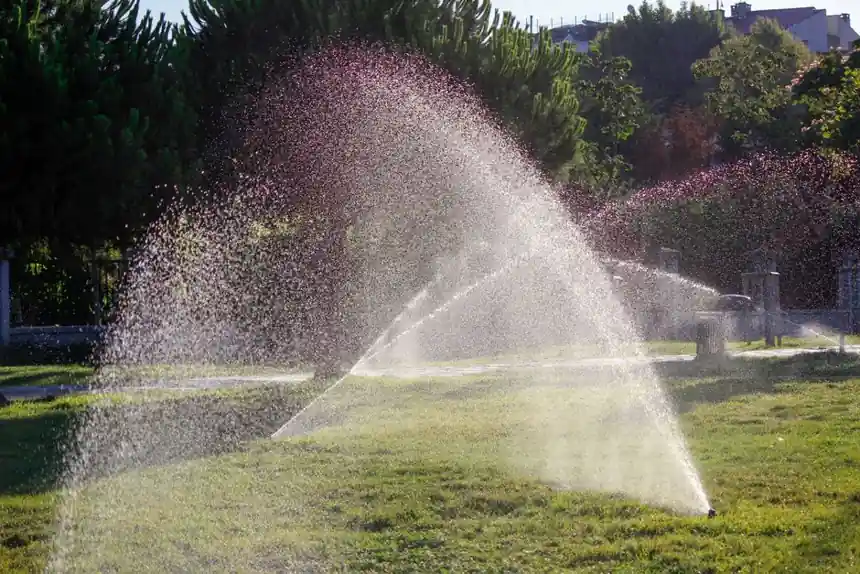
Buyers comparing irrigation systems in 2026 should start with three numbers: lawn area in square feet, available flow in gallons per minute, and target zones, since these directly map to whether a $40 hose-end unit, a $2,000 in-ground retrofit, or a micro-sprinkler array is the right answer [S1][S2].
Total installed cost in 2026 spans roughly $1,600 to $3,600, with an average of $2,539, and each additional zone adds $600 to $2,000; standalone sprinkler heads run $5 to $40 each depending on body and nozzle [S2]. For an at-a-glance reference of the wider irrigation category, see the sprinkler system encyclopedia entry.
Four system families, mapped to lot size and plant type
Hose-end sprinklers, in-ground sprinkler grids, drip irrigation, and micro-sprinklers cover the entire residential and light-commercial market; each maps to a different duty cycle, flow budget, and labor budget [S1][S4]. A smart controller retrofit, for example the Rain Bird ARC Series WiFi unit, can sit on top of any of these and is the cheapest path from a dumb timer to weather-aware scheduling [S1]. Buyers weighing one of the other equipment categories such as industrial barcode scanner selection will recognize the same pattern: define the interface first, then size the head-end.
Selection rule of thumb from the Rain Bird 2026 homeowner guide: small or irregular lawns get hose-end; lawns above about 1,500 sq ft or full-yard automation get in-ground; flower beds, vegetable rows, and container plantings get drip; orchards, greenhouses, and densely planted landscapes get micro-sprinklers [S1]. Drip is the highest-efficiency option for plant-by-plant watering and is widely used on raised beds, while micro-sprinklers cover the gap between drip and full spray with 30 to 200 LPH heads [S1][S4].
Cost breakdown by system type
Per-zone installed cost for an in-ground system runs $600 to $2,000, which includes trenching, lateral pipe, valves, heads, and the controller; the national average total install lands at $2,539 with a typical band of $1,600 to $3,600 [S2]. Micro-sprinkler hardware itself is modest, but the budget items are the filter, pressure regulator, and the inline tubing that has to be sized to the flow rate in LPH or GPH [S4].
Where costs swing the most: soil type (rock vs sand), number of zones, and whether a smart controller is included. Smart controllers that pull local weather data typically add roughly $150 to $350 to the bill but cut seasonal water use by adjusting cycle times off live rainfall and evapotranspiration feeds [S1][S5]. The cost framing used here mirrors a wider spec-first approach familiar from guides such as the warehouse warning tape spec map: unit price is the least interesting number, total installed cost per zone is the one that drives the decision.
Flow, pressure, and spray geometry: the spec numbers that matter
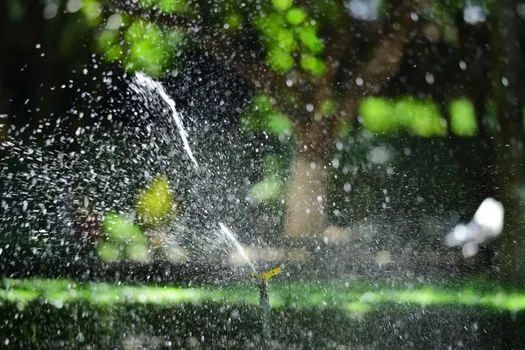
Micro-sprinkler selection reduces to four numbers, all of which must be matched to the water supply and the plant spacing: flow rate in LPH or GPH, working pressure in PSI or bar, spray radius in feet or meters, and adjustable arc range [S4]. Working pressure that is too low throws short, too high wears nozzles and can blow seals; for most residential mains pressure, a 20 to 40 PSI band is the working sweet spot for rotor and spray heads alike [S4].
Coverage is where most DIY layouts go wrong. A full-circle impact head like the Orbit 58308Z throws up to 90 ft in diameter, which is roughly 6,360 sq ft of single-head coverage at full circle, while a portable track sprinkler such as the Nelson RainTrain is sized for narrow rectangular strips of lawn [S3]. The practical rule: head-to-head coverage, meaning each head's spray should reach the adjacent head, otherwise dry bands form between nozzles and weeds fill the gaps [S1][S3].
Smart controllers and weather intelligence
Smart irrigation controllers in 2026 standardise on two features: per-zone scheduling by day, time, and run duration, and weather intelligence that pulls a local forecast to skip cycles before rain or freeze events [S5]. Most residential controllers expose 8 or 16 zones on the terminal strip, so the upgrade path from a dumb timer is a straight swap of the head-end box with the existing zone wiring left in place [S5].
For hose-based systems, smart hose timers attach at the spigot and accept any downstream sprinkler or drip manifold, which makes them the lowest-cost entry into automated, weather-aware watering [S5]. Independent reviewers have been running multi-zone test yards up to 1.3 acres across both California and Texas, which gives the published recommendations real cross-climate grounding rather than a single-region sample [S5].
Material, durability, and what to skip
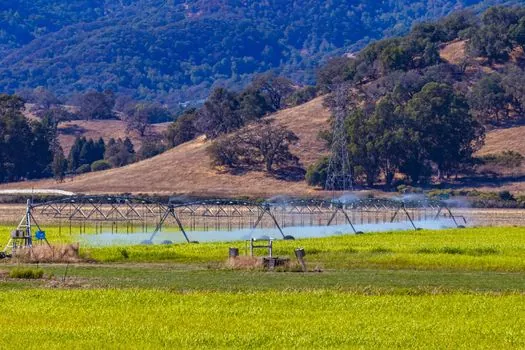
For above-ground portable heads, a cast-iron body with chip-resistant powder coating and adjustable aluminum arms is the durability benchmark; the Nelson RainTrain uses exactly that build and remains a go-to track sprinkler for irregular lawns [S3]. For in-ground nozzles and micro-sprinklers, UV-stabilized polymer bodies with stainless or ceramic orifice inserts resist the two real failure modes: UV embrittlement and mineral clogging [S4].
Avoid heads that lock you into a fixed arc, fixed radius, or proprietary quick-coupler unless the rest of the system is from the same vendor. Match the body to the supply: low-pressure wells or harvested rainwater need a pressure booster or a pressure-regulated head, and any source with iron or sediment needs a filter ahead of the first emitter or the system fails inside one season [S4]. Buyers who want to keep a single supplier across categories can browse a broader equipment map such as the galvanized steel sheet competitive landscape for comparison, but stick to irrigation-rated polymer or brass for any water-contact component.
Who should not buy the mainstream option
Skip the in-ground grid if the lot is smaller than 1,500 sq ft, the water service cannot supply the simultaneous GPM the zones need, or the property is rented; hose-end and drip deliver the same plant health on a fraction of the install cost and are removable [S1][S2]. Skip micro-sprinklers if the water source has heavy sediment without a filter, or if the planting is row crops spaced more than 4 ft apart; drip with pressure-compensating emitters is the better fit on wider spacing because micro-sprinklers waste water to bare ground between plants [S4].
Skip the cheap smart controller if the yard has more than 16 zones, the existing wiring is aluminum, or the WiFi signal at the controller location is unreliable; a mid-tier controller with a wired rain sensor and a local-only schedule will run a large yard more reliably than a cloud-dependent budget box [S5].
Shortlist logic for a 2026 install
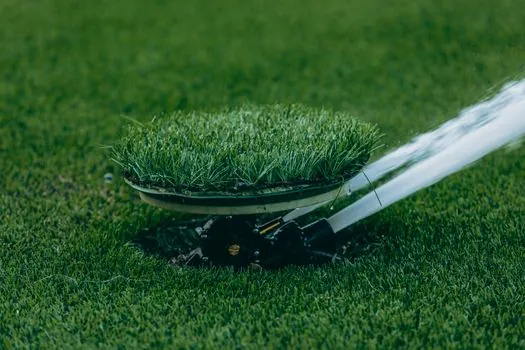
Step 1: measure the planted area and split it into hydrozones by sun exposure and plant water need. Step 2: measure available GPM at the tap and static PSI; the supplier, controller, and head type all fall out of these two numbers. Step 3: pick the system family from the area-and-plant matrix above. Step 4: spec the controller to the zone count plus one spare zone for future expansion. Step 5: budget the install at $600 to $2,000 per zone plus $150 to $350 for a smart controller if weather-aware scheduling is required [S2][S5].
The two signals worth tracking into late 2026 are municipal rebates on EPA WaterSense-labeled smart controllers, which can offset 30% to 50% of the controller cost in many US jurisdictions, and the wider rollout of soil-moisture sensor integration on mid-tier controllers, which moves the system from weather-skip to actual root-zone feedback [S5].
Spec-level background on the components involved: linear guide, and crossed roller guide.