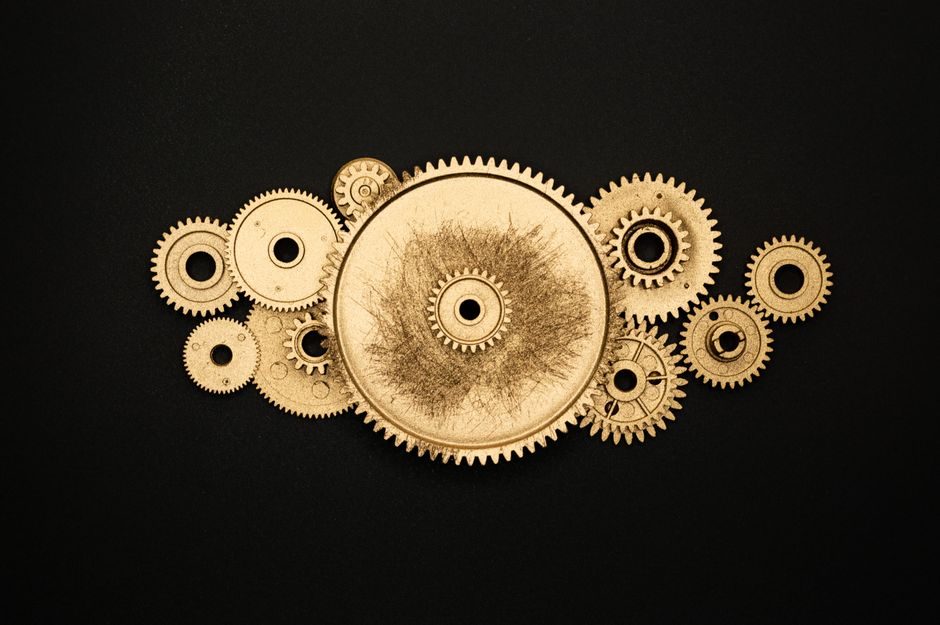
A sprocket is a toothed wheel that engages a chain or a timing belt to transmit torque between parallel shafts, and the practical trade-off in any spec comes down to efficiency versus radial load, alignment tolerance versus service life, and material cost versus wear rate [S2].
The choice between a standard roller-chain sprocket, a silent-chain (inverted-tooth) sprocket, and a synchronous-belt pulley is driven by the duty cycle, the contamination class of the environment, and the maximum permissible noise — three variables that almost always outweigh a pure price comparison when a 5–10 year service interval is required [S2].
Three Sprocket Families and Where Each Fits
Standard roller-chain sprockets (e.g. ISO 606 08B/10B/12B chains with pitches 12.7–19.05 mm) cover the largest share of low-to-medium-speed industrial drives and are produced as steel plate, cast iron, or sintered-steel variants depending on the operating temperature and corrosion exposure [S2]. Silent-chain (inverted-tooth) sprockets run in the same envelope but use a multi-tooth flank contact, lifting the practical efficiency into the 97–98% band and trimming noise to roughly 70–75 dB(A) on a 1.5 m test stand — the headline reason automotive timing drives and printing presses move to them [S2]. Synchronous-belt pulleys, although often filed in the same procurement category, are not true chain sprockets and are covered in a separate trade-off profile referenced in our Timing Belt Trade-Offs note; chain sprockets retain the edge when the shaft is exposed to oil, dust, or temperatures above 80 °C where rubber compounds harden and crack [S2].
Plate-wheel sprockets cut from 3–6 mm hot-rolled mild or medium-carbon steel keep cost down and are field-repairable; cast-iron variants (GG-20 / GG-25 to EN 1561) damp vibration better but add 1.5–2.5× the unit mass; sintered-steel and surface-hardened C45 / 42CrMo4 (DIN EN 10083) sprockets are specified where tooth surface pressure exceeds roughly 350 N/mm² or where the drive must survive 15 000 h without re-lubrication [S2]. The material map is best read alongside the industrial fastener market 2026 spec map because most sprocket hubs and shafts share the same ISO 898 bolt grades and the same corrosion expectations [S2].
Measured Advantages: Efficiency, Compactness, and Service Life
Roller-chain drives on standard sprockets routinely deliver 95–97% mechanical efficiency in the 100–1 000 r/min operating window, and silent-chain inverted-tooth gears reach 97–98% with a 20–30 dB(A) drop in airborne noise, making them the spec target for indoor overhead conveyors and AGV cabins where operators are present [S2]. The torque-to-weight ratio is the second major win: a 12B-2 duplex chain on a 19.05 mm pitch, 38-tooth sprocket transmits roughly 18–22 kW at 800 r/min in a package under 250 mm outer diameter, and the shaft spacing can be cut to 40–60× the chain pitch without intermediate idlers, which simplifies guards and lubrication paths [S2].
Maintenance is also lighter than belt drives: drip lubrication at 60–120 drops/min (oil viscosity ISO VG 68–220 depending on ambient) and annual chain-length inspection cover the bulk of the field routine, and replacement is limited to a master link — no tensioner re-shimming is needed if the drive was aligned to 0.05–0.15 mm/m in the original install [S2].
Measured Disadvantages: Radial Load, Noise, and Sensitivity to Misalignment
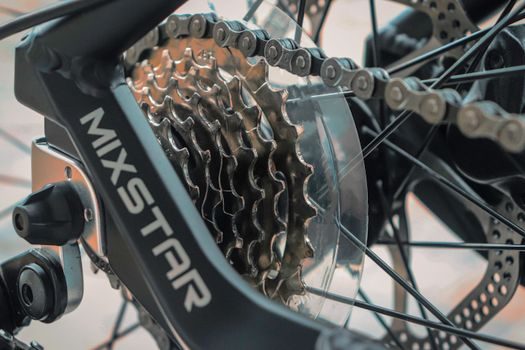
Chain-sprocket drives impose a non-trivial radial load on the shafts because the chain wrap angle and the tooth engagement generate a horizontal pull equal to roughly 5–10% of the transmitted tangential force on a 2-strand drive and 10–15% on a single-strand drive — bearing selection must therefore be sized to B-10 life at the upper end of the load envelope, and a minimum 30–40 mm overhang on the shaft is recommended to keep the bending moment below the bearing's dynamic load rating C [S2]. Sprockets also run louder than helical gears on a comparable envelope: a standard 10B-1 chain on 21-tooth pinions typically reads 78–84 dB(A) at 1 m, and the meshing frequency can excite resonant panels if the guard is under-damped — silent-chain profiles and rubber-faced sprocket hubs are the main countermeasures [S2].
Misalignment is the dominant failure mode: a 0.3° angular error between driver and driven shafts will produce measurable tooth wear within 500 h, and parallel offset of 0.5 mm/m accelerates chain elongation by 2–3×; the practical field rule is to hold parallel alignment under 0.05–0.15 mm/m and angular error under 0.1° before the first commissioning run [S2]. Environmental seals are also weaker than on gearboxes: an open chain running at 80 °C and 0.1 mg/m³ of abrasive dust has roughly half the service life of the same chain in a clean enclosure, which is why IP54–IP65 covers are now standard on most conveyor OEM build sheets in food, beverage, and chemical lines [S2].
Selection Criteria and a Side-by-Side Comparison
For a 1.5 kW, 600 r/min, 4 000 h/year conveyor in a clean indoor environment, a standard roller-chain sprocket in C45 (DIN EN 10083) with simplex 08B-1 chain delivers the lowest total cost and tolerates oil splash without degradation; a silent-chain sprocket is preferred when the cabinet is operator-occupied or the noise budget sits below 75 dB(A) [S2]. For outdoor or wash-down lines with corrosive mist, 1.4301 / 1.4404 stainless or surface-coated (zinc flake, black oxide, or Delta-Protekt KL100) sprockets extend the 1% elongation limit roughly 30–40% over bare steel in salt-spray testing [S2].
Decision criteria (chain sprocket families): Standard roller-chain — 95–97% efficiency, lowest cost, 78–84 dB(A) noise, 8 000–12 000 h service, OK to ±0.15 mm/m parallel offset, 80 °C upper oil-bath limit; Silent-chain — 97–98% efficiency, 1.5–2× unit cost, 70–75 dB(A) noise, 15 000–20 000 h service, OK to ±0.10 mm/m, 100–120 °C limit; Plate-wheel (thin section) — 94–95% efficiency, very low cost, 80–85 dB(A), 6 000–9 000 h, OK to ±0.20 mm/m, 60 °C — suited only to low-power conveyor and agricultural drives [S2].
Operating Limits, Failure Modes, and Standards Reference
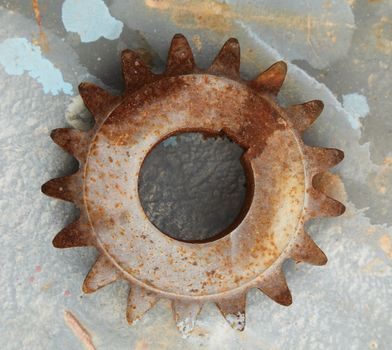
Standard chain and sprocket geometry is governed by ISO 606 (short-pitch transmission chains), with hub and tooth-strength reference given in ISO 10823; safety factors of 7–10 are typical for general industrial drives and 12–15 for lifting (e.g. hoists, stage rigging) where safety factor 7–10 is a baseline reference but actual certification depends on the lifting standard in force [S2].
Operational boundaries: pitch-line speed is generally capped at 12 m/s for standard roller chain, with silent chain reaching 25–30 m/s before impact noise dominates; ambient operating temperature for standard chain is −10 °C to +150 °C with the right lubricant, while rubber-or polyurethane-belt alternatives lose hardness above 80 °C and are limited to 90 °C at the elastomer upper bound; tooth-count minimum is 17 on standard chain (to keep polygon-ing under 1.5%) and 25 on silent chain to keep tooth-meshing pressure below the fatigue limit [S2].
Who Should Spec a Sprocket — and Who Should Spec Something Else
Sprockets are the right pick when the drive is parallel-shaft, the shaft spacing is fixed, the environment is contaminated, and a 5–10 year replacement interval is acceptable — i.e. conveyors, packaging lines, chain hoists, motorcycle final drives, agricultural machinery, and low-noise timing drives with silent chain [S2]. They are NOT the right pick when the requirement is zero-backlash positioning (use servo gear or cycloidal reducer), high ratios above 7:1 in a single stage (use a gear reducer), oil-free food contact where a chain lubricant film is not allowed (use timing belt with stainless or polyurethane body), or when the drive must run silently below 65 dB(A) at 1 m with no enclosure (use helical or hypoid gearing) [S2]. The procurement rule of thumb: a chain-sprocket drive is normally cheaper than a gear pair up to roughly 7–10 kW at distances above 1 m; above that, gear and direct-drive solutions start to win on total cost of ownership [S2].
Track these signals before the next quote package goes out: (1) ISO 606 chain pitch and ISO 10823 sprocket-strength reference are the minimum spec line; (2) require a written alignment tolerance of 0.05–0.15 mm/m and a lubrication schedule in the purchase order; (3) confirm whether a silent-chain upgrade is needed when the cabinet dB(A) budget is below 75. This article is informational and does not constitute engineering certification for any specific installation.
Spec-level background on the components involved: pressure transmitter, and flow meter.