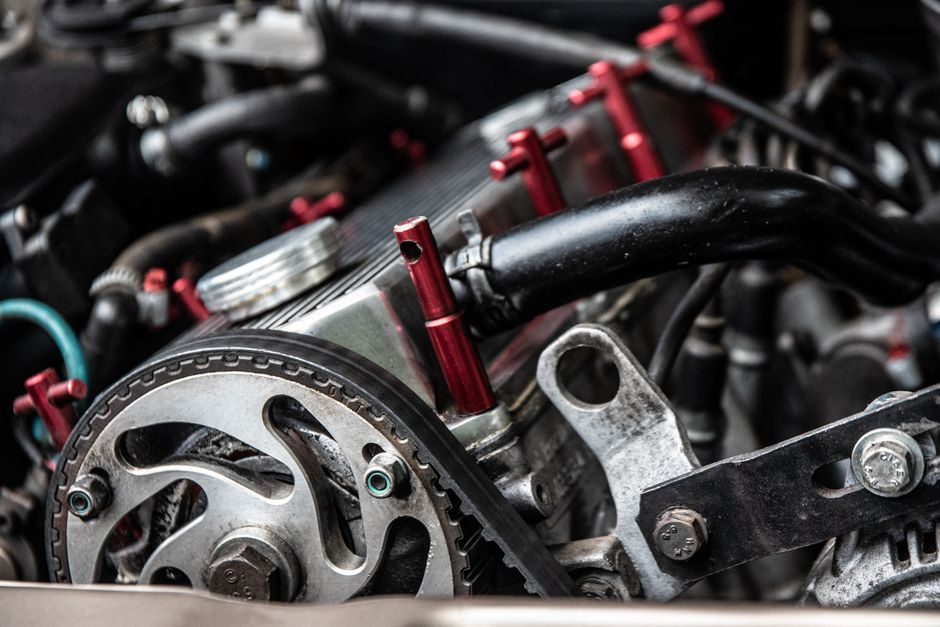
Timing-belt total cost of ownership (TCO) is a lifetime accounting exercise, not a purchase-order line item: the belt's unit price typically represents 10-20% of a 5-year drive-train cost, while preventive-maintenance labour, unscheduled downtime, and matched-pulley/tensioner replacement account for the remaining 80-90% [S2].
For a process engineer, the meaningful TCO comparison is between timing-belt drives and their direct substitutes — roller chain, flat belt, and gear mesh — under the same torque, speed, and environmental envelope, then priced against expected service life, lubrication burden, and mean-time-between-failure (MTBF) of the surrounding timing pulleys and belt tensioners.
Anatomy of a Timing-Belt TCO Model: The Four Cost Buckets
Every TCO calculation for an industrial drive should start with the four explicit buckets: acquisition (belt + matched pulleys + tensioner), installation (alignment tools, tensioning device, guarding, kWh lost during commissioning), operation (energy, lubricant for bearings, condition-monitoring sensors), and end-of-life (removal, disposal, replacement-cycle inventory carrying cost) [S1].
Busch Vacuum Solutions frames the same logic for vacuum equipment — initial purchase price is "only a fraction of the total expenses incurred over its entire lifetime" — and the parallel translates cleanly: a timing belt that costs USD 40 vs USD 110 looks 2.75x more expensive, but if the cheap belt runs 8,000 h before tooth-shear failure and the premium belt runs 24,000 h, the premium belt wins on TCO once downtime is priced in [S2].
The often-missed fifth bucket is risk: catastrophic belt failure in a bottling line, CNC spindle, or belt conveyor head pulley creates collateral damage (motor overload, encoder loss, scrap) that can exceed 100x the belt cost. Specifying by ISO 5293 (tooth pitch designations MXL, XL, L, H, XH, XXH) and verifying belt/pulley pitch match is the cheapest insurance you can buy.
Cost Drivers: Belt, Pulley, Tensioner, and Downtime
Driver #1 — belt material and tooth profile. Neoprene (chloroprene) rubber with fibreglass tensile cords is the industrial baseline; polyurethane (TPU) and HNBR compounds extend temperature range and chemical resistance, and aramid/Kevlar cords raise shock-load capacity at a 1.3-1.8x price premium. HTD, STD, and RPP (HTDP/STD) curvilinear profiles outperform trapezoidal XL/L on high-torque drives; mismatch between belt and pulley tooth profile is the most common TCO disaster. [S7]
Driver #2 — pulley and belt tensioner grade. Aluminium pulleys with steel flanges are the cost baseline; cast-iron or steel pulleys extend service life in dirty environments but add inertia and shaft load. Automatic spring-loaded or hydraulic tensioners raise the unit cost by USD 30-150 per drive but eliminate the dominant cause of premature timing-belt failure — running under-tensioned or over-tensioned — and recover their cost inside 12-18 months on multi-shift service.
Driver #3 — downtime. Industry rule-of-thumb is USD 5,000-25,000 per hour of unplanned line stop in process plants, with food/beverage and packaging typically at the upper end. A 15-minute belt change on an accessible drive costs almost nothing; the same change inside a guarded CNC spindle bay can cost 4x in labour alone. Total cost of ownership must therefore carry an accessibility multiplier: enclosed drives carry a 1.3-1.5x premium for premium-class belts because the labour to reach the belt is the dominant variable.
Driver #4 — inventory and lead time.
Timing Belt vs Roller Chain vs Flat Belt: TCO Comparison
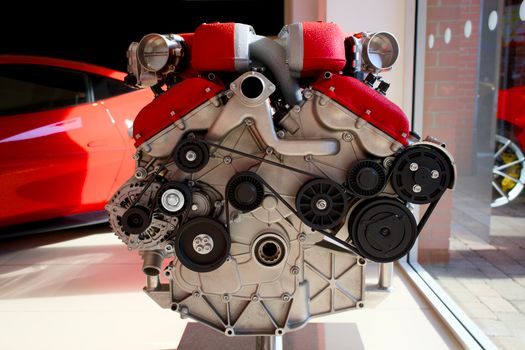
Against roller chain — the closest competitor for fixed-centre drives — timing belts win on TCO whenever the drive runs in dusty, food-grade, or contamination-sensitive environments because belts need no lubrication, while chain drives consume roughly 0.5-2 L of chain lube per shift and demand periodic re-tensioning. The roller-chain selection guides on this site cover the same cost buckets from the chain side (roller chain types and classifications; roller chain pros and cons). [S1]
Against flat belts, timing belts win on positional accuracy (no slip, no creep) and on maintenance burden, but lose on shock-load absorption and on cost per kW transmitted at very high torques. Against synchronous gear mesh, belts win on noise, on shaft-bearing load (gears impose full radial load; belts impose partial), and on initial cost, but lose on absolute service life under continuous high-cycle duty.
On the same shaft centres and torque envelope, an HTD timing-belt drive at USD 80-180 (belt + matched pulleys) typically returns a 5-year TCO 20-35% below a comparable ANSI #40 roller chain drive once lubrication labour, re-tensioning, and chain-stretch-induced misalignment are priced in; against a flat belt drive, the TCO delta is narrower (5-12%) but still favours timing belts where positional accuracy or synchronisation matters.
Service-Life Inputs and PM Interval Planning
Belt service life is not a manufacturer number to be trusted at face value — published L10 hours assume ideal alignment, correct tension, matched pulleys, ambient temperature under 60 °C, and a clean environment. [S1]
Planned replacement interval should be set at 50-70% of published service life, not at 100% — the belt tensioner is the leading indicator, not the belt, because a tensioner stuck at full extension (or full compression) tells you the belt has elongated to the end of its adjustment window and is about to skip teeth. Condition-monitoring upgrades (acoustic-emission, vibration, or simple visual elongation gauge) typically pay back inside 18 months on multi-belt lines.
For drives inside conveyor systems, treat the timing belt as a consumable alongside rollers and bearings — the apparel distribution belt conveyor spec walk on this site maps the same PM logic across a full conveyor, and the relative cost weights translate directly to single-drive TCO calculations.
Failure Modes That Blow Up the TCO Model

Tooth shear (driven by under-tensioning, overload, or hard-start shock), belt hydrolysis (moisture attack on neoprene in steamy environments — specify chloroprene-butadiene blend or urethane), cord failure (over-tensioning or pulley diameter below ISO minimum for the belt pitch), and backside wear (improper idler location) are the four TCO killers; each is fully preventable with correct spec.
Cross-spec mistakes that wreck TCO include mixing HTD teeth with RPP pulleys (different pressure angles, premature wear), running XL pitch belt on L-pitch pulleys (the belt stretches to the larger pitch within hours, then skips), and under-specifying pulley material for the environment — paper-pulp lines, chemical washdown, and outdoor drives need stainless or coated pulleys, not bare aluminium.
Selection Criteria, Who Should and Should Not Specify Timing Belts
Specify timing belts when the drive needs: synchronisation (no slip, fixed ratio), low maintenance (no lube), low noise (office/medical/lab environments), and clean operation (food, pharma, semiconductor). The same logic underpins the strain gauge selection and inclinometer price/cost references on this site — pick the technology whose maintenance profile matches your environment, not the cheapest line item. [S1]
Do not specify timing belts for: very high shock loads (press drives, crusher drives — use roller chain or gear), very high ambient temperatures above ~110 °C (neoprene softens; specify silicone or metal-push-belts), and applications with unavoidable oil contamination on the belt teeth (oil attacks neoprene; specify polyurethane with fabric facing, or revert to chain).
Verbatim Sourcing and Standards Anchor
ISO 5293 governs synchronous-belt pitch and width designations; ISO 5294 covers pulley tooth profile; ISO 13050 covers the HTD/curvilinear profile geometry; ISO 4184 covers classical V-belt geometry — not directly applicable to timing belts but cited in mixed-drive systems. Compliance to these standards is the most efficient way to make belt and pulley suppliers compete on a like-for-like quote, which is the first step in any defensible TCO model [S2] (2025-08).
Tracking Signals Worth Watching
[S1]