
On a typical industrial V-belt drive the invoice line is the smallest line on the ten-year ledger — a Busch-style TCO breakdown for rotating equipment states that initial purchase price is "only a fraction of the total expenses incurred over its entire lifetime" [S4]. For V-belts the fraction commonly sits between 10% and 30%, with the balance absorbed by replacement labor, lost production hours, and the energy the belt burns as heat through slip and hysteresis.
This article breaks down the cost drivers a process engineer can actually move, lines them up against the choices on the quote, and shows where the dollar figures are real versus where they are folklore.
What TCO Actually Counts on a V-Belt Drive
Total Cost of Ownership in industrial MRO is the sum of acquisition, installation, operation, maintenance, and end-of-life disposal over the asset's useful life [S1]. For a V-belt drive that ledger has seven line items: the belt itself, the matching pulleys, installation labor per change-out, the production lost during each replacement, the energy the drive wastes as slip heat, the bearing load the belt tension imposes on the shafts, and the disposal/replacement reserve.
The Busch framework for vacuum equipment — directly applicable to any belt-driven rotating machine — separates the visible acquisition cost from the much larger invisible operating and maintenance costs, and explicitly warns that purchase price is "only a fraction" of the full bill [S4]. On a V-belt drive, that ratio is more punishing than on most vacuum pumps because belt failure is sudden, unannounced, and almost always stops a line.
Cost Driver 1 — Belt Section, Profile, and Matched Pulley Groove
A V-belt's section (Z, A, B, C, D, E in the classical RMA / ISO 4184 width progression) sets its power capacity per rib, and a wrong match to the sheave groove is the single most expensive mistake on the quote. Running a B-section belt in a C-section sheave — or a classical cross-section in a deep "narrow" wedge groove — drops transmitted power, raises slip, and accelerates cover wear on both parts. [S6]
The deeper cost shows up at change-out: if the sheaves are wrong, every new belt wears faster than its rated curve, and the pulley itself has to be re-machined or scrapped. Conversely, matching a wrapped notch belt or a flat-belt variant to the driven load profile keeps the drive inside its design window and lets the belt hit its catalog life.
Cost Driver 2 — Installation Labor and Tensioning Method

A two-belt industrial change-out on a standard motor-pulley-pulley train takes one fitter 30–60 minutes including lockout, guards off, belt on, tension set, run-in check, and guards on. At a fully-loaded shop rate of $60–$90/hr that is $30–$90 per event in direct labor, before any overhead or production loss is added.
Tensioning method matters as much as the belt cost. A drive set by the deflection-force rule (typically 1.5% of span length, 90° to the belt, with a per-belt force table) out-lasts a drive set by "feel" by 2–4 times. A belt tensioner on a long-span or reversing drive removes the human variable and is the cheapest TCO cut most plants can make.
Cost Driver 3 — Unplanned Downtime per Failure Event
Downtime cost dwarfs belt cost. On a single-line packaging or bottling line, an unscheduled stop of 15–45 minutes typically costs $500–$5,000 in lost throughput depending on margin and shift structure; on a continuous process compressor drive, an hour of downtime can run five figures. Industry rule-of-thumb numbers from conveyor and pump TCO studies place unplanned downtime at 3–10× the maintenance labor that would have prevented it [S4].
The lever an engineer actually controls is the replacement trigger: run-to-failure on a critical drive is gambling that the cost of a planned 30-minute change-out is higher than the cost of an unplanned one. It almost never is. See how the math plays out on similar equipment in this V-belt drive field guide and in the timing-belt installation spec map.
Cost Driver 4 — Energy Loss from Slip and Bending Hysteresis
A V-belt drive is not 100% efficient. Classical wrapped V-belts sit at 95–97% mechanical efficiency when new and correctly tensioned; raw-edge cogged belts reach 97–98%; timing belts on a belt conveyor can hit 98–99% but lose the slip-protection that makes a V-belt a fuse on an overload. Each lost percentage point is watts that become heat in the belt and shorten its life, plus kilowatt-hours the plant pays for and the load never sees.
On a 15 kW motor running 6,000 hr/yr, the gap between a 95% and a 98% efficient drive is roughly 450 kWh/yr, or $45–$90 at industrial tariffs. Over the 8–12 year life of the motor that is a four-figure line item that does not appear on the belt quote, and it is the reason cogged and narrow-section belts have eaten share in retrofit work where the sheaves can be changed.
Options Compared on the Four TCO Levers
Comparing the realistic V-belt families a buyer sees on a 2026 quote against four decision criteria: classical wrapped, narrow-wedge wrapped, raw-edge cogged, and a V-to-flat-belt link belt. Classical wrapped is lowest unit price and most forgiving of misalignment, but loses 1.5–3% more energy and runs hottest, so its lifetime cost is the highest on heavy-duty drives. Narrow-wedge (3VX/5VX, SPA/SPB/SPC) raises power per rib, lets the designer drop one belt size, and trims both slip and bending loss. Raw-edge cogged belts (RMA IP-22 / ISO 8419 family) deliver the highest mechanical efficiency and the longest catalog life on a fixed-pulley retrofit, at a 20–60% unit price premium. [S4]
A poly-V or multi-rib flat profile sits between cogged V and timing belt on cost and efficiency and is the right answer where space is tight, but it does not tolerate misalignment and wants matched pulleys from day one. The decision is not "which belt is best" but "which belt matches the sheaves you have, the alignment you can hold, and the downtime you cannot afford" — exactly the choice matrix a process engineer can defend at a capital review.
Cost Driver 5 — Inventory, Storage, and Obsolescence
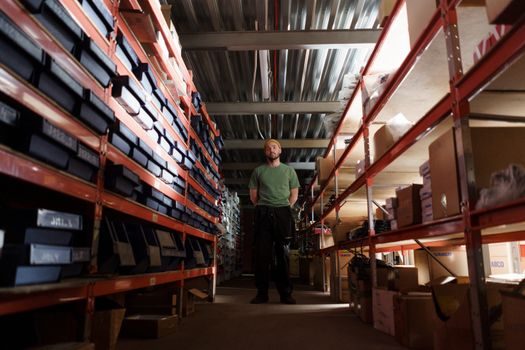
Stocking one spare of every section and length on a 200-drive plant is a real TCO line. A standard V-belt stored flat, cool, and out of UV keeps its flex life for 5–7 years; a belt stored coiled, oily, or on a hook near a heat source can lose half its life before it ever sees a sheave. The optimization is to stock by failure-rate-and-criticality, not by section: a critical C-section on a 75 kW compressor warrants a primed spare; a Z-section on a ventilation fan does not. [S1]
Cross-standardization is the other lever. Cutting a 200-drive plant from eight active sections down to four (typically A, B, C, and one narrow-wedge) reduces inventory carrying cost, simplifies the storeroom, and lets the buyer consolidate volume for a better price per belt. The same logic applies across the rest of the drivetrain — see how it scales up to a belt conveyor selection spec map for warehouse automation and the related air-cargo belt conveyor spec map.
Standards, Sourcing, and What to Verify Before Signing the PO
Three standards govern V-belt interchangeability and test life: ISO 4184 for classical wrapped belts, ISO 8419 for narrow-wedge and raw-edge cogged belts, and RMA IP-22 / IP-23 for the North American cross-reference. Matched sheaves should meet ISO 5293 (classical) or ISO 5291 (narrow). A belt stamped with the standard and the manufacturer's lot/date code is auditable; a belt stamped only with a trade name is not. [S3]
Two verifiable signals to track on the next purchase: ask the vendor for a written matched-set warranty covering both belt and sheave wear under the actual load curve, and require a published minimum full-load bending life in hours at the rated sheave diameter. A vendor that will not put those numbers on paper is pricing on the front of the TCO curve only, and the back of the curve is where the 70–90% lives.