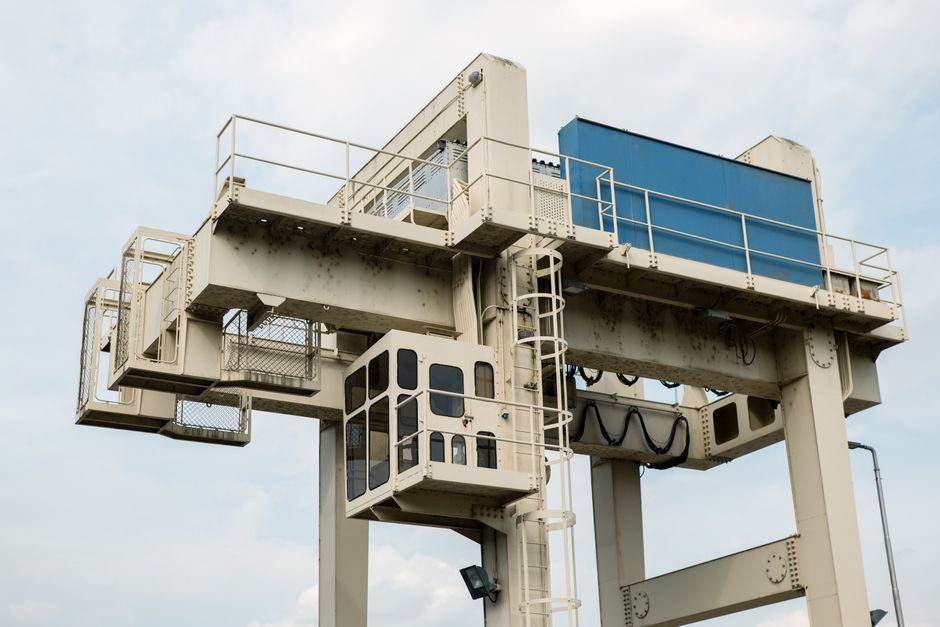
An automated stacker crane specified for a 2026 AS/RS build typically runs 6-40 m mast heights, lifts 50-5,000 kg per cycle, and is governed by ASME B30.18-2011 for top-running and under-running bridge/trolley configurations [S6].
Buyers evaluating equipment in mid-2026 face a market dominated by Chinese fabricators on the unit-load side and a smaller group of Japanese/European integrators on the miniload and crane-based AS/RS side, with ABB drives and Mitsubishi Electric PLCs named on multiple OEM reference architectures [S1][S3][S4].
What a Stacker Crane Is and Which Standard Governs It
ASME B30.18-2011 — titled "Stacker Cranes (Top or Under Running Bridge, Multiple Girder with Top or Under Running Trolley Hoist)" — is the principal U.S. consensus standard for the equipment class and is the document engineers reach for when classifying bridge, trolley and hoist duty [S6].
A stacker crane is, mechanically, a rail-guided mast with a telescopic fork or platform that travels horizontally on floor or ceiling rails and vertically along the mast; the column carries steel wheels running on the rail, and the load-handling fork moves up and down the column. Floor-supported units roll on the lower rail and use an upper rail for anti-tilt stability; ceiling-suspended units invert that geometry. This rail constraint is what separates a true stacker crane from a free-rolling stacker crane on rubber tyres or a pallet stacker walkie.
Two Main Architectural Choices: Unit-Load vs Miniload
Unit-load stacker cranes handle single pallets or totes in the 500-5,000 kg range on single- or double-deep racking and are the default for pallet AS/RS; miniload (or "mini-load") cranes handle totes, bins and trays in the 5-250 kg range on close-centre shelving and are the default for parts-to-picker and e-fulfilment cells [S2].
Mast height is the most expensive dimension: each additional metre of column above ~12 m drives a step-change in section size, drive sizing and seismic anchoring. Modern high-rise unit-load builds now exceed 40 m, and Chinese suppliers routinely quote 6-24 m standard heights for mid-tier warehouses [S4][S5]. Cycle time is the second scaling lever — ABB notes its drives and PLCs adapt hoisting, traversing and lifting to both heavy and light load states to keep dual-cycle (loaded + empty) times competitive [S1].
Selection Criteria Buyers Should Lock Down Before Quoting
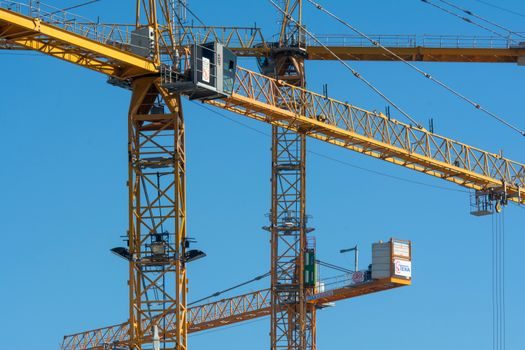
Five numbers drive 80% of the BOM and should be frozen before vendor contact: (1) load per cycle, (2) lift height, (3) aisle width, (4) single-cycle time target (S-direction + Z-direction), and (5) duty class per ASME B30.18 [S6].
Drive architecture is the next gate. ABB's segment page specifically calls out variable-speed drives (VSDs) paired with PLCs as the control backbone for both heavy and light load adaptation on hoists, traverses and lifts [S1]. Mitsubishi Electric's logistics FA solution page states the same scope — cycle-time reduction, in-house WCS/WMS integration, short startup, and a 5-point safety spec block — and frames the stacker crane as part of an [e-F@ctory] FA-IT stack rather than a standalone mechanical buy [S3]. Buyers who skip the controls conversation at RFQ stage typically pay for it in field integration.
Comparing the Common Configurations Against Decision Criteria
Three configurations cover ~90% of 2026 RFQs: floor-supported unit-load, ceiling-suspended unit-load, and miniload tote-handler. The table below lines them up against the four criteria that change price band and lead time most. [S1]
On (1) load, floor-supported wins for >1,000 kg; on (2) height, ceiling-suspended avoids floor-rail congestion in retrofit brownfield sites; on (3) throughput, miniload on close-centre shelving (typically 300-600 mm pitch) beats unit-load for SKUs under 50 kg; on (4) cost per pick position, the floor-supported single-mast unit-load design is the lowest-cost baseline for greenfield pallet warehouses, with Chinese export quotes clustering at the budget end of the spectrum [S4][S5].
Who a Stacker Crane Is For, and Who It Is Not For
Stacker cranes pay back where pick density, height and SKU velocity are all high simultaneously — typically >500 SKU lines, >6 m clear height, and >20 picks/hour sustained. Outside that envelope, a VNA forklift, a conveyor-fed sorter, or a crawler crane is the wrong tool. [S2]
For operations below ~10,000 pallet positions, below 8 m clear height, or with very long dwell times (weeks, not days), the capex on rails, masts, controls and WCS usually does not amortise against a counterbalanced or reach truck fleet. For e-fulfilment under ~50 kg/SKU with high pick rates, a miniload crane with tote shuttles is the right class — not a full-size unit-load stacker. The mistake I see most often in early-stage RFQs is sizing a unit-load crane to a miniload duty cycle and burning 3-4× the drive and energy budget for the same throughput.
Drive, Control and Safety Stack for 2026 Builds
The de facto 2026 control stack on a new build is: WMS → WCS → PLC (Mitsubishi, Siemens, Allen-Bradley) → VSD per axis (ABB, Siemens, Yaskawa) → servo or geared motor → encoder + absolute positioning on each axis [S1][S3].
Safety on the 2026 generation is a layered spec: a SIL-rated safety PLC, light curtains at aisle entries, laser or radar scanners on the mast base, and an anti-collision bus between cranes in the same aisle. ABB frames its stacker-crane offering around heavy/light load adaptation, which is the energy-side counterpart to the safety side — regenerative braking on the hoist axis typically returns 20-30% of lifting energy on a busy crane, and the VSD/PLC pairing is what makes that recovery usable rather than dissipated as heat [S1]. Mitsubishi's solution page lists five named benefits: cycle-time reduction, inbound/outbound process efficiency, design-cost saving, short startup/maintenance, and enhanced safety — i.e. the same five-pillar pitch that shows up across the Japanese FA integrator tier [S3].
Cost, Lead Time and Sourcing Reality in 2026

Budget-grade unit-load stacker cranes from Chinese export catalogues in 2026 cluster in the low-to-mid five-figure USD band per crane, with options, taller masts, and integrated conveyors pushing the figure into six figures for a complete AS/RS cell [S4][S5].
Lead time is now the gating constraint more than price: a standard-height unit-load crane on a 6-12 m mast typically ships 60-90 days ex-works from a Chinese fabricator, while a miniload crane with close-centre shelving and WCS integration routinely runs 120-180 days because of the controls and software content [S2][S4]. The conveyor, WCS and WMS layer adds another 20-40% on top of the mechanical crane price and is where most of the integration risk lives; EBILTECH's product page lays out the standard AS/RS bill of materials as shelves + stacker + conveyor line + WCS + WMS + peripherals [S2]. Buyers who want a single point of accountability for that whole stack should specify the integrator, not the crane vendor.
Inspection, Installation and Acceptance Gates
Acceptance is where 2026 stacker-crane projects most often slip, so the gates should be written into the PO. The mechanical side follows ASME B30.18-2011 directly, including load test, brake test, and limit-switch verification across top-running and under-running bridge/trolley configurations [S6].
ABB's positioning of VSD+PLC as the adaptation layer is relevant here because the drives are what enforce those envelope tests, and the same drives that enable heavy/light load adaptation are the ones that flag any axis drifting outside its tested envelope at commissioning [S1]. Without these three tests written into the FAT/SAT documents, "cycle time" becomes a verbal claim rather than a contractual number.
Trackable signals to watch over the next 6 months: Chinese export catalogues pushing taller standard masts (24 m and above) into the unit-load segment, and a second wave of integrators bundling WCS/WMS into the crane PO rather than leaving it to the end-customer's IT team. Buyers comparing lines such as stacker crane and pallet stacker walkies on the same RFQ should treat the mast, the drives, and the WCS layer as three separate price lines, not a bundled number. For wider industrial line context, the same selection-gate logic shows up in adjacent 2026 buying guides on titanium alloys and cast iron cost — material choice and equipment choice both follow the rule: freeze the spec, freeze the standard, then price.