
AS/RS stacker cranes are routinely installed into warehouses taller than 30 m, with pallet-rack units on the Direct Industry listing covering maximum loads from 500 kg to 1,500 kg under ISO9001/ISO1400 management schemes [S1]. Long-load and bar-stack variants on the same 2026-06-26 listing push the envelope from 400 kg up to 2.5 t per load, while horizontal honeycomb systems under HUBMASTER extend the upper end to 40 t [S1].
The product tree on Direct Industry splits stacker-crane solutions into 11 vertical and 5 horizontal SKUs, with KASTO UNITOP, NEDCON Beamtype Miniload, EBILTECH radio-shuttle hybrids and HUBMASTER drum storage each defining a distinct installation envelope [S1][S7]. For buyers benchmarking cost, made-in-china.com's 2026-06-03 catalogue lists a Chinese-supplier AS/RS stacker crane at US$20,000 factory-direct for pallet storage, with custom-engineered high-bay units quoted at US$200,000 [S2].
What a Stacker-Crane Installation Actually Covers
An AS/RS stacker crane is defined in the S1 Direct Industry catalogue as a "computerized robotic system that automates operations such as unloading, sorting, put-away, storage" inside a racking envelope, with installations exceeding 30 m of clear height when stacker cranes replace forklift-truck-only picking [S1]. The crane itself is a mast-guided vehicle running on two floor rails, with a telescopic fork or satellite platform for unit-load, tote, roll or long-bar payloads [S1].
For long-bar and sheet-metal storage, the KASTO UNITOP system is listed at 1 t to 5 t maximum load per cycle, with a "minimum of personnel" operating model [S1]. NEDCON's Beamtype Miniload targets small parts in totes or cartons, while the EBILTECH radio shuttle + stacker hybrid layers a shuttle car behind a conventional stacker crane to multiply tunnel depth without multiplying crane count [S7].
Pre-Install Site and Foundation Gates
Floor-rail flatness is the single largest source of stacker-crane commissioning rework; suppliers on the S1 listing require rails straight within ±1–2 mm over the full aisle length, anchored to a reinforced concrete slab designed for the combined dead load of mast, payload and racking uplift. The Chinese national rule TSG Q7016-2008 (起重机械安装改造重大维修监督检验规则) governs installation, modification and major-overhaul supervision inspection of lifting appliances in PRC projects, and remains the cited reference document for in-scope Chinese sites [S8].
Power and control routing is the second gate: an AS/RS stacker crane typically draws 400 V three-phase through a busbar or festoon along the aisle, with absolute encoders on each mast axis and a laser or camera-based pallet-position sensor on the fork carriage. Communication to WMS/WCS is most often Ethernet/IP or PROFINET on a 24 V control bus, with the EBILTECH hybrid explicitly integrating the shuttle into the same WMS/WCS control loop as the pallet stacker and conveyors [S7].
Selection Criteria: Pallet vs Miniload vs Long-Load vs Hybrid
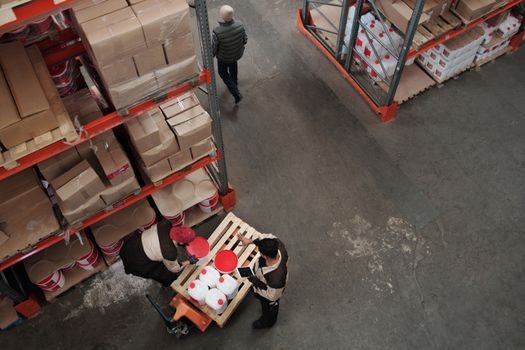
Four stacker-crane archetypes dominate the 2026 catalogue set, and the choice is driven by load profile, unit size, throughput and aisle length, not by brand loyalty [S1]. A 4-criteria comparison extracted from the S1 and S7 listings:
Pallet stacker crane — load 500–1,500 kg (ISO9001/ISO1400/UN-AUTO1035), 30 m+ height, 1-deep or 2-deep racking, used for finished-goods pallets in distribution centres [S1]. Miniload stacker crane (NEDCON Beamtype) — load sub-100 kg totes/cartons, 12–24 m height, single-deep or double-deep bins, used for spare parts and e-commerce piece picking [S1]. Long-load/bar stacker crane (KASTO UNITOP, HUBMASTER long-load) — load 400–2,500 kg for long items, 1 t to 5 t for bar stacks, cantilevered load-handling, used for steel service centres and sawmills [S1]. Hybrid radio-shuttle + stacker (EBILTECH) — load matched to pallet class, FIFO and random-in storage, used for high-density tunnel warehouses where stacker count must be minimised [S7].
The structural linear-guide and rack interaction is the same across all four: a linear guide on the mast carries the lift platform, and a crossed roller guide typically locates the satellite fork on the carriage. HUBMASTER's 40 t horizontal honeycomb storer is a different machine class — a crane-and-trolley honeycomb with 40 t per load, used where cycle time is the design driver [S1].
Mechanical and Electrical Installation Steps
A stacker-crane mechanical install follows a defined sequence: rail survey and shim, mast assembly, hoist and trolley fit, fork/satellite fit, cable reel or busbar, then safety-circuit commissioning [S8]. TSG Q7016-2008 explicitly covers installation, modification and major-overhaul supervision, and is the inspection document the Chinese supervisory body references before sign-off [S8].
Electrical commissioning is gated by the same rule plus the OEM SAT (site acceptance test) protocol: encoder calibration on each axis, end-of-travel limits, anti-collision light curtains, overspeed governors on the hoist, and a controlled drop test on the fork satellite. A 2026-06-10 product sheet from EBILTECH states its shuttle + stacker solution integrates the shuttle, stacker and conveyor into "full automatic operation" under WMS/WCS, with FIFO and random-in storage both supported [S7].
Failure Modes and Constraints Buyers Hit

The three most common post-install complaints are rail-flatness drift, encoder-slack on the mast, and WMS/WCS handshake failure between shuttle and crane. The EBILTECH system explicitly addresses the first two by moving the dense-storage function to a shuttle that rides in the rack, so the stacker crane only indexes tunnel-to-tunnel, which reduces mast-cycle count and the rail-wear rate [S7].
Height, not load, is the binding constraint for high-bay sites: the S1 NEDCON and KASTO entries both note that stacker-crane reach pushes warehouses past 30 m, and above this height the rail alignment tolerance tightens because mast-torsional resonance moves into the operational speed band. The Schiltz Crane full-service model — installation plus maintenance on a single contract — is the typical US channel for overhead-crane post-install support, and is the analogue an AS/RS buyer should look for when a stacker crane ships from a Chinese factory direct [S4].
Standards, Sourcing and Cost Bands
For Chinese sites, TSG Q7016-2008 is the inspection document the supervisory body applies during and after installation, modification or major overhaul of a lifting appliance [S8]. The Direct Industry 2026-06-26 listing shows the European/OEM baseline as ISO 9001 and ISO 14001 management certification, with KASTO UNITOP, HUBMASTER, NEDCON and CTI all publishing product sheets under those marks [S1]. For buyers comparing factory-direct Asian supply, made-in-china.com's 2026-06-03 catalogue shows a US$20,000 entry-level pallet stacker crane and a US$200,000 custom high-bay unit, with OEM/custom design available on request [S2].
For project planners weighing a stacker-crane line against a fixed-rack + forklift baseline, the relevant trade study sits in the same family as our Cold Chamber Die Casting Machine: Foundation to First Shot Field Guide — foundation tolerance, power routing and WMS integration are the three gates that decide whether a capex line pays back. Where the load profile is dominated by long items rather than pallets, the Pneumatic Conveying Systems: Spec-Driven Pros, Cons and Selection Gates comparison framework — load class, footprint, throughput and control interface — transfers cleanly to a long-load stacker-crane spec. Buyers tracking 2026 AS/RS capex should watch the WMS/WCS handshake and the ISO 9001/14001 audit trail on the supplier datasheet as the two non-negotiable pass/fail items on the stacker crane tender.