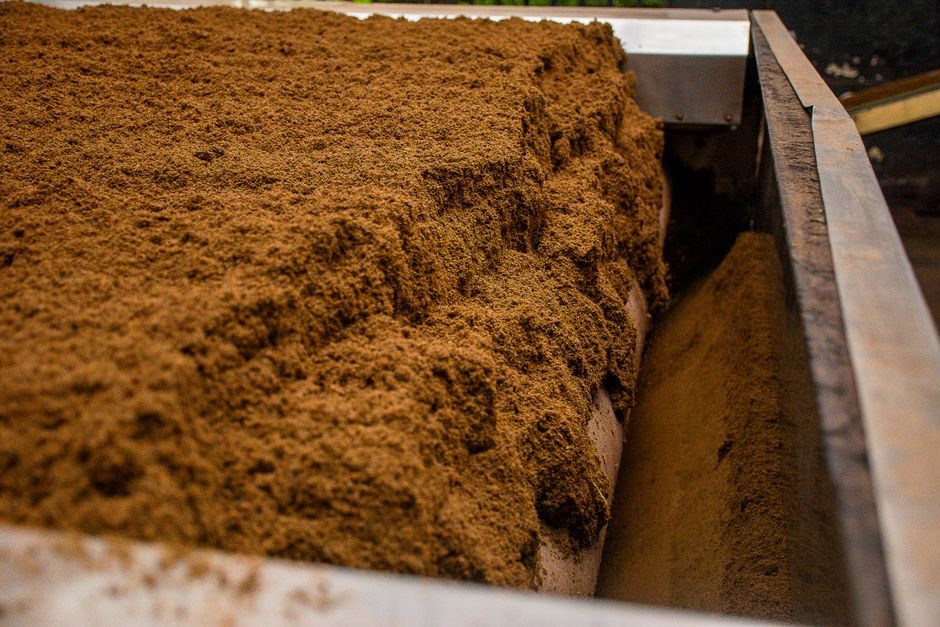
Vibrating conveyors transport bulk solids on a trough or pan driven by an eccentric or electromagnetic actuator at typical frequencies of 5 Hz to 60 Hz and amplitudes of 1 mm to 25 mm, with no internal bearings, belts, chains or screws touching the material [S1].
Spec range is wide: trough widths run roughly 150 mm to 1500 mm, lengths from 1 m to about 20 m, and they are used across mining, foundry sand, food, chemical and pharmaceutical lines for moving granular, hot, abrasive or sanitary material.
Operating Principle and Equipment Class
A vibrating conveyor uses an oscillating drive to throw material forward in a series of small parabolic hops along an open or enclosed trough; the trough itself does not rotate or translate as a body but vibrates against the supports on rubber, spring or leaf-spring isolators. [S1]
Industrial units fall into two broad families: natural-frequency (spring-mounted) machines tuned near resonance for low drive power, and brute-force or two-mass designs with separate counterweights; electromagnetic exciters are common in food and pharma for clean, fine metering, while eccentric drives dominate heavy mining and foundry duty [S1].
For comparison against other continuous equipment, a vibrating conveyor sits beside screw, belt conveyor and chain conveyor options on most process flow diagrams, and selection is driven more by feed character than by throughput alone.
Advantages Engineers Actually Count
With no internal moving parts immersed in the material, the trough itself is the only wear item, so maintenance on a vibrating conveyor drops to drive bearings, springs and the pan liner rather than to the conveying element [S1].
Sanitary duty is straightforward: the open trough can be washed, sterilized and inspected in minutes, and electromagnetic-driven units run at variable amplitude to act as a feeder, screen or conveyor in a single compact frame, which is why they dominate food, dairy and pharmaceutical transfer lines [S1].
Heat tolerance is high — troughs of stainless steel or heat-resistant alloy handle 200 °C to 500 °C continuous feed on foundry sand and hot-clinker applications, where a belt conveyor would burn and a pneumatic conveyor would degrade the product. Energy recovery on resonance-tuned units and tight, enclosed flow also cut dust and product loss, which is why a vibrating conveyor is the default for handling abrasive minerals, cast-iron chips, glass cullet, hot sinter, foundry sand, plastic pellets, food grains and pharmaceutical powders across a duty envelope that a chain conveyor cannot match without lubrication [S1].
Disadvantages and Failure Modes
The chief trade-off is drive power and structural load: throwing mass forward takes more energy per ton than sliding it on a belt, and the dynamic forces couple into the building unless the frame is properly isolated on rubber or spring mounts with at least a 10:1 transmissibility ratio to the foundation [S1].
Wet, sticky or cohesive material packs on the trough and rides rather than throws, so capacity collapses; friable feed also degrades under repeated impacts, which is why brittle cereals, certain crystal products and oil-seed meals are typically handled on a gentle overhead conveyor or a slow belt instead.
Tuning drift is a chronic field problem — springs weaken, mass changes with liner wear, and the unit falls out of resonance, raising current draw; sound levels on brute-force machines regularly sit in the 85 dB(A) to 95 dB(A) range, so hearing protection and isolation are mandatory in occupied plants [S1].
Selection Criteria and Spec Gates
Pick a vibrating conveyor on feed character, not headline capacity: it excels for dry, granular, abrasive, hot or sanitary bulk at typically 0.5 t/h to 200 t/h, and falls short on wet, sticky, fibrous, fragile or high-tonnage duties above that range. [S2]
Spec gates a process engineer should write into the enquiry are: trough width and length, material of construction (mild steel, 304/316 stainless, hardened liner), drive type and power (electromagnetic, single-eccentric, twin-eccentric, two-mass), amplitude and frequency envelope, and isolation mount type with calculated static and dynamic reaction loads handed to civil [S1].
Compared side-by-side against a screw conveyor on a 50 t/h dry abrasive duty, a vibrating conveyor usually wins on wear life and sanitation but loses on energy per ton and floor-space; against a pneumatic conveyor it wins on particle degradation and power for dense solids but loses on layout flexibility, and against a belt conveyor it wins on enclosed, sanitary, hot or abrasive feeds but loses on long-haul, high-tonnage, gentle-handling applications [S1].
Use Cases and Industry Fit
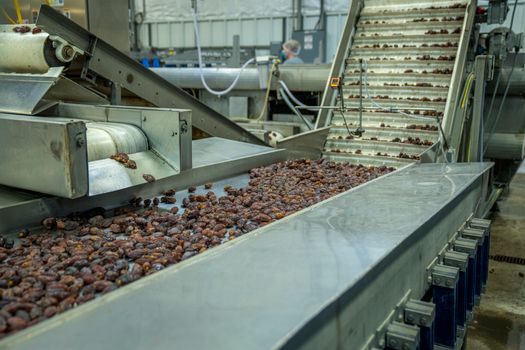
Foundry green-sand and return-sand lines, hot-sinter cooler conveyors in cement and steel, glass cullet and cullet-fines transfer, food-grade grain and sugar handling, and pharmaceutical powder feeders are the canonical installations where the open-trough, no-lubrication, high-temperature profile of a vibrating conveyor is decisive [S1].
The same equipment is increasingly used as a combined feeder–conveyor–screen in European and North American chemical plants, where it is often compared head-to-head with a bucket elevator on vertical-lift duty, with selection following temperature and sanitation rules rather than energy per ton.
It is the wrong tool for sewage sludge, wet filter cake, sticky clays, raw municipal solid waste, fresh concrete, or any long-haul line beyond roughly 20 m, where a belt conveyor, pneumatic conveyor or overhead conveyor is mechanically and economically the better answer [S1].
Maintenance, Sourcing and Standards
Preventive work on a vibrating conveyor is dominated by drive bearings, spring packs, isolators, liner plates and the eccentric or coil assembly; mean time between overhauls on a well-tuned foundry unit typically sits in the 12 000 h to 30 000 h range, driven largely by feed abrasiveness and isolation quality [S1].
Specification should follow the equipment maker's API, CEMA or equivalent mechanical-handling data sheet, with reaction loads and amplitude/frequency confirmed against ISO 21920 surface-finish and ISO 1940-1 balance grades for rotating drive components, and ATEX 2014/34/EU applied where a dust-cloud hazard exists around the trough [S1].
Buyers chasing lowest first cost usually get long-tail spares pain on the drive bearings and spring packs, so total-cost evaluation over 5 to 10 years typically narrows the field to a small set of established mechanical-handling vendors whose aftermarket network is already proven on similar duty. For process engineers comparing options, similar decision logic on pros, cons and spec gates has been laid out for demolition hammer advantages, disadvantages and spec gates and bulldozer advantages and disadvantages: a spec engineer's cut, where the same character-of-feed versus cost-per-ton trade-off dominates.
Track these signals through 2026: published vendor moves to widen the electromagnetic-drive power band above 25 kW, and the next round of energy-efficiency rules for bulk-solids handling in the EU, both of which are likely to redraw the cost gap between vibrating and belt conveyors on medium-duty lines. For nearby plant decisions on solids-handling specs, a useful parallel is cyclone separator selection: duty, sizing, and spec gates, which faces a similar character-of-feed gating logic.