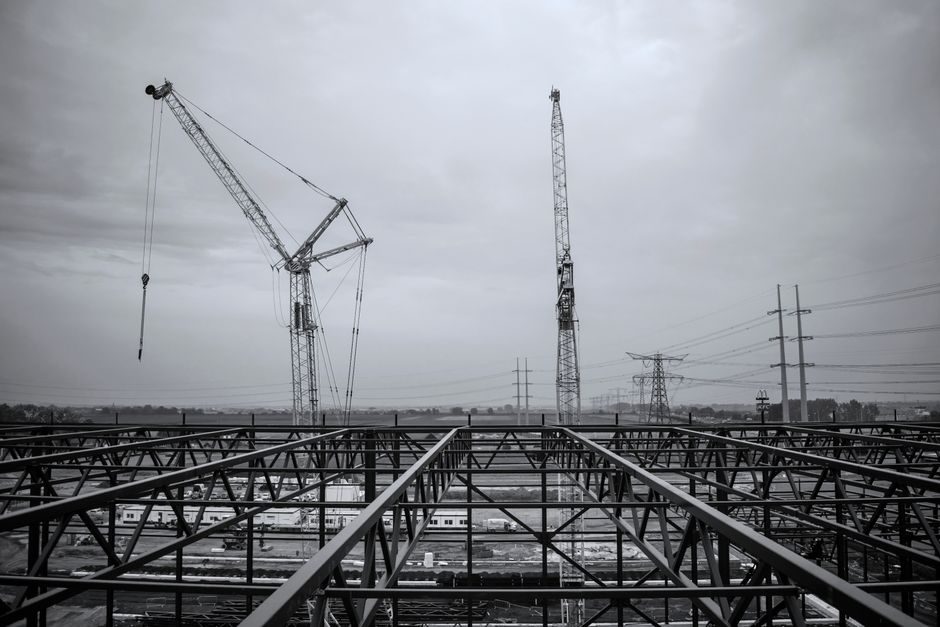
ASME B30.18-2016 categorises stacker cranes into top-running bridge and under-running bridge configurations, each available in single-girder or multiple-girder layouts with a top- or under-running trolley hoist, and the standard was scheduled for its next revision in 2021 [S3].
Within those structural envelopes, the market segment splits into mini-load (box), unit-load (pallet) and heavy-load (ton-scale) classes, served by product lines such as the INFORM Panther, Lion and Giraffe series, plus dedicated heavy-load ASRS and mini-load box stacker cranes [S2].
ASME B30.18 Structural Taxonomy
The full title of the governing US safety standard reads "Stacker Cranes (Top or Under Running Bridge, Multiple Girder With Top or Under Running Trolley Hoist)" and the document was issued on 26 August 2016, with an effective date one year after issuance [S3].
Top-running bridge stacker cranes carry the runway rails on top of the aisle building structure, allowing higher lift heights and heavier payloads; under-running bridge units hang from the rails, lowering headroom requirements at the cost of lower rated capacity. Multiple-girder designs distribute load across two or more bridge beams and pair with either a top-running or under-running trolley hoist depending on aisle geometry and lifting duty [S3].
Unit-Load Pallet Stacker Crane Class
The Panther, Lion and Giraffe series from INFORM cover the unit-load pallet segment, with the Giraffe series typically handling the tallest aisle heights and the Panther series targeting standard double-deep pallet positions in ASRS cells [S2].
Unit-load cranes move a single pallet or tote per cycle on a load-handling device that telescopes into the rack, with typical single-mast column heights ranging from 8 m to over 40 m and single-cycle payloads commonly in the 1000-1500 kg range for standard pallet handlers. Mitsubishi Electric's FA package specifies vibration control, position calibration, and built-in inverter functions directly to stabilise high-speed load and unload cycles on this crane class [S1].
Mini-Load Box Stacker Crane Class
Mini-load stacker cranes serve carton, tote and bin storage in light-duty racking, and INFORM's product line positions them alongside beam-type, roller track-type, medium-sized Type I and Type II racking for light-duty applications [S2].
These cranes typically handle loads of 30-100 kg per cycle at much higher cycle rates than unit-load machines, and they are often paired with miniload ASRS configurations where the rack is self-supported by the building steel. Mitsubishi's FA solution targets cycle-time reduction through vibration damping and parameter-driven servo tuning rather than mechanical re-engineering, a pattern that maps directly onto mini-load cycle profiles [S1].
Heavy-Load and Specialty Configurations
Heavy-load stacker crane ASRS cells handle single loads well above standard pallet weight, often in steel coils, engine blocks, or tooling, and the ASME B30.18 multiple-girder framework is the structural reference these heavy units fall back to for bridge and hoist safety requirements [S3][S2].
Beyond the three core classes, special-purpose stacker cranes include crane-scale-integrated designs for weigh-and-store workflows (see the crane scale reference) and gantry-format stackers that run on ground rails instead of an overhead runway, classified under the broader gantry crane family at gantry crane. For operations that need to move a single pallet through a smaller footprint at floor level rather than through a full ASRS aisle, a dedicated pallet stacker is the right tool, not a stacker crane.
Drive, Control and Safety Subsystems
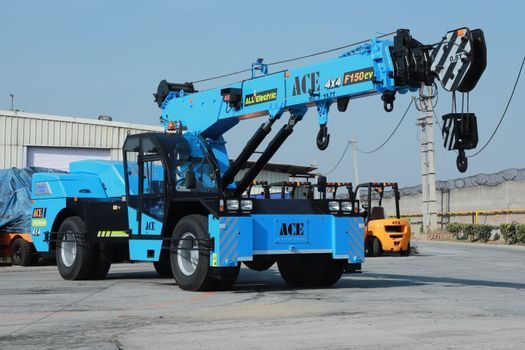
Mitsubishi Electric's stacker crane FA solution lists cycle-time reduction, enhanced safety, short startup and maintenance, and built-in inverter fault-avoidance as the four engineering targets, with vibration control and position calibration directly addressing mast sway at high travel speeds [S1].
The control stack centres on MELSEC iQ-R / iQ-F PLCs paired with MELSERVO-J5 or MELSERVO-J4 servo drives and FR-A800 / FR-F800 inverters, which is a typical high-end ASRS motion architecture for both stacker crane and mini-load installations. A redundant process-control option and total-maintenance service package are also listed in Mitsubishi's competencies, both relevant to unattended 24/7 ASRS cells where a stacker crane is the single point of failure for the entire aisle.
Selection Criteria and Operating Limits
Three criteria dominate the unit-load versus mini-load versus heavy-load choice: payload per cycle, cycle rate, and aisle height. Mini-load wins on cycle rate above roughly 60-100 cycles per hour per crane; unit-load wins on payload versatility in the 500-1500 kg band; heavy-load wins above roughly 3000 kg per cycle where multiple-girder bridge design becomes mandatory under ASME B30.18 [S3][S2].
Aisle height is the second hard constraint: top-running bridge designs reach higher than under-running designs for the same building column height, and self-supported racking (where the rack itself carries building loads) can push stacker crane mast height past 40 m for unit-load ASRS. Floor-rail stacker cranes that need to leave the aisle should be evaluated against the crawler crane or mobile crane families instead, since those are designed for outdoor travel rather than fixed-aisle storage cycles.
Standards, Sources and What to Verify Before Specifying
ASME B30.18-2016 is the explicit US safety standard for stacker cranes and the scheduled next edition date in the document itself is 2021, so any specifier should confirm which edition is current on the ASME committee page rather than assuming the 2016 revision is still in force [S3].
For European installations, EN ISO 3691-1 and the machinery-related CE conformity route typically govern the same hazards covered by ASME B30.18. Related ASRS cell safety (rack supported buildings, shuttle integration) is not in scope of B30.18 and should be cross-checked against the racking supplier's EN 15635 / EN 15629 documentation, while movement of the load itself is the stacker crane OEM's responsibility under ASME B30.18 [S3][S2].
Trackable next signal: confirm which edition of ASME B30.18 is currently in force on the ASME committee page, and watch for INFORM and Mitsubishi Electric to publish revised Panther, Lion or Giraffe series payload tables that quote specific cycle rates at specific mast heights rather than generic "high-speed" marketing language. For a structural material cross-check useful in specifying the mast and bridge sections of any stacker crane, the steel section types and classifications reference is a working companion document.