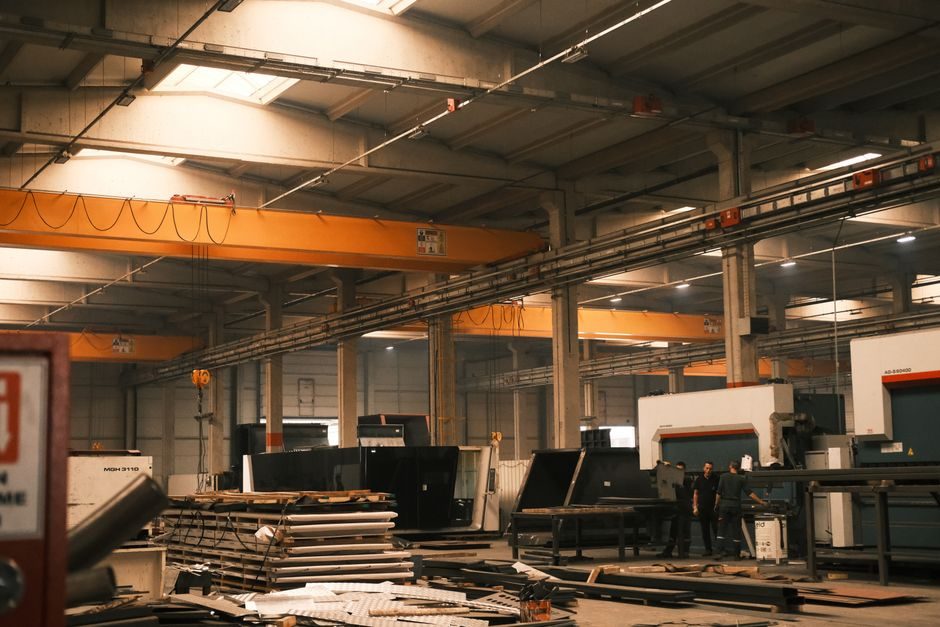
A stacker crane (SRM, storage/retrieval machine) is a rail-guided mast vehicle that shuttles pallets, totes, or long loads between a single aisle and a rack position; a sorting system is a conveyor-and-divert network that routes items to outbound destinations. They sit at different layers of intralogistics: the crane owns the "where does it live" decision inside fixed racking, while the sorter owns the "where does it go next" decision across a flow path.
DirectIndustry lists 13 industrial manufacturers and 21 products in the "automatic storage system with stacker crane" category as of 2026-05-20, with major suppliers including Daifuku, CTI Systems, KASTO, HUBMASTER, LOGITOWER, and ELECTROCLASS [S1]. The category sits adjacent to — but does not overlap with — conveyor sorting lines that feed order-fulfillment cells.
What a stacker crane actually does on the floor
A stacker crane runs on a top and bottom rail inside a single narrow aisle, with a mast that elevates a load-handling carriage to the target rack level. GIS AG describes its storage-and-retrieval unit for boards and pallets, with vacuum lifter or lifting fork options, full-height use of the building envelope, and a slewing lifting guide up to 360° [S2]. KASTO, Daifuku and CTI build comparable unit-load ASRS cranes with similar kinematics [S1].
Mecalux markets an automated trilateral stacker crane as the simplest, most cost-effective option to automate pallet storage in new or existing racking, explicitly positioned to replace trilateral forklifts without rack modification [S4]. Interlake Mecalux documents a computer-vision positioning stack on its pallet SRM, allowing the crane to "see" and "understand" its surroundings in dynamic mixed-traffic aisles (2024-04) [S6].
What a sorting system actually does on the floor
A sorting system is a network of belt, roller, or cross-belt conveyors fitted with diverts, scanners, and induct stations. The sorting system pattern is a destination decision, not a slot decision: a scanner reads a barcode, the WCS/WES picks a chute or outbound lane, and a divert arm, sliding shoe, or cross-belt kicker fires at the right index. This is a horizontal, high-throughput, item-level routing function, not a vertical, low-throughput, pallet-level storage function. [S1]
Stacker cranes and sorting systems are routinely co-specified in the same facility: pallet SRMs feed reserve storage, conveyors and sorters feed forward picking. The cost and throughput envelopes are also non-overlapping. Made-in-China lists entry-level stacker cranes around US$12,000 and ASRS-class units at US$200,000, indicating a roughly 15-20× spread on the crane side alone. A sorter line scales with divert count, scan density, and conveyor length, and is dimensioned in items per hour, not pallets per hour.
Selection criteria: when each is the right tool
Choose a stacker crane when: (a) load units are pallets, totes, or long stock stored in fixed-aisle racking; (b) the building envelope is tall and floor footprint is the constraint; (c) SKU count is high and pick face is small; (d) you can tolerate single-aisle throughput limits. A unit-load ASRS crane, the canonical stacker crane configuration, fits all four [S1][S2].
Choose a sorting system when: (a) load units are polybags, parcels, or eaches moving to many destinations; (b) throughput target is thousands of items per hour per lane; (c) destinations shift with order mix rather than storage policy; (d) the layout is wide and flat, not tall and narrow. Conveyor sorters scale horizontally; stacker cranes scale vertically. Trilateral and rail-guided pallet stackers split the difference for low- to mid-rise racking where full ASRS economics do not yet pay back [S4].
Throughput, height, and footprint: a side-by-side comparison
Four decision criteria line the two classes up cleanly. (1) Vertical reach: stacker cranes commonly serve racking to 40 m and above; sorting systems are essentially floor-bound, with mezzanines rarely above 8-10 m. (2) Unit size: cranes move pallets, totes, or long stock; sorters move items, parcels, and cartons. (3) Throughput metric: a single aisle SRM is dimensioned in 30-100 pallet cycles/hr depending on height and S/R versus picking mode; sorters are dimensioned in items/hr/lane, typically 3,000-10,000+ for shoe/cross-belt. (4) Decision logic: the crane executes a known storage or retrieval slot; the sorter executes a per-item destination lookup. [S2]
For very-high-density storage above 100,000 pallet positions, an ASRS system using one or more stacker cranes per aisle is the established pattern. For shuttle-based dense storage, a shuttle system replaces the crane's vertical travel with horizontal shuttle runs on each level — different kinematics, but still pallet-class unit loads, not items. Mecalux's trilateral SRM is the lower-cost boundary case where the crane replaces a forklift rather than a miniload or unit-load ASRS [S4].
Failure modes and integration boundaries
Stacker crane failure modes are concentrated in the mast, hoist, and rail guidance: rope wear, telescopic fork drift, encoder loss on the lifting axis, and aisle collision during dual-crane handover. The Autodesk FlexSim forum thread on dual-crane collision avoidance (2025-07) is a typical control-engineering problem, where two SRMs share an aisle and need interlocking logic. Simscape Multibody stacks the kinematics — sway, pendulum, oscillation — into a tunable model for control design, with adjustable masses, dimensions, and densities at the mask interface [S3].
Sorting system failure modes are concentrated at the divert: mis-indexed shoes, scanner read-rate drops, recirculation loops saturating, and WCS/WES latency starving the divert decision. Hongfu Forklift, a Chinese OEM, builds the adjacent truck-and-stacker line and runs ISO 9001:2019 plus an ERP-tracked production system — a useful vendor reference for the support infrastructure behind either equipment class [S5]. Both classes are also constrained by upstream packaging quality: an unstable tote or a tilted carton breaks SRM telescopic forks and sorter shoes equally. For brownfield retrofits, a trilateral SRM lets the racking stay unchanged [S4]; adding a sorter to a brownfield site usually forces conveyor trenching and WMS re-mapping, which is the real capex driver rather than the sorter hardware itself.
Standards, sourcing, and what to verify on a quote
Hongfu's ISO 9001:2019 certification is the minimum governance signal to look for on Chinese-supplied stacker and truck equipment [S5]. On the European side, FEM 9.341 / EN 15095 and EN 528 govern ASRS crane safety, while conveyor and sorter lines fall under EN 619 (continuous mechanical handling equipment) and ISO 5048 / ISO 7149 for safe design. The exact revision dates and conformity-assessment routes should be confirmed against the OEM's Declaration of Conformity at quote stage — do not take a generic "CE" mark as a substitute.
Spec-side, pin down six numbers before signing: (1) cycle time at rated load, (2) maximum lift height to the topmost rack position, (3) load-handling fork envelope, (4) aisle length and rail joint tolerances, (5) the WCS/WES-to-crane protocol (typically PROFIsafe, PROFINET, or vendor proprietary), and (6) the maintenance access envelope at the aisle ends. On the sorter side, pin down: (1) items/hr per lane at peak mix, (2) divert accuracy at rated conveyor speed, (3) barcode read-rate, (4) recirculation loop capacity, and (5) the WCS API surface. Made-in-China's US$12,000-200,000 spread is the broad sourcing range to anchor first-pass budgeting; the OEM quote will land inside it once aisle length, height, and fork type are fixed.
For readers scaling conveyor throughput alongside storage automation, the overhead conveyor vs roller conveyor selection guide covers the horizontal-flow layer that usually sits between an SRM and a sorter. Where a stacker crane reaches its height limit, a shuttle-based system takes over the dense-storage role; the spec frame for that swap differs from a trilateral SRM, and Mecalux's trilateral line is the lower-cost boundary case worth a line on any layout sketch [S4].