Selection between an overhead conveyor and a roller conveyor is decided by three physical questions: is the load hanging or standing, is the path three-dimensional, and does the line need to clear floor traffic. As of 2026-05-29, DirectIndustry lists 14 manufacturers offering overhead conveyor systems, with 24 products in the category, the largest suppliers including DAIFUKU, DEMATIC, and CTI Systems S.à r.l. (each with dedicated overhead product families) [S1].
Roller conveyor is the higher-volume category: Chinese mills such as SY Conveyor and Huzhou Jiutong list steel, HDPE/UHMWPE, impact, rubber-coated, ceramic-rubber pulley, and motorized pulley roller families in their main product catalogs as of 2026-06-22 and 2026-06-09 respectively [S4][S5]. UK bearing supplier Bridge Bearings, active in this space, describes itself as a manufacturer of bearings and ball transfer units for both conveyor rollers and overhead conveyor lines, with steel and plastic housings for Crowded Race and Sintered type applications [S6].
Definition and Physical Scope
An overhead conveyor is a powered chain-rail or enclosed-track system that suspends workpieces from a hook, carrier or work-hanger, the chain running on a structural monorail fixed to the building ceiling or to free-standing supports. DirectIndustry's category page indexes overhead conveyor equipment for warehouse, logistics, automotive wire harness, storage, assembly line, and motorcycle-applications uses, reflecting the dominant industrial sectors [S1]. A roller conveyor is a floor-mounted line in which cylindrical rollers — the load-carrying elements — let cartons, totes, pallets or skids travel by gravity, by belt/chain drive through the rollers, or by motorized drum (MDR), with each roller mounted in a side frame on a fixed horizontal axis.
Construction of the load-contact elements differs sharply. Roll-ven's DELTA 2R chain-drive roller, an OEM product listed on 2024-05-23, uses a tapered-end steel tube in stainless or galvanised steel, with diameters from 38 mm (1.496 in) to 89 mm (3.504 in) and a 200 mm (7.9 in) length, designed for straight-line roller conveyors and heavy load transport in dusty industrial environments [S2]. Overhead systems use links, trolleys, and either chain or cable as the moving element; the carrying surface is structural steel or aluminium, not a roller.
Selection Criteria: Floor, Load and Throughput
Floor footprint is the single biggest decision driver. An overhead conveyor recovers the floor entirely: operators, forklifts, and tugs can pass underneath while parts move continuously through paint, plating, drying, or finishing cells. Cym Materiales' belt shot blasting machine, exhibited with overhead-conveyor handling for profiles and pipes as of 2026-05-17, demonstrates this pattern — the part is suspended so the abrasive stream can hit all faces in a continuous pass [S3]. A roller conveyor, by contrast, occupies floor area equal to the line footprint plus drive/control zones, and typically requires a clear lane of approximately 600–1200 mm along the running side for service and re-entry.
Load geometry drives the second criterion. Hanging work — car bodies on a paint deck, garments on hooks, work-hangers through cleaning, plating, or powder coating — is structurally overhead work; a roller cannot carry a hanging load. Conversely, a 25 kg carton, a Euro pallet (1200 × 800 mm) or a corrugated tote wants a flat, repeatable, statically supported surface with low rolling resistance. For those, a roller conveyor configured with steel or HDPE rollers is the standard answer. Load capacity on roller lines scales with roller diameter, axle size, and frame pitch; the 89 mm diameter DELTA 2R roller is positioned for heavy-load straight sections specifically [S2].
Throughput characterisation differs as well. Overhead systems are typically continuous-loop, low-start-stop, and throughput-limited by chain pitch, carrier spacing and process-zone length. Roller lines can be modular: gravity sections for accumulation, MDR sections for zero-pressure zero-contact, and slaved sections for sortation; Chinese suppliers routinely list accumulate-roller and driven-roller series alongside sprockets and ball-transfer units as standalone catalog items [S5]. When the application is variable pick-face, batch sortation or pallet dispatch, a roller conveyor is the more flexible tool.
Who Each System Is For — and Who It Is Not For
Overhead conveyors are for plants that need: (1) floor area recovered for forklift or operator traffic, (2) three-dimensional routing through elevation changes, dips, and switchbacks, (3) work-in-process carried on a hook, hanger, or fixture — typical automotive paint, finishing, and storage loops — and (4) inverted orientation for cleaning, coating, or inspection processes [S1][S3]. They are not for: bagged or boxed loose goods, pallet handling, picking aisles, or any line that needs side-loading carriers at human-waist height.
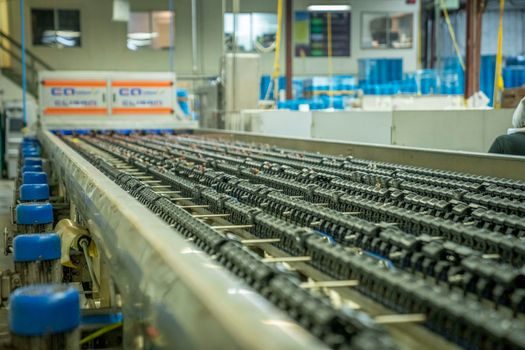
Roller conveyors are for plants that need: (1) horizontal flow of cases, totes and pallets at floor or waist height, (2) modular sections that can be reconfigured, (3) gravity-accumulation to buffer surges, and (4) integration with scanners, scales, and diverters at sort points. They are not for: hanging or work-piece carriers, inverted processes, or lines that must route over a workstation without floor contact. SY Conveyor's catalog lists impact, rubber disc, and HDPE/UHMWPE rollers alongside steel rollers, the material choice itself is a tell: HDPE and UHMWPE rollers suit clean, low-noise carton lines, while steel and rubber-coated rollers serve quarries, coal-prep, cement, steel and port environments [S4].
Options Compared on Four Decision Criteria
On a four-criterion comparison — load orientation, path complexity, floor clearance, and per-foot installed cost — the two families diverge cleanly. [S1]
On load orientation, overhead systems require a hookable or fixture-mounted carrier, while roller systems require a flat-bottomed, statically stable load (a requirement met by every standard carton, tote and pallet). On path complexity, overhead conveyors handle horizontal curves, vertical lifts, dips and 3D layouts by simply bending the rail; roller conveyors are restricted to horizontal runs with side transfers and modest inclines (gravity declines typically capped at roughly 4–8° depending on load). On floor clearance, overhead systems are essentially full-clearance under the rail (subject to local structural and safety zones), while roller systems occupy a continuous strip of floor equal to the line footprint.
On per-foot installed cost, gravity roller lines are typically the lowest cost option for short carton runs, driven-roller (MDR) and slaved roller lines sit in the middle, and powered overhead systems are the highest per-foot cost because of the structural rail, drive units, carriers, and hoist/catwalk provisions. Inside the roller family, the cost driver is roller material: steel rollers are the workhorse, HDPE/UHMWPE rollers cost more but reduce noise and protect packaging, and stainless or galvanised rollers are the choice for wash-down or food-grade environments [S2][S4]. For plants weighing a chain conveyor vs vibrating conveyor decision in parallel, the same logic — match transport medium to load state and route — applies.
Real Use Cases, Sourcing and Standards Anchors

Automotive paint, e-coat, and trim-and-final storage loops are the textbook overhead application; manufacturers such as DAIFUKU and DEMATIC are listed in the overhead category for automotive, storage and wire-harness work [S1]. Garment and laundry lines, footwear finishing, and any continuous plating or anodising line are also overhead, since the part must be inverted or rotated through a process bath. The Cym Materiales shot-blasting machine for profiles and pipes, using an overhead-conveyor feed, is a typical finishing-cell example [S3].
Distribution-centre case flow, cross-belt sortation, picking aisles, and pallet dispatch are textbook roller applications. Chinese suppliers SY Conveyor and Huzhou Jiutong are visible in the catalog as 2026-06-22 / 2026-06-09 listings covering steel rollers, HDPE rollers, impact rollers, rubber disc return rollers, motorized pulleys, ceramic-rubber pulleys, and accumulate-roller series [S4][S5]. For mines, cement, and steel plants, impact idlers, rubber disc return rollers and ceramic-rubber pulleys are specified to absorb drop energy and carry abrasive material [S4]. Bearings inside the rollers and inside the overhead carriers are a shared component: Bridge Bearings supplies steel and plastic housed bearings for conveyor rollers and Crowded Race / Sintered variants specifically for overhead conveyor applications [S6].
Standards discipline: roller line geometry typically references ISO 1537 / ISO 340 for belt conveyors, EN 619 for industrial roller conveyors, and ISO 281 for bearing dynamic load rating inside the rollers; overhead systems typically reference EN 1991 / FEM 9.341 / CMAA 70/74 (US) or FEM 1.001 / 1.004 (EU) for structural and drive sizing, with a roller chain selected to ISO 606. None of these standards are invented here — they are the standard practice applied to these equipment families when buyers in EU/US sites issue RFQs.
Limitations, Failure Modes, and Common Spec Traps
Overhead conveyor common failures: chain elongation and pin wear, trolley wheel bearing failure (a frequent service item — Bridge Bearings' Crowded Race and Sintered bearing lines are sold directly into this point of pain [S6]), drive unit chain or coupling wear, and overload of the structural rail at curves and take-ups. Spec traps include under-rated drive for the loaded-up accumulation, forgetting a powered take-up on long loops, and specifying a chain pitch that is too coarse for the tight radii in the layout. Plants that retrofit an overhead system into an existing building also often underestimate the vertical clear zone and the need for catwalks or access platforms.
Roller conveyor common failures: roller shell wear, bearing seizure (especially in wash-down or dusty environments), frame twist from over-loaded pallets, and belt/chain stretch in driven sections. The roll-ven DELTA 2R's tapered-end steel tube and dust-tolerant design target exactly this dust environment, with both stainless and galvanised steel options for corrosive sites [S2]. Spec traps include mixing gravity and driven zones without a transition roller, under-pitching frames for pallet loads, picking the wrong roller diameter (38–89 mm is the common industrial range) for the carton weight, and forgetting electrical zoning on MDR lines [S2]. Plants scaling up should also confirm that a road roller or overhead bridge crane on the same site does not share an electrical bus that creates harmonic problems for variable-frequency drives on the conveyor.
For applications that sit between the two — light, hanging textile or small-parts finishing versus a flat carton line — a hybrid is often the answer: an overhead conveyor loop delivering work to a small gravity roller takeaway that stages parts to the workstation. This combination is common in light-electronics assembly and small-motor production, and is the practical middle ground when a single technology cannot carry the whole process.
Next node: pull the manufacturer cut sheets for the candidate overhead and roller families — DAIFUKU / DEMATIC for overhead, SY Conveyor / Huzhou Jiutong for rollers — and match them against the four criteria above before issuing the layout sketch. Trackable signals for the next 90 days: any new ISO 340 / EN 619 update affecting roller geometry, and any new FEM 1.001 / 9.341 revision affecting overhead drive sizing.