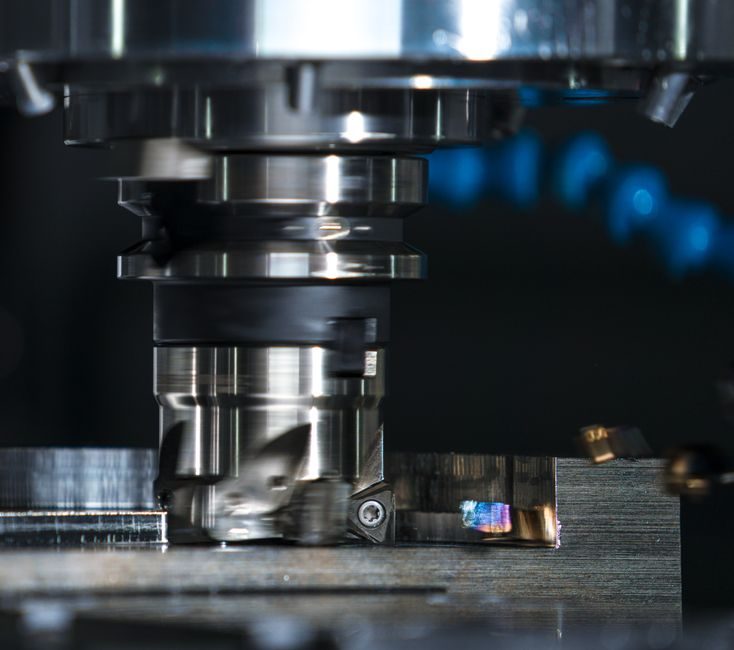
Plastic-injection mold cavities and metal-stamping/forming dies that must survive abrasive glass-filled resins, halogenated flame retardants, or food/medical cleanability call for stainless tooling steels rather than the conventional P20 or H13 baselines [S1].
For a 10,000-shot production run on a 30% glass-filled PA66 part, the right cavity material can mean the difference between 50,000 shots before pitting corrosion shuts the tool down and a 1-million-shot life on the same machine [S1]. This guide maps the grade families, hardness ranges, and corrosion thresholds that drive that gap, drawing on the stainless steel base-grade taxonomy and the tool die steel reference framework.
Three stainless families cover ~90% of mold and die applications
Martensitic 420 (1.2083/AISI 420) and 440C (1.4125) are the workhorses for plastic-mold cavities, delivering 50-56 HRC after vacuum heat treatment and a chromium content of 13-18% that provides passivation against polyolefin and ABS corrosion [S1]. For higher-hardness requirements such as stamping or blanking dies, 440C reaches 58-60 HRC, while 420 tops out near 54-56 HRC for compressible cavity surfaces [S1].
Precipitation-hardening 17-4 PH (AISI 630 / 1.4548 / DIN X5CrNiCuNb16-4) is the alternative when machinability in the solution-annealed state (around 32 HRC) is the priority, followed by a single aging step at 482°C that lifts hardness to 44 HRC (H900 condition) without the distortion budget of a full quench [S1]. PH grades are widely specified for stainless pipe hardware tooling and for medical-device molds where ASTM F899/F138 biocompatibility traceability is required.
Austenitic 304 (1.4301) and 316 (1.4404) are reserved for low-wear, high-corrosion roles — cooling channels, ejector retainer plates, and conformal-cooling inserts where thermal conductivity of ~16 W/m·K at 100°C is acceptable but wear resistance is not the limit state [S1]. A useful comparison for spec-writing: 420 costs roughly 2.0-2.4× 304 per kg in European stock, but delivers ~2× the surface hardness after heat treat.
Corrosion versus hardness: the central trade-off
For PVC, flame-retardant ABS with brominated additives, and any halogen-bearing resin, a minimum of 16% chromium in the cavity steel is the practical threshold to avoid pitting within the first 5,000 production shots, based on mold-shop service feedback compiled in supplier references [S1]. That pushes the choice toward 1.2083 (16-18% Cr) or 1.4125 (16-18% Cr) over 1.2316 equivalents at lower Cr content.
Hardness ceilings follow from carbon: 420 sits at ~0.38% C for 50-54 HRC, while 440C pushes to ~1.0% C and 58-60 HRC. Going past 60 HRC sacrifices corrosion resistance because the volume fraction of chromium-tied carbides consumes the matrix Cr below the 12% passivation floor [S1]. For die-casting cores exposed to molten Al at 680°C, H13 hot-work die steel remains the default, but 1.2343 ESR (H11-mod) and 1.2367 (H10-mod) are specified where the die sees both thermal cycling and water-soluble die lubricants.
A related reading that maps the same family-of-grades logic for the aerospace sector — where 15-5 PH, 17-4 PH, and 440C sit alongside 300-series austenitic grades — is the aerospace stainless steel selection guide, which lays out the tensile/yield envelope differences in 90-ksi increment terms.
Mold-base, slide, and insert: where each grade fits
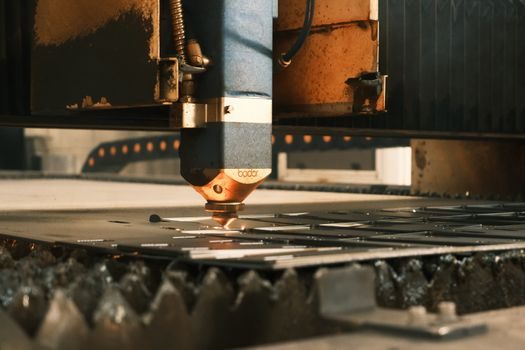
The mold base — the support frame, parting-line lock, and ejection plate — usually runs P20 (1.2311 / 1.2738) at 32-36 HRC for cost reasons, with stainless-clad variants (P20 + 420 cavity insert, electron-beam-welded or diffusion-bonded) used only when the resin package or the cleanability requirement justifies the 1.8-2.2× cost premium [S1].
Slides, lifters, and core pins are the second-tier decision: 17-4 PH H900 at 44 HRC is the common pick when EDM-finished surfaces need to mate against 420 cavities without galling, while HSS-M2 (1.3343) and HSS-M4 (1.3351) at 62-64 HRC are reserved for high-cycle slides in progressive dies where wear — not corrosion — is the limit state [S1]. For inserts in sand casting mold tooling that must survive repeated heating, 1.2344 (H13) at 50-54 HRC remains the standard, and stainless variants enter only when the casting alloy (e.g., Mg, certain Ti) reacts with conventional H13.
Selection criteria for the buyer: five questions, one decision tree
Run the following sequence before signing the steel PO: (1) What resin or workpiece? PVC, flame-retardant, or food-contact polymer → 1.2083; commodity polyolefin/ABS → P20 or 1.2738; medical or implant-grade polymer → 17-4 PH or 420 ESR with traceability. (2) Required cavity hardness? < 40 HRC → P20/1.2738; 44-48 HRC → 17-4 PH; 50-56 HRC → 420/1.2083; 58-60 HRC → 440C/1.4125 [S1].
(3) Polish or texture requirement? Optical-grade polish to A1 (Ra < 0.025 µm) → 420 ESR or 1.2083 ESR with vacuum-arc remelt; SPI-SPI-D2 finish → P20 acceptable. (4) Cycle count? < 100,000 shots → P20 is fine; 100k-1M → 1.2083; >1M with corrosive resin → 1.4125 ESR or hard-chrome-plated 1.2083. (5) Heat treat capability? In-house vacuum furnace → any grade; outsourced only → 17-4 PH to avoid distortion rework [S1].
For a closer look at how the same kind of decision tree is built for Cr-Mo alloy grades in upstream energy equipment — where Cr content, NACE MR0175 sour-service qualification, and ASTM A387 plate specs are the equivalent three dials — see the alloy steel selection for energy equipment piece, which applies a parallel logic to a different industry.
Standards, sourcing, and what the 2026 nickel surcharge means
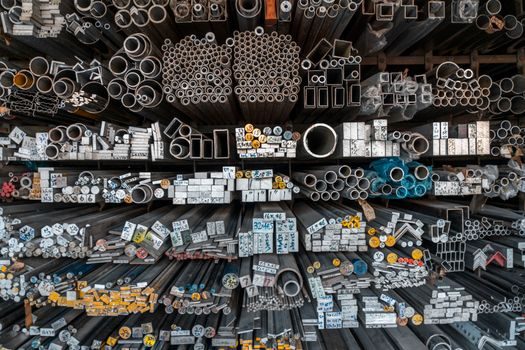
The standards framework that governs mold-steel specification is DIN EN ISO 4957 (tool steels) for European tooling, AISI/SAE grade designations from ASTM A681 for the US nomenclature, and the GB/T 1299 series for Chinese-origin stock — the same material appears under all three systems as AISI 420 / DIN 1.2083 / GB 4Cr13 [S1]. For medical and food-contact tooling, ASTM F899 and EU 1935/2004 compliance of the melt source are auditable requirements, and 17-4 PH is typically procured to AMS 5643 with a remelt-grade ESR (electroslag remelt) certificate.
On the cost side, the European alloy surcharge for 304L and 316L cold-rolled flat products was published for August 2026, and nickel remains the dominant swing variable [S2]. YUSCO (Taiwan) raised its August 2026 stainless CR prices despite weaker demand and lower Indonesian hot-rolled feedstock, citing TWD depreciation against the USD as the main driver — a move worth watching if your mold program uses 304-family frames [S2]. POSCO, separately, is preparing an anti-circumvention case against Malaysian stainless CR routed to bypass South Korean duties, a signal that regional CR supply may tighten through Q4 2026 [S2].
One more upstream variable to track: Indonesian customs inspections for rare-earth elements have delayed nickel-pig-iron export shipments through end-July 2026, and any sustained disruption will feed into 316L/1.4404 surcharge moves within roughly 60-90 days [S2]. For tooling buyers running long-lead mold builds, that argues for fixing surcharge at PO date rather than at delivery.
What to watch over the next 60-90 days
Two trackable signals will reshape stainless-tool-steel sourcing through the rest of 2026: the September 2026 European alloy surcharge bulletin (304L/316L/430) for indication of nickel pass-through, and any POSCO filing on the Malaysian CR circumvention case — a confirmed filing would likely harden Asian 304/316 spot prices by mid-Q4 2026 [S2].
For new mold programs due to start sampling before Q1 2027, the practical recommendation is to lock 1.2083 and 1.4125 orders now against Q1 delivery, hold 17-4 PH at H900 condition as the secondary spec for slides and ejector pins, and keep P20/1.2738 on the mold base where corrosion is not on the critical path. The grade you do not specify is the grade you pay to rework after the first 50,000 shots.