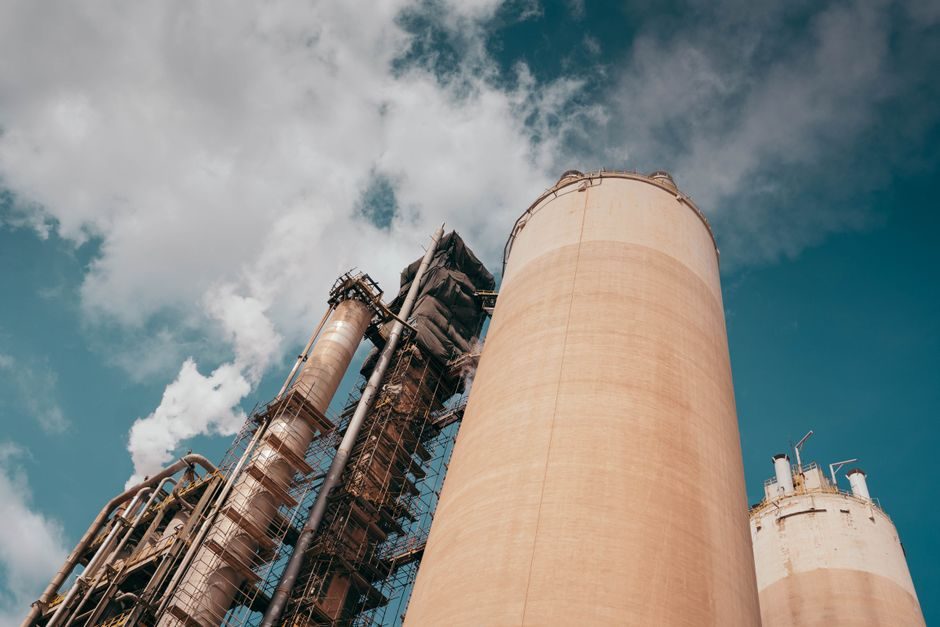
For upstream and downstream oil-and-gas service, stainless selection is a function of four variables — chloride content, partial pressure of H2S (pH2S), peak temperature, and the welding/PWHT route the fabricator can actually run — and the current industry default remains austenitic 300-series with super-duplex climbing in chloride-rich flowlines, per TWI's review of newer grades [S1].
The reference shortlist is now narrower than a decade ago: established 13%Cr martensitic, 22%Cr/5%Ni duplex, 25%Cr/7%Ni/4%Mo super-duplex, and 6%Mo austenitic (e.g. UNS S31254), with 904L (N08904) bridging the cost gap. Industeel lists plate and clad plate supply for onshore/offshore production, gas processing, liquefaction trains, and LNG storage tanks under the same selection logic [S5].
Grade Map by Service Environment
Austenitic 316/316L (UNS S31600/S31603) is the default for sweet, moderate-chloride process piping and instrument tubing up to roughly 400 °C, while 6%Mo grades (S31254, N08354) extend the chloride envelope to seawater-cooled heat exchangers and topside pipework. Industeel's oil-and-gas portfolio explicitly covers stainless plate and clad plate for production, transport, and storage service, including LNG tanks where low-temperature austenitic toughness is decisive [S5].
According to a TWI paper on welding stainless steels for the oil and gas industry, a range of low carbon 13%Cr martensitic steels has been developed for oil and gas service, and their practical application is critically dependent on welding since welding can have a significant influence on the corrosion performance of the completed assembly. For sour plus chloride exposure, super-duplex 2507 (S32750) and 22%Cr duplex (S31803/S32205) replace 13%Cr — TWI notes duplex and super-duplex tonnages have grown materially over the last 20 years because they combine CO2/H2S tolerance with high yield strength [S1].
Welding and PWHT Constraints That Drive Selection
Every upgrade in corrosion resistance costs something in weldability. TWI flags dissimilar welding of super-duplex to pipeline carbon steel as a metallurgical pain point because the two-phase ferritic-austenitic balance is sensitive to heat input and dilution, per Sharma & Sharma's review of SDSS dissimilar joints to pipeline steel [S6].
For 13%Cr martensitic, the practical rule is preheat plus PWHT to avoid hydrogen cracking, with NACE MR0175 setting the hardness ceiling for sour service; without PWHT access (e.g. in-service tie-ins), a 13%Cr grade is often replaced by a corrosion-resistant alloy overlay or a duplex alternative [S1]. For 6%Mo austenitic, the constraint is different: avoid prolonged thermal exposure in the 600-950 °C range that can sensitise the weld HAZ and degrade pitting resistance, and qualify filler metals (e.g. Ni-Cr-Mo alloy 625) rather than autogenously welding thin wall [S1].
Standards, Hardness, and Sourcing References
NACE MR0175 remains the controlling document for sour-service hardness limits, with TWI's review summarising the cap that "welded joints should meet similar hardness limits" to the base metal [S1]. Material supply to oil-and-gas projects is generally dual-certified to ASTM/ASME (A240, A312, A358, A790) plus EN 10028 for pressure equipment, and Future Metal lists supply under ASTM, ASME, DIN, JIS, and GB across pipe, plate, and welding consumables [S2]. For Indian supply, Steel India Co. stocks stainless and nickel-alloy pipe under ASTM/ASME, EN, and DIN comparison data sets useful for cross-region sourcing [S3].
Stainless Steel Club continues to publish raw-material and stainless pricing across 75 countries, which is the live input for cost-vs-corrosion trade-offs in long-lead pipe and plate orders [S7]. For background on the base material family, see the stainless steel reference, the stainless pipe product entry, and the oil seal page where elastomer-and-metal selection overlaps with downhole tooling.
Decision Comparison: Common Grades Against Four Criteria
For a process engineer, the simplest selection table is grade × (corrosion limit, max temperature, sour H2S, weldability). A 6%Mo austenitic like S31254 handles the highest chloride and roughly 200 °C continuous, but is the most expensive and demands controlled heat input. 2507 super-duplex is the best mechanical-strength-per-cost in seawater/sour service, with TWI confirming its two-phase microstructure as both the reason for its corrosion performance and the reason for its narrow welding window [S6]. L80 13%Cr is the cheapest downhole option but is bounded by NACE MR0175 hardness for sour service and requires PWHT for welded strings [S1].
When the fabrication route excludes PWHT or restricts heat input — e.g. clad pipe, in-service hot taps, or thin-wall instrument tubing — the 300-series austenitic (316L) is often the only practical answer, trading chloride ceiling for procedural simplicity, a trade-off echoed across TWI's welding-of-newer-stainless review [S1]. For adjacent guidance on another process industry, see the multi-gas detector selection for mining map.
Limits, Failure Modes, and Common Mistakes
Three failure modes repeat in field service: chloride pitting on 316L in seawater-cooled exchangers above roughly 50 °C, hydrogen-induced cracking (HIC) in sour wet 13%Cr when PWHT is skipped, and sigma-phase embrittlement of super-duplex after prolonged 600-900 °C exposure during weld repair — all three are flagged in the TWI welding review as the recurring causes of failed oil-and-gas stainless assemblies [S1]. Stainless Steel Fittings highlights that precision-machined stainless components for downstream OEMs are also subject to similar corrosion controls in fluid-handling assemblies, so the same grade selection logic applies to instrumentation sub-assemblies [S4].
Climbing above 25%Cr to hyper-duplex or super-austenitic 6%Mo only pays off if the operating envelope actually demands it; the cost delta against 2507 is typically 30-50% on the alloy surcharge alone, and welding becomes strictly procedure-controlled, so the upgrade should be justified by a measured chloride/H2S/temperature point, not by conservatism [S1][S5].
For related steel selection work in other industries, see the stainless selection map for mold and die making and the stainless selection for automotive manufacturing — both follow the same match-grade-to-environment discipline. The next two signals to track are the September 2026 NACE/AMPP MR0175 revision maintenance cycle and any new 6%Mo plate availability notes from Industeel, since both directly shift the cost-vs-corrosion frontier used in oil-and-gas stainless specifications [S1][S5].