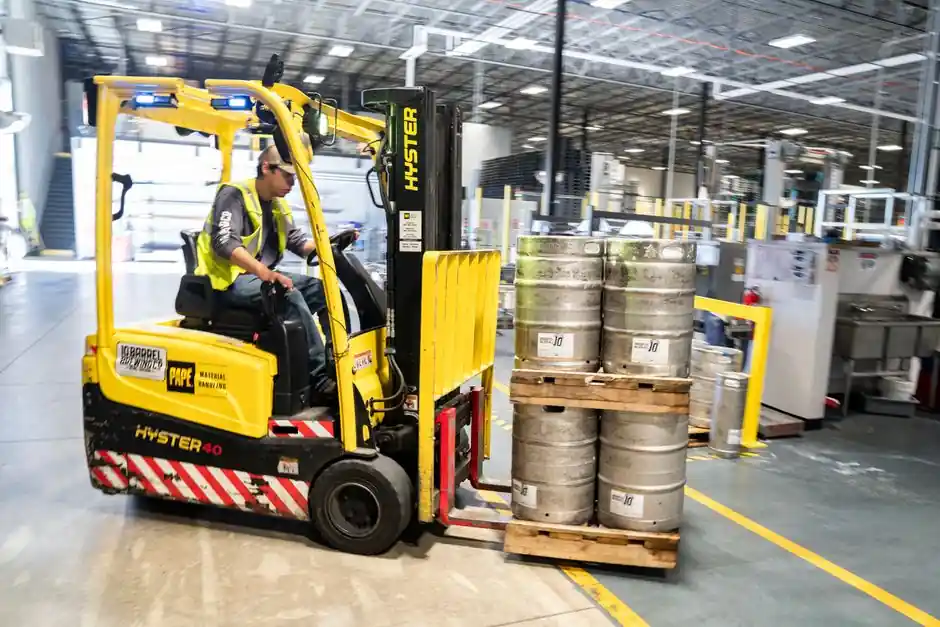
A standard counterbalance forklift and a narrow aisle truck solve different problems inside the same building: the counterbalance trades aisle efficiency for raw lift capacity and outdoor flexibility, while the narrow aisle truck trades capacity and outdoor use for tighter turning and higher stacking [S5][S8]. For a buyer or engineer, the choice starts with three numbers on the floor plan: aisle width, lift height, and the heaviest pallet that will move through that aisle [S3].
For context, a standard counterbalance unit typically measures 4 to 7 ft wide and 8 to 10 ft long, with a rear-mounted cast-iron counterweight that lets the forks engage a pallet without outriggers or stabilising legs [S1]. Narrow aisle trucks are a family, not a single product: reach trucks, order pickers, turret trucks, and side loaders, all grouped under Class II electric motor narrow aisle trucks in the standard classification [S1]. The full forklift classification and types guide breaks down how the counterbalance sits in Class I (electric rider) or Class IV (cushion-tire ICE) while the narrow aisle family lives in Class II.
Aisle Width and Turning Geometry
A counterbalance forklift needs a minimum of 3.5 to 4.5 metres of clear aisle width to turn 90 degrees and place a load, because the rear of the truck swings out opposite the forks during the turn [S10]. Standard warehouse aisles are sized to roughly 12 to 13 ft, around 3.7 to 4.0 m, to accommodate this geometry plus a standard 48 in pallet [S2][S3]. Narrow aisle equipment is defined as operating in aisles of 9 to 10.5 ft, with very narrow aisle trucks rated for 5 to 7 ft aisles, and some articulated narrow aisle models working in as little as 6 ft [S3][S2].
The practical effect is a 20 to 40 percent reduction in aisle footprint when switching from counterbalance to narrow aisle, which directly increases pallet positions per square metre of floor [S2]. Counterbalance trucks cannot reasonably operate below the 3.5 m threshold, so any retrofit below 10 ft of clear aisle effectively forces the spec to a narrow aisle truck or a turret/articulated unit [S10][S8].
Lift Height, Mast Design, and Load Capacity
Counterbalance forklifts rely on a vertical mast with lift heights typically in the 3 to 6 m range for general warehouse use, and they are available in capacities from roughly 1,500 lb walk-behind variants up to 35,000 lb heavy industrial units, with the most common sit-down counterbalance in the 4,000 to 6,000 lb range [S3][S4]. The reach truck, the workhorse of the narrow aisle family, uses an extending pantograph or telescopic mast that pushes the forks forward into the rack, allowing lift heights commonly reaching 9 to 12 m, with high-rack order pickers rated for 10 m plus [S1][S5].
The trade-off is reach trucks trade raw capacity for stacking height: a typical Class II reach truck is rated around 3,000 to 4,500 lb, lower than a comparable sit-down counterbalance, because the narrower chassis and the extending mast limit the counterweight that can be carried [S5][S3]. Operators selecting a stand-up electric counterbalance like a 4,000 lb EFG-class unit for shuttling work can keep counterbalance ergonomics while still fitting in narrow aisles, but they give up the 10 m stacking height of a dedicated reach truck [S3][S5].
Power Source, Environment, and Operator Skill
Counterbalance forklifts are available in electric (Class I), LPG, petrol, and diesel (Class IV cushion-tire), which is why they are the default for mixed indoor and outdoor yards, loading docks, and rough construction surfaces, with the electric variant carrying an industrial battery that doubles as ballast [S1][S4]. Narrow aisle trucks are almost exclusively electric, because they operate indoors on smooth concrete in temperature-controlled warehouses, and the electric drivetrain eliminates exhaust in confined aisles where ventilation is limited [S1][S2].
Operationally, the counterbalance is the most intuitive truck on a fleet: drive forward, lift, drive away, with no extending mechanism to manage, and most general operators can be productive after standard OSHA-style training [S4][S5]. A reach truck or turret truck requires a more specialised operator, because the extending mast, pantograph travel, and the absence of rear swing visibility all add control complexity, and many sites mandate a separate narrow aisle certification beyond the standard counterbalance licence [S5][S6].
Decision Matrix: Counterbalance vs Narrow Aisle by Use Case
Specifying the right truck is a four-criterion decision: aisle width, lift height, capacity, and environment, and the matrix below lines up the two families against those criteria using the research data [S1][S3][S5][S8][S10].
For aisle width, a counterbalance needs 3.5 to 4.5 m of clear turning width, a narrow aisle truck operates in 9 to 10.5 ft (2.7 to 3.2 m) aisles, and a very narrow aisle truck works in 5 to 7 ft (1.5 to 2.1 m) [S10][S3]. For typical lift height, a counterbalance mast reaches 3 to 6 m for general use, while a reach truck commonly stacks to 9 to 12 m [S1][S5]. For load capacity, a sit-down counterbalance is commonly rated 4,000 to 6,000 lb and is available up to 35,000 lb for heavy industrial use, while a Class II reach truck is typically 3,000 to 4,500 lb [S3][S4][S5]. For environment, a counterbalance handles indoor and outdoor, paved and semi-rough, with electric, LPG, and diesel options, while a narrow aisle truck is indoor-only on smooth floors with electric drive [S1][S4][S5].
Use a counterbalance when the work is outdoor or mixed, when the load exceeds 4,500 lb, when lift height stays below 6 m, or when aisle width is at or above 12 ft [S5][S4]. Use a narrow aisle truck when the aisle is below 10 ft, when stacking exceeds 6 m, when the floor is smooth indoor concrete, and when the heaviest pallet stays inside the 3,000 to 4,500 lb window [S3][S5][S8]. Many high-throughput distribution centres end up running both, with counterbalance trucks handling inbound and outbound dock work and reach trucks servicing the rack interior, a pattern reinforced by the typical fleet mix in third-party logistics operations [S3][S5].
Limitations, Failure Modes, and Sourcing Constraints
Counterbalance trucks fail in narrow aisle retrofits: forcing a 12 ft truck into a 9 ft aisle stops the operation, damages racking, and creates the visibility-related incident pattern that narrow aisle panoramic-view masts are specifically designed to address [S2][S10]. Narrow aisle trucks fail outdoors: low ground clearance, smooth cushion or poly tyres, and electric-only drivetrains make them impractical on gravel, dirt, or wet paved yards, so any facility that needs both indoor racking and outdoor transport has to budget for two truck classes [S1][S4][S5].
Sourcing-wise, narrow aisle fleets require matched batteries, chargers, and racking tolerances, and the specialised operator training requirement narrows the available labour pool compared to a general counterbalance licence, which is a constraint on the buyer side, not just on the equipment spec [S2][S5][S6]. Counterbalance trucks, by contrast, are the most widely supported service network, with parts and certified operators broadly available across regions, which is part of why they remain the default first truck for a new facility [S4][S1]. For projects that include any rough-terrain or unpaved work, the spec should branch toward a rough terrain forklift instead of trying to force a cushion-tire counterbalance onto gravel, and the broader forklift family reference covers the full class breakdown.
Trackable signals for the next spec cycle: forklift OEM guidance on aisle-width thresholds for new Class II electric reach trucks, any update to OSHA 1910.178 operator-training interpretation around narrow aisle certification, and warehouse real-estate benchmarks on aisle width as a percentage of total floor area for new builds. For a related equipment-spec comparison outside the forklift category, the skid steer vs stand-on mini track loader decision matrix uses a similar criterion-by-criterion approach to load class, working width, and surface.
Spec-level background on the components involved: pressure transmitter.