
Hooked-end cold-drawn carbon steel fiber at 20-50 kg/m³ dosage with a 60-80 aspect ratio remains the default specification for industrial warehouse slabs cast on grade, where the goal is joint-free or wide-joint floor performance under racking and forklift loads [S1].
Warehouse floor design differs from pavements, bridge decks, and shotcrete in three load-driven ways: high point loads from racking posts (typically 50-150 kN per leg), repeated dynamic wheel loads from electric pallet jacks, and large pour areas (often 1,500-4,000 m² per pour), which means shrinkage control and crack-width control matter more than peak flexural strength alone.
Why the hooked-end, cold-drawn geometry dominates warehouse slabs
Hooked-end cold-drawn wire fibers (ASTM A820 Type I, cold-drawn, with end deformations) deliver the highest pull-out resistance per kilogram of any common steel fiber shape, because the cold-drawing process raises tensile strength to 1,000-2,000 MPa while the hook anchors mechanically engage the matrix during crack opening [S1].
Straight-cut round wire and melt-extracted fibers have been documented to underperform in pavement and slab applications, and the Chinese engineering consensus explicitly flags them for replacement: round straight-cut wire shows poor matrix bond, and carbon-steel melt-extracted fibers develop an oxide scale during air cooling that severely degrades the steel-to-paste interface, so both types are effectively obsolete for bonded structural use [S2]. For a warehouse slab where cracks from shrinkage or racking loads initiate at the fiber-matrix interface, those two shapes leave performance on the table.
Glued bundles of hooked-end fibers (collated in water-soluble glue that releases during mixing) solve the classic "balling" problem when dosing 30-50 kg/m³ in a ready-mix truck, and the loose variant is preferred for dry-mix shotcrete or hand-cast patches where balling is less of a concern [S1].
Dosage, aspect ratio, and slab thickness: the working ranges
For unreinforced-by-rebar warehouse slabs 130-180 mm thick carrying racking loads, the working dosage band is 25-40 kg/m³ of concrete, with 30 kg/m³ being a common starting point for slabs on insulation or void forms where crack control is the primary driver.
Aspect ratio (length divided by diameter) controls the balance between workability and post-crack performance: 60-80 is the warehouse slab sweet spot, achieved with 30-60 mm length fibers at 0.5-0.9 mm diameter. Pushing aspect ratio above 80 increases fiber balling risk in standard mixers and reduces finishability for power-troweled floors, while dropping below 50 wastes the bond advantage of the hooked geometry [S1].
Higher dosages (40-60 kg/m³) are reserved for thick slabs (200-300 mm) carrying heavy container racking with point loads above 100 kN per post, or where the design target is to eliminate rebar in the negative-moment zones at re-entrant corners. Concrete compressive grade is typically C30/37 to C35/45 (cylinder strength 30-35 MPa, cube 37-45 MPa) for these fiber dosages.
Joint spacing, crack-width control, and the "joint-free" promise
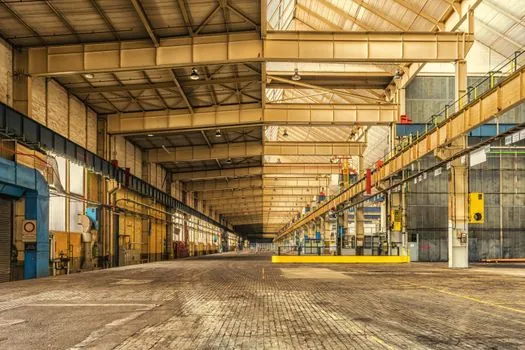
Steel fiber reinforcement lets warehouse slabs push joint spacing from the traditional 6 m × 6 m saw-cut grid to 10-15 m × 10-15 m, or eliminate contraction joints entirely (so-called "jointless" or "steel-fiber-only" slabs) when dosage exceeds 35 kg/m³ and slab geometry is reasonably isotropic [S1].
The mechanism is residual flexural strength: fibers bridge an open crack and carry tensile load across it, keeping service-load crack widths below 0.2-0.3 mm even when shrinkage tries to open the joint. The post-crack flexural strength ratio (Re,3 / fR1) is the design parameter tracked in European TR34 and the relevant fib Model Code 2010 sections for steel-fibrous warehouse floors, and most warehouse specs require Re,3 ≥ 1.0-1.5 MPa at 28 days.
Sawn control joints are still cast; the difference is that they remain tightly closed under traffic rather than spalling at the arris. For facilities with high-bay racking where joint maintenance drives long-term cost, the jointless approach is often the single largest lifecycle saving.
Exposure environment: galvanized, stainless, and brass-coated options
Galvanized steel fibers (zinc-coated) are specified for warehouses with intermittent moisture exposure, such as loading docks, wash-down areas, or ambient-humidity spaces without aggressive chloride exposure; the zinc layer buys roughly 0.5-1.0 mm of sacrificial corrosion margin before base steel is exposed [S1].
Stainless steel fibers (typically 304 or 316L grade) are required for cold-storage warehouses where the slab is on the warm side of an insulated envelope and condensation can carry chlorides from forklift traffic; the same logic applies to food-processing or pharmaceutical warehouses with routine wet cleaning. Compared with carbon steel, stainless fibers raise material cost by roughly 5-10x but eliminate the rust-staining and fiber-section loss that compromises service life in those environments.
Brass-coated micro fibers (typically 0.2 mm diameter, length 6-12 mm) sit in a different niche: thin-section precast panels, overlays, and concrete repair patches under 50 mm thick, where larger hooked fibers won't mix uniformly. They are not the right pick for bulk warehouse slabs, where the aspect-ratio and pull-out energy of the larger hooked fibers are needed.
Mix design interaction: water/cement ratio, aggregate, and slump
Keep water/cement ratio at 0.45-0.55 for steel-fiber warehouse slabs; lower W/C tightens the matrix and improves fiber bond, but going below 0.42 without a high-range water reducer produces harsh mixes that ball fibers and trap air. [S1]
Maximum aggregate size should be capped at 20 mm for slabs with 30-50 mm long fibers, otherwise fibers bend around coarse particles and lose orientation along the tension face. Slump at the point of placement should land at 100-150 mm with the fibers already in the mix; above 180 mm, fibers tend to settle and lose uniform distribution.
For slabs on slab-on-grade insulation (XPS or EPS plus vapor barrier) or on void-forming systems, the same dosage rules apply, but the residual flexural target should move to the upper end of the design band because the support stiffness below the slab is lower than for a concrete sub-base. The steel fiber selection for prefabricated construction article covers the related precast case where faster demold cycles and higher early strength are the drivers.
Standards, tests, and what to put in the spec
The governing material standard is ASTM A820 for the steel fiber itself (Types I-V by manufacturing process), with EN 14889-1 covering the European equivalent and the same hooked-end / cold-drawn geometry as the dominant specification. Performance is verified by residual flexural strength per EN 14651 (the beam test that yields fR1, fR2, fR3 values) or by ASTM C1609 for the U.S. version of the same load-deflection approach. [S1]
A warehouse-floor spec should call out, at minimum: ASTM A820 Type (cold-drawn, hooked-end, Type I), length and diameter (or aspect ratio band), minimum tensile strength of the wire (typically 1,100 MPa), dosage in kg/m³, target residual flexural strength class (e.g. "Re,3 ≥ 1.2 MPa per EN 14651" or equivalent C1609 residual), and concrete grade. Specifying fiber dosage alone without a residual-strength target leaves the door open for substitution with lower-performance fiber that happens to meet the kilogram count.
For cold-storage warehouse slabs the same dosage and aspect-ratio bands apply, but the fiber grade shifts to galvanized or stainless because the thermal gradient and condensation cycle drive corrosion that the galvanized or 316L coating is designed to absorb.
Failure modes and limits: where steel fiber alone is not enough
Steel fibers do not replace rebar in all cases. Column footings, pile caps, and localized punching-shear zones under racking post base plates still need conventional rebar cages or stud rails, because fiber-reinforced concrete's tensile capacity, while real, is far below what concentrated bearing or punching loads demand. [S1]
Freezer-room floors that cycle through freeze-thaw need air-entrained concrete (typically 4-6% total air content) in addition to the steel fiber; the fiber controls crack width, the air void system handles freeze-thaw internal pressure. Without both, surface scaling appears within the first 50-100 thermal cycles.
Slabs designed to carry vehicle wheel loads from Class 1-3 forklifts (per TR34 classifications) are within the steel-fiber-only envelope up to about 50-60 kg/m³ dosage; beyond that, you're paying for diminishing returns and a conventional rebar top mat becomes more cost-effective.
Track for the next 3-6 months: any revision to ASTM A820 covering tighter tolerances on hooked-end geometry (the current standard allows wide latitude in hook angle, which affects pull-out performance), and any update to EN 14651 dose-equivalence factors that change how residual-strength classes are assigned for warehouse-floor design.
Spec-level background on the components involved: steel fiber, carbon fiber, and concrete fiber.