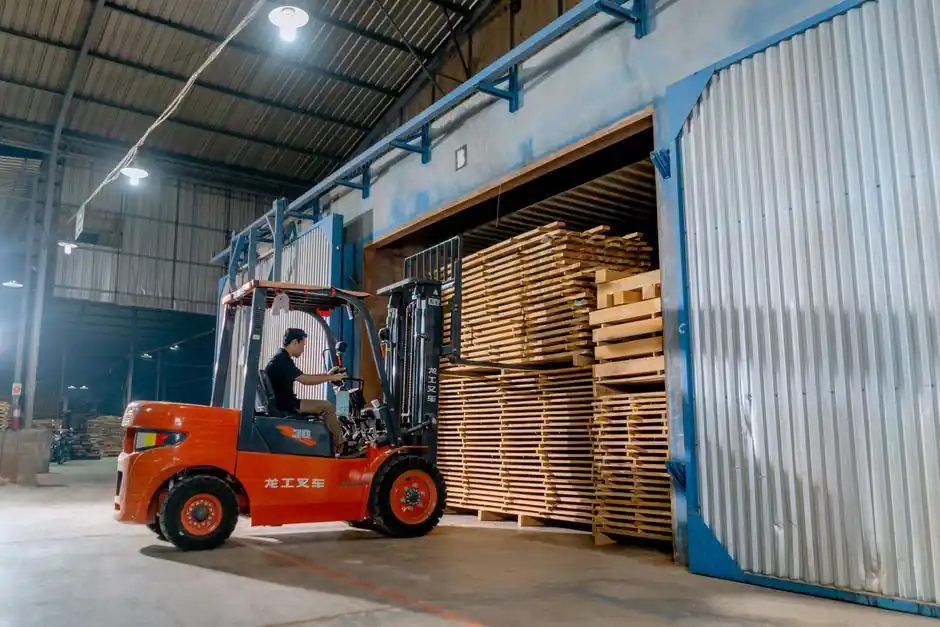
Steel fiber dosage in jointless cold storage floors typically runs 20-40 kg/m³ with hooked-end geometry, paired with chemical prestress to eliminate saw cuts and armored joints [S2].
Sub-zero chambers cycle between +15°C chilled rooms and -40°C blast freezers, exposing the slab to repeated thermal gradient and frost-heave loading; concrete mix, vapor barrier, and reinforcement must be specified together, not in isolation [S5][S7].
Why jointless, fiber-reinforced slabs dominate cold storage floors
A jointless cold storage floor is engineered with chemical prestress combined with steel fiber reinforcement so that no saw cuts and no armored joints interrupt the slab [S2]. Eliminating joints is not cosmetic: each saw cut is a path for moisture migration toward the insulation and subgrade, and in freezers the resulting ice lens lifts the slab.
Steel fibers raise post-cracking tensile capacity, distribute point loads from pallet jacks and forklifts, and keep crack widths tight when the slab contracts during chill-down [S3]. Warehouse operators moving from -25°C freezer aisles to +5°C dock transitions need fibers that survive thousands of thermal cycles without losing anchorage, which is why most cold-storage specifications lock in hook-end deformed fibers rather than straight collated alternatives.
Dosage, geometry, and steel grade: the three decision variables
For light-duty warehouse slabs, macro-synthetic or steel fiber reinforcement alone is often sufficient; for medium to heavy-duty cold storage floors, a hybrid approach (fiber combined with rebar or mesh) is the working baseline [S8]. A starting point is 20-25 kg/m³ for fiber-only, light-traffic slabs and 30-40 kg/m³ when forklifts with hard-wheel loading are present, with the project engineer validating by the residual flexural strength ratio (typically Rₑ,3 ≥ 0.30 for warehouse service per EN 14889-1).
Fiber geometry matters as much as dosage. Hooked-end fibers pull-out, not snap, which gives ductile post-crack behavior; the European classification EN 14889-1 groups steel fibers into Group I (cold-drawn wire) and Group II (cut sheet/hooked), with tensile strength commonly 1000-1200 MPa. A standard selection rubric looks like:
Light-duty chilled warehouse (+5 to +15°C), forklift ≤ 2.5 t, dry: carbon steel hooked-end, 20-25 kg/m³, no rebar [S8].<br>Medium-duty cold storage (-5 to -25°C), forklift 3-5 t, mixed traffic: carbon steel hooked-end, 30-35 kg/m³, plus rebar at column lines and dock doors [S3][S8].<br>Heavy-duty blast freezer (-25 to -40°C), racking ≥ 10 t point load, wash-down: stainless 304 or 316L fiber, 35-40 kg/m³, hybrid with rebar, jointless chemically prestressed [S2][S7].
For sub-zero service, stainless 304/316L fibers avoid the rust bleed that carbon steel leaves along cracks after the first thaw cycle; for a deeper look at cleanroom-grade fiber grades, the stainless 304/316L hooked-end fiber spec sheet breaks down low-shed and corrosion behavior side by side.
How the slab system fits with the cold room envelope
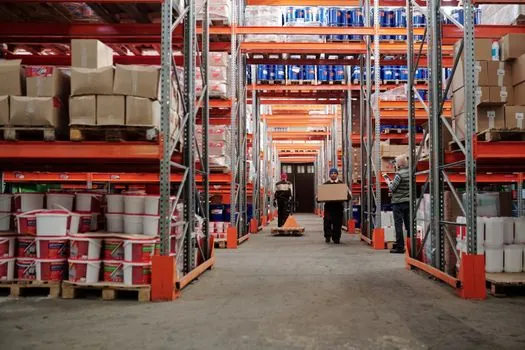
Insulation, vapor barrier, and steel-fiber slab work as one assembly. Closed-cell PUR, PIR, and XPS are the common panel cores; in Indian cold-chain field data, selecting the right insulation directly drives kWh/MT, and slab thermal mass interacts with the panel's U-value [S4][S5]. The selected fiber must therefore tolerate whatever temperature swing the panel envelope imposes on the slab surface, not just the steady-state chamber setpoint.
Stainless steel door and hardware choices follow the same thermal logic. Cold-room sliding doors such as the KIDE MF7 use stainless steel leaves with EN 1634-1 fire certification for 60 minutes, a benchmark that any hardware in the slab-to-door thermal break has to match [S1]. When the slab moves, the door frame moves, and the fiber choice controls how much the joint between them opens up. A 30-40 kg/m³ hooked-end mix keeps that joint within the tolerance the gasket can absorb.
Who steel fiber is for, and who should stay with rebar
Steel fiber is the right call when the floor must be jointless, when crack-width control under thermal cycling matters, and when slab thickness is constrained (typical 130-180 mm for freezer slabs vs. 200-250 mm for rebar-only). It is the wrong call when the slab carries very high concentrated loads from racking posts without a structural topping, or when a project has no experience with fiber-reinforced concrete placement and finishing; both situations are common failure points. [S2]
For procurement teams that are also evaluating the broader cold-room spec, looking at access control for warehouses and diesel generator set selection together avoids the trap of specifying the floor before the load profile and backup-power setpoint are fixed. Slab load, traffic pattern, and standby-power HVAC behavior are coupled; the fiber spec only matters once the upstream decisions are made.
Limits, failure modes, and quality signals to track
The main failure mode in a steel-fiber cold storage slab is not fiber pull-out but uncontrolled crack width at construction joints and penetrations, especially around floor drains, column penetrations, and door thresholds. Fiber controls cracks, it does not eliminate them; design must still call for a continuous vapor barrier under the slab, perimeter edge insulation, and an isolation joint at the wall, otherwise even a 40 kg/m³ mix will crack along a 1-2 mm opening that admits water vapor. [S1]
Three quality signals to require from the fiber supplier: EN 14889-1 Group I or Group II classification on the data sheet, Rₑ,3 residual flexural strength from a recognized beam test, and traceable chemistry (304/316L mill cert when stainless). A signal worth tracking over the next procurement cycle is whether suppliers publish combined chloride-migration and freeze-thaw test data on the same fiber lot, since EN 14889-1 alone does not cover the chloride ingress risk from de-icing salt tracked in on forklift wheels. The market has not standardized this combined test, so buyers who want a defensible cold-storage spec should request it explicitly and budget the lead time.
The underlying component specifications are covered under storage cage, storage handling, and storage rack.