
Carbon and structural steel plate is typically installed in the 0.5–200 mm thickness band, with hot-rolled Q235B/Q355B and ASTM A36/A572 Gr.50 covering most building, bridge and heavy-equipment work [S7]. Above ~100 mm, deliveries move to project-specific mill orders; below 4 mm, the product is classed as sheet rather than plate, which changes handling, welding procedure and price-per-tonne logic [S2].
Three real-world signals define the 2026 installation flow: stockholders such as Steel Plates & Sections (55+ years, UK) and SFI-Gray Steel (40+ years, Houston) deliver pre-cut, ISO 9001:2015-traced plate with flame-cutting, bending and rolling in-line [S1][S3]. For reference, see the steel plate types and classifications 2026 spec reference for the grade-vs-thickness matrix, and the steel plate encyclopedia entry for flat-product definitions.
Grade and Thickness Selection Before Plate Hits Site
Plate is graded by chemistry and mechanical properties, and 2026 procurement runs converge on a small set of workhorses: ASTM A36 and A572 Gr.50 for general structural and bridge work, EN 10025 S235JR for European builds, and Q235B/Q355B for Chinese-mill supply [S7]. Thickness drives everything downstream — under 4 mm is sheet, 4–20 mm is the common structural band, 20–100 mm is heavy plate, and 100–200 mm is project-mill territory often tied to boiler, pressure-vessel or shipbuilding plate specifications [S2][S7].
Match the grade to the load path, not to the price. Q235B is the cheapest hot-rolled commodity grade with a yield point around 235 MPa and is the default for non-critical fabrication; Q355B raises yield to ~355 MPa and is the structural default for bridge decks and heavy-equipment frames. ASTM A572 Gr.50 is the North-American structural equivalent of Q355B at 50 ksi minimum yield [S7]. For a deeper material-property baseline, the carbon steel and alloy steel encyclopedia entries cover the chemistry-vs-property logic. Stainless plate (304/304L/316L, 3–200 mm cold-rolled) is reserved for corrosion-loaded service such as heat exchangers and food-processing skids [S4][S5].
Pre-Install: Stockholder Services That Drive Site Risk
Modern steel plate installation begins at the stockholder, not on the scaffold. Flame-cutting, CNC profiling, bending, rolling, machining and welding-prep are listed as standard value-adds by both SPS (UK) and SFI-Gray (US), with ISO 9001:2015 quality systems and 40–55 year operating histories [S1][S3]. That means the lifting plan, weld-prep geometry and dimensional tolerance are largely fixed before the plate leaves the yard.
Spec the cut edge, not just the plate. Plasma and oxy-fuel flame cutting introduce a heat-affected zone (HAZ) of roughly 1–3 mm on the cut face; for fatigue-loaded or welded primary structure, specify machining or grinding back 1–2 mm to sound metal before fit-up. Stockholders also offer rolling to cylindrical or conical shells (typical minimum radius ≈ 10× thickness for hot-rolled carbon plate without edge-cracking risk) and press-brake bending to ≤ 3× thickness in the 6–25 mm band [S1][S3]. If your project is plate-fed rather than coil-fed, cross-check handling rules against the stainless steel coil manufacturing five-stage process map — the same handling philosophy applies at the receiving end.
Lift-In, Fit-Up and Welding Sequence on Site

Plate lift-in follows four hard rules in 2026 site practice: lift points sized to plate weight (carbon steel ≈ 7.85 t/m³ at nominal size, so a 20 mm × 2 m × 6 m plate weighs ~1.88 t), spreader bars used for plates over ~2 t to keep sling angles below 60°, soft slings specified for stainless or hot-dip galvanized plate to prevent coating damage, and tagged lifting lugs pre-cut by the stockholder when the plate is profiled [S1][S3]. Welding-prep geometry (typically a 30° included V or 45° double-V above 25 mm) is best cut at the flame-cutting station rather than gouged on site.
Welding procedure is grade-gated. Q235B and ASTM A36 are forgiving — rutile-cellulosic E6013 electrodes or GMAW with ER70S work for non-critical joints. Q355B and A572 Gr.50 require low-hydrogen consumables (e.g. E7018 or ER70S-7 with PWHT specified on thicker sections) to avoid hydrogen-assisted cracking in the HAZ. For tool-steel or high-carbon plate used in dies and wear surfaces, follow the tool and die steel installation grade gates sequencing — heat-treat windows and hardness targets differ from structural plate.
Comparison: Common 2026 Plate Grades on Four Decision Criteria
On a four-criterion field selection — yield strength, typical thickness supply range, cost index (1 = cheapest commodity), and primary application — Q235B, Q355B, ASTM A572 Gr.50 and 304 stainless line up as follows. Q235B: ~235 MPa yield, 0.5–200 mm supply, cost index 1.0, general fabrication and non-critical structure. Q355B: ~355 MPa yield, 0.5–200 mm supply, cost index ~1.1, bridges, heavy-equipment frames, building columns [S7]. ASTM A572 Gr.50: 50 ksi (≈345 MPa) yield, 6–100 mm supply, cost index ~1.15, North-American structural and bridge builds [S7]. 304 stainless (304L low-carbon variant): ~215 MPa yield, 3–200 mm cold-rolled supply [S5], cost index ~3.5–4.0, corrosion-loaded service such as heat exchangers and food-grade skids [S4][S5].
The cost spread between commodity carbon plate and stainless plate is roughly 3.5–4×, so the right first question is always: does the service environment actually require alloy content, or is a coated carbon plate (galvanized, painted, or intumescent) acceptable? Galvanized hot-rolled Q195/Q235 listed on 2026 sourcing platforms [S2] sits at cost index ~1.05 and closes most of the corrosion gap for non-immersion service.
Limits, Failure Modes and When Plate Is the Wrong Product
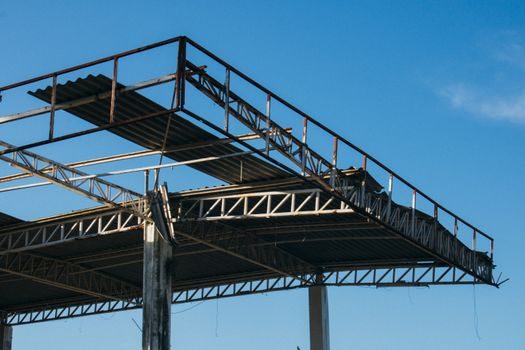
Steel plate fails in three predictable ways on install: distortion from uneven heat input during flame cutting or welding, lamellar tearing in T-joint welds on thick plate with through-thickness strain, and HAZ cracking in higher-carbon grades when hydrogen is not controlled. Mitigation is procedural — balance welds around the plate neutral axis, specify through-thickness property steel (Z-grade, e.g. S355J2+N with Z35) for primary T-joints over 25 mm, and use low-hydrogen consumables plus preheat on Q355B and A572 above ~20 mm [S7].
Plate is the wrong product when the application needs formability beyond ~3× thickness tight radius, or when the part is small and high-volume — that is the sheet-stamping domain. Plate is also the wrong product for any application needing tight chemical control at very thin gauges (under ~3 mm) where cold-rolled sheet or coil is dimensionally tighter. If your scope is mesh or wire rather than plate, see the welded steel mesh strength, limits and spec gates reference. For wire-rod payoff systems feeding downstream drawing or forming, the wire rod installation field guide covers coil-end handling.
Sourcing and Standards Audit Before Order Release
Every 2026 plate order should pass four audit gates before release: mill test certificate (MTC) traceable to heat number and compliant with EN 10204 3.1, dimensional certificate against ASTM A6 / A20 (or EN 10029 for European supply), ISO 9001:2015 supplier certification held by the stockholder or mill [S1][S3][S6], and — for boiler, pressure-vessel or shipbuilding plate — the relevant ASME, EN 10028 or classification-society stamp pre-applied at the mill rather than retrofitted at site. Chinese mills exporting plate in 2026 (Henan Anson, Liaocheng Mingxing) all list ISO 9001 as the baseline system, with ISO 14001 and ISO 45001 layered on for the larger volume shippers [S6][S7].
Two trackable signals to watch in the next procurement cycle: MOQ thresholds on the B2B platforms (Liaocheng Mingxing lists 5-tonne MOQ at US$451–521/tonne for Q235B/Q355B/A36/A572 plate in the 0.5–200 mm band [S7]) and the rise of project-mill orders above 100 mm thickness, where stockholders increasingly require 4–8 week mill lead-times rather than ex-stock shipment. Both will tighten the 2026 install window for heavy-plate work and push more pre-cut, pre-cambered plate onto sites.