Warehouse plate buyers in 2026 are sizing on four decision gates: ASTM spec, thickness, surface protection, and floor-plate pattern, with ASTM A36, A572, A516, and A786 dominating the shortlist [S4].
Stockholders across the U.S., U.K., and China are reporting full plate, sheet, and coil inventories in mild, high-yield, and stainless grades with in-house flame, plasma, and laser cutting [S1][S7]. The shift since 2024 has been buyers moving from generic "structural plate" calls to grade-specific RFQs tied to racking UDL, forklift axle load, and roof-deck span.
Grade shortlist: which ASTM plate goes where
ASTM A36 plate remains the default for warehouse columns, base plates, gussets, and mezzanine framing because of its 36 ksi minimum yield and broad availability in thicknesses from 3/16 in. to 12 in. across U.S. service centers [S4]. For primary racking and roof beams where a higher strength-to-weight ratio reduces tonnage, ASTM A572 Grade 50 (50 ksi yield) is the common upgrade, and it welds with the same procedures as A36 in most WPS qualified to AWS D1.1.
For ground-level slabs, dock plates, and stair treads, ASTM A786 floor plate (the standard checker/tread plate) is the spec to call out, since it combines a raised pattern for slip resistance with a base bar that meets the same mechanical requirements as the underlying hot-rolled sheet [S4]. Where the plate sees forklift or pallet-jack abuse, abrasion-resistant grades such as AR400 are sometimes substituted for A36, but only after a cost check, because AR400 is roughly 2-3x the price per pound of A36 and is not generally welded without procedure qualification.
Pressure-vessel or boiler-fed humidification lines inside a warehouse occasionally pull ASTM A516 Grade 70, but that is a niche call and outside the standard warehouse frame package [S4]. See the steel plate reference for grade family context and the carbon steel entry for the metallurgical baseline that A36 and A572 share.
Thickness and racking load: the UDL-to-gauge mapping
Pallet-rack UDL is the driver most warehouse plate buyers underestimate. A standard selective rack with two beam pairs per bay, 96 in. beam length, and a 40,000 lb. bay load typically asks for 3/16 in. (0.1875 in., ~4.76 mm) base-plate shims and 1/4 in. to 3/8 in. column base plates, while a 60,000 lb. bay pushes to 1/2 in. base plates with four 5/8 in. anchor rods. [S4]
Roof-deck bearing plates under bar joists run 1/4 in. to 5/16 in. for spans under 30 ft., stepping to 3/8 in. once the joist reaction exceeds 10 kips. Stockholders routinely cut these to sketch from 1/4 in., 5/16 in., 3/8 in., 1/2 in., 3/4 in., and 1 in. A36 plate, with tolerances per ASTM A6 [S1][S4].
Floor plate for forklift aisles is most commonly 1/4 in. (6.35 mm) or 5/16 in. (7.94 mm) A786 with the standard raised pattern; going thicker than 3/8 in. is rarely justified by static load alone and usually signals the specifier has confused floor plate with wear plate [S4].
Surface protection: galvanize, paint, or bare

Galvanized sheet and plate (G60, G90, or hot-dip per ASTM A123/A653) is the default for outdoor-exposed warehouse cladding components, dock hardware, and rooftop equipment rails because the zinc coating delivers a 50+ year service life in non-coastal atmospheres [S4]. Inside a dry warehouse, however, a standard alkyd or epoxy primer over blast-cleaned A36 is usually sufficient and saves roughly 30-40% on material cost versus galvanized equivalents.
For food-grade, pharmaceutical, or cold-storage warehouses with high humidity or wash-down cycles, stainless steel plate (304 or 316) is occasionally specified for kick plates, column guards, and wall liners, with 304 handling most interior cases and 316 reserved for chloride exposure from road salt or coastal air [S9]. Stainless plate runs roughly 4-6x the price of A36 per pound, so the call should be driven by a documented corrosion class, not a generic "food grade" label.
See the stainless steel and alloy steel entries for the metallurgical distinctions behind these price jumps, and the silicon steel reference for cases where transformer-grade electrical plate leaks into a warehouse electrical-room spec.
Floor plate vs. bar grating vs. concrete: traffic-zone decision
Three options dominate warehouse traffic zones: ASTM A786 checker plate, hot-dip galvanized bar grating (typically 1-1/4 in. x 3/16 in. bearing bars at 19-W-4), and reinforced concrete. A786 plate is the right pick where the floor must be washable, skid-resistant, and able to carry small-wheeled carts without visible deflection. Bar grating wins where drainage, ventilation, or removal-for-access matters (mezzanine catwalks, equipment platforms). Concrete wins on raw cost for a slab-on-grade but loses the moment a forklift starts dropping pallets, because repair is structural. [S4]
For mezzanines carrying office loads (100 psf), 1-1/2 in. x 3/16 in. grating on 6 ft. spans is a common layout, while 1-1/4 in. x 3/16 in. grating handles 50-75 psf storage loads. Plate mezzanines run 1/4 in. A36 with stiffeners on 24 in. centers for the same duty class. Stockholders keep both in stock and will cut to drawing with a 1-2 day lead time on standard widths [S1][S7].
Processing and lead time: cut-to-sketch vs. stock sizes
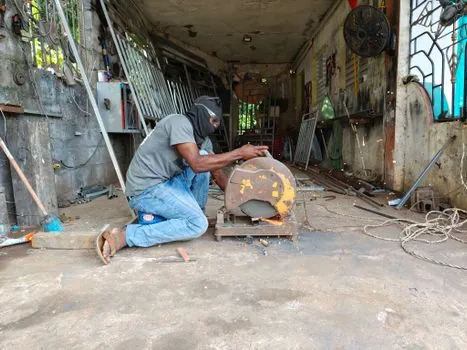
Houston-based plate processors like SFI-Gray run flame-cutting on plate up to 12 in. thick with in-house machining, rolling, and forming for oil-and-gas and heavy-equipment customers, and they stock a wide range of carbon and alloy grades [S1]. U.K. stockholders (SPS, 55+ years in the trade) and Chinese mills (Yusheng, a HBIS contractor with port-city stock warehouses) offer similar cut-to-size services on mild, stainless, and high-yield plate, with third-party inspection (TUV, BV, SGS) available for export orders [S6][S7][S8].
Standard lead time for cut-to-size A36 in 2026 is 3-5 business days from a U.S. service center and 7-10 days from a Chinese mill for FOB shipments, with galvanized G90 coil and sheet typically stocked for same-day pickup [S1][S4][S6]. A786 floor plate and stainless plate run longer (2-3 weeks) when not a stock item because the pattern mill or coil line is a separate production path.
Limits and common failure modes
Specifying AR400 or AR500 for the entire warehouse frame is a recurring over-spec, because these grades do not bend or weld as easily as A36 and they can crack at the heat-affected zone without a qualified WPS. Similarly, ordering "stainless plate" without a corrosion class usually defaults to 304, which is wrong for chloride-rich environments where 316L or a duplex grade is the documented pick. [S4]
Floor plate thinner than 1/4 in. on forklift aisles will deform under repeated pallet drops and should be rejected at the submittal stage, and galvanized plate stored in wet conditions will suffer white rust (zinc hydroxide) within weeks if not dried or passivated. These are not paperwork failures; they are field failures with measurable repair cost.
Sourcing checklist and trackable signals
Buyers should anchor each warehouse plate order to four documents: the ASTM spec (A36, A572, A786, A516, etc.), the ASTM A6 tolerance table for thickness and flatness, the AWS D1.1 welding procedure for any welded joint, and the coating standard (ASTM A123 for hot-dip galvanize, SSPC-PA1 for paint application) [S4]. Trackable signals for the next procurement cycle: ASTM A6 revision status, the spread between A36 and AR400 surcharges, and the availability of 1/4 in. and 5/16 in. A786 in standard 48 in. x 96 in. and 60 in. x 120 in. sheet sizes from regional stockholders.
For related spec work outside the frame, see Steel Plate Selection Gates for School Buildings and Vocational Workshops for lighter-duty building variants, and revisit procurement when Q4 2026 service-center inventory reports land.