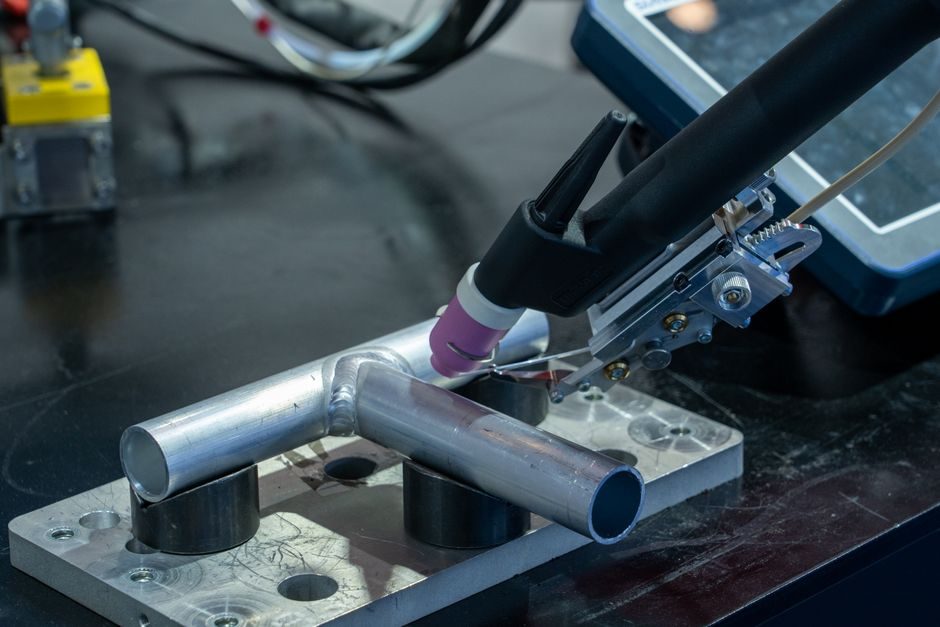
Steel sections — H-beam, I-beam, channel, equal-angle, hollow structural section (HSS) — are sold by mass per metre and sized by section modulus, not by wall thickness; steel pipes are sold by outside diameter × wall thickness and rated by schedule, a difference that decides whether a profile is a beam or a pressure vessel.
The clearest 2026 demarcation: pick a steel section when the job is load-bearing framing, machine bases, conveyor supports or tower internals; pick a pipe when the job is fluid/gas transport, heat-exchange tubing, OCTG casing, piling under axial load, or any application where you need a closed, leak-tight cross-section. The closed hollow geometry of pipe gives near-equal moment of inertia on both axes, which is why structural hollow sections (SHS/RHS/CHS) are routinely cross-shopped against H-beams for torsion-sensitive frames.
Geometry, Metric and How Each Product is Ordered
Steel sections are ordered by section name plus length: HEB 200 × 6.000 m, UPN 120 × 6 m, L 50 × 50 × 5 × 6 m, SHS 100 × 100 × 5 mm. The dimensional datum is section depth × flange/web thickness in millimetres; mass per metre (kg/m) is a derived property listed on the mill cert. [S1]
Steel pipe is ordered by outside diameter × wall thickness × length, with schedule (SCH 40, SCH 80, SCH 160, XXS) the legacy shortcut for wall thickness. A typical process line reads "OD 168.3 mm × WT 7.11 mm × 6 m, SCH 40, SMLS, API 5L X65" — four numbers carry the order [S4][S6].
For reference, structural hollow sections made to EN 10210 use a 1% ovalisation tolerance on OD, with corner radius 1.5×–2× wall for hot-finished and 1.0×–1.5× for cold-formed; the corner radius is what kills interchangeability with a pipe of the same OD, because pipe is round and HSS has four corner radii of the same magnitude.
Standards and the Material Stack in Front of You
Structural hot-rolled sections follow EN 10025 (S275JR/J0/J2, S355JR/J0/J2/K2), EN 10034 (H-beam tolerances), EN 10056 (equal/unequal angle) and ASTM A36 / A572 / A992 on the US side. Hollow sections pick up EN 10210 (hot-finished) or EN 10219 (cold-formed) plus CSA G40.20/G40.21 in Canada. [S2]
Steel pipe is a separate standards universe: API 5L for linepipe, API 5CT for casing/tubing, ASTM A106/A53 for high- and standard-temperature service, ASTM A333 for low-temperature, ASTM A335 (P11, P22, P91) for alloy pipe, and EN 10216 / 10217 on the European side. Material grade A335 P22 — a 2.25Cr-1Mo alloy — is the boiler-industry default for 540–580 °C headers [S5].
Manufacturer quality stacks in 2026 are converging on three ISO certificates: ISO 9001 (quality), ISO 14001 (environmental) and ISO 45001 (occupational H&S). Finego Steel lists the triple ISO 9001/14001/45001 stack on its corporate profile alongside OCTG, welded, seamless and coated pipe plus a steel-section business line — the same triple-stack pattern shows up across the major Chinese exporters [S4].
Load Behaviour: Bending, Torsion, Pressure
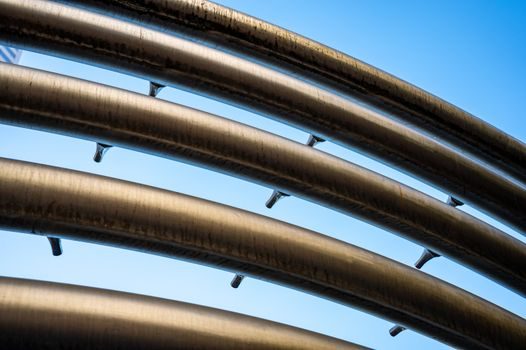
Open sections (H-beam, I-beam, channel) win on bending stiffness per kilogram along the strong axis because material is concentrated at the flanges, 100–250 mm from the neutral axis. The same shape is weak on the weak axis and has very low torsional constant J — a long span under lateral load or a torsion-sensitive frame wants a closed section. [S3]
A 100 × 100 × 5 mm SHS has a torsional constant roughly 200× that of a 100 mm HEA 100 beam at the same linear mass, and a near-symmetric second moment of area on both axes. That is why architects, bridge detailers and machine-tool builders move from H-beam to SHS/RHS/CHS the moment torsion or bi-axial bending shows up.
Pipe under internal pressure is rated by the Barlow formula P = 2·S·t / D, where S is allowable hoop stress. Doubling wall thickness doubles pressure rating; doubling diameter halves it. A SCH 40, 6-inch (OD 168.3 mm, WT 7.11 mm) A106-B pipe at 240 MPa allowable stress calculates to about 20.3 MPa hoop rating — the actual MAWP is derated by joint efficiency, corrosion allowance and temperature de-rating per ASME B31.3.
Selection Criteria: Frame vs Pressure vs Combined Duty
Use steel section (H/I/U/L) for: building columns and beams longer than 4 m, conveyor stringers, crane rails, gantry supports, mezzanine framing, sign gantries, transmission towers. The trade-off: open sections corrode at the inside of the web, need gusset/cleat connections that are labour-heavy, and cannot carry internal pressure. [S4]
Use steel pipe for: process piping, water/gas transmission, fire-water mains, boiler tubes, heat-exchanger tubes, OCTG casing, structural hollow sections when torsion is dominant, and any application where the closed cross-section doubles as a pressure or leak boundary. Pipe joints are welded, flanged, threaded (NPT/BSP) or grooved — fewer labour hours per metre than the cleat-and-bolt section connection [S1][S2].
Use coated pipe for: buried water/gas where the coating (3LPE, FBE, bitumen, cement-mortar lining) is the corrosion barrier; the most common 2026 specification is 3LPE outside + FBE inside for water mains, and FBE-only for oil & gas linepipe [S4]. Use structural steel section when fire rating, ease of site bolting and open inspection outweigh these concerns.
Manufacturing Routes and 2026 Supply Map
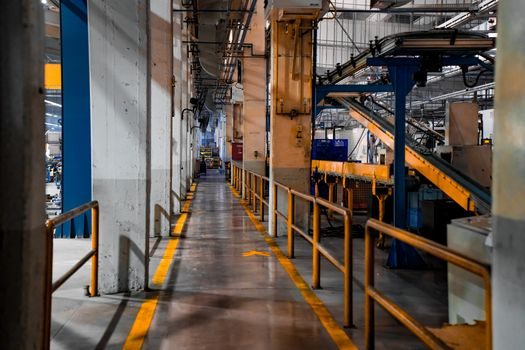
H-beams are hot-rolled from a continuous caster bloom through a universal beam mill; HSS is either hot-finished (EN 10210, formed from round then heated and reduced through a sizing mill) or cold-formed (EN 10219, roll-formed from strip and seam-welded). Section mills in 2026 are concentrated in China (Tangshan, Maanshan, Tangshan/Handan combined), India (JSW, SAIL) and Turkey (Tosyalı, İskenderun). [S5]
Steel pipe is split by forming route: seamless (SMLS) made by hot-piercing a billet and elongating over a mandrel (Mannesmann, plug mill, mandrel mill) for high-pressure / high-temperature service; welded (ERW/HFI, LSAW, SSAW, DSAW) made by forming strip/plate and seam-welding for linepipe, structural and water service. ERW covers up to ~24-inch OD, LSAW 24–48 inch, SSAW up to ~100 inch [S6].
For sourcing, the 2026 landscape is anchored by Chinese mills with triple-ISO certification: Hebei Province Dianli Pipe Fitting (Cangzhou), Liaocheng Hongqi Steel Pipe (Shandong), Finego Steel, Hebei Zhongran Pipefitting, CHN Steel Pipe & Tube, and Jinan Sino Rise — each lists pipe + section cross-selling plus pipe fittings [S2][S4][S5][S6]. Indian mills (Steel Pipes & Tubes India) cover stainless / carbon / alloy / duplex / high-nickel / Inconel / Monel / Hastelloy / Alloy 20 / copper-nickel pipe and tube, with sheet, plate, coil, round bar and rod as cross-sell [S1]. Taiwanese builders of pipe-making equipment (Jang Wuel Steel Machinery) supply the forming/welding lines that feed both pipe and tube output globally [S3].
Limits, Failure Modes and Cross-Shopping Gotchas
Open sections fail first by lateral-torsional buckling in long unbraced spans; pipe fails first by hoop stress at the thinnest point of a corroded or eroded zone. A pipe used in a structural framing role is often more conservative than a hot-rolled section because pipe's mass per metre for the same bending stiffness is higher — that is the cost of closed geometry and uniform torsion. [S6]
Common 2026 specification errors worth flagging: (1) ordering a "structural tube" and getting cold-formed EN 10219 when hot-finished EN 10210 was specified for the temperature regime; (2) sizing a pipe by nominal bore (DN 100 = OD 114.3 mm) and forgetting schedule derating, ending up with a wall 1.5 mm thinner than the calculation assumed; (3) cross-shopping a "SHS 100 × 100 × 5" against a "CHS 114.3 × 5" — different section moduli, different corner-radius behaviour, different mill routes.
For process engineers, the cross-shop rule is: H-beam ↔ SHS/RHS only when bending is dominant, never when internal pressure is in scope; pipe ↔ pressure-vessel tube only when the design code (ASME B31.3 vs VIII) is the same on both sides. Heat-exchanger tubes (A179, A192, A213) are not interchangeable with linepipe (A106, API 5L) even at the same OD × wall, because dimensional and surface-finish tolerances differ by an order of magnitude.
Decision Snapshot for Buyers and Engineers
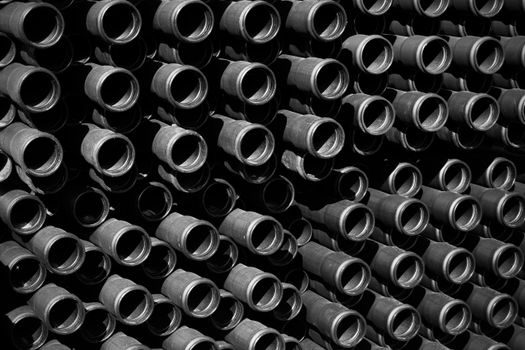
Decision rule of thumb: if the part is a beam, column or frame member, order a steel section by section name + length + steel grade (e.g. HEB 200 S355JR, 12 m); if the part is a pipe, order by OD × wall × length + schedule + material code (e.g. OD 168.3 × 7.11 mm SCH 40 SMLS API 5L X65 PSL2, 12 m). The two order formats do not mix; the mill cert format does not mix; and the standards map (EN 10025/EN 10210 vs API 5L/ASTM A106) does not mix. [S1]
For a 2026 procurement run, the practical gate sequence is: (1) confirm the design code (structural Eurocode 3 vs ASME B31.3); (2) fix the standards stack (EN 10025 + EN 10210 for sections, API 5L + ASTM A106 for pipe); (3) verify the manufacturer's ISO 9001/14001/45001 triple certification; (4) confirm mill test cert to EN 10204 3.1 or 3.2; (5) for OCTG, confirm API 5CT monogram on the product, not just the certificate [S4].
Track these signals over the next 1–2 quarters: Chinese mill export pricing for H-beam S355JR and SMLS API 5L X65 (rolled into 2026 tender lists), the spread between ERW and SMLS linepipe per tonne, and any new coating line announcements (3LPE/FBE capacity) from the Hebei/Shandong cluster. If you are spec'ing new conveyor or process-pipe runs in parallel, it is worth running both the steel section and seamless steel pipe tonnage past the same supplier for freight consolidation — the suppliers above all quote both lines [S2].
For related coverage, see Top Rare Earth Companies 2026: Producers, Processors and Sourcing Map.