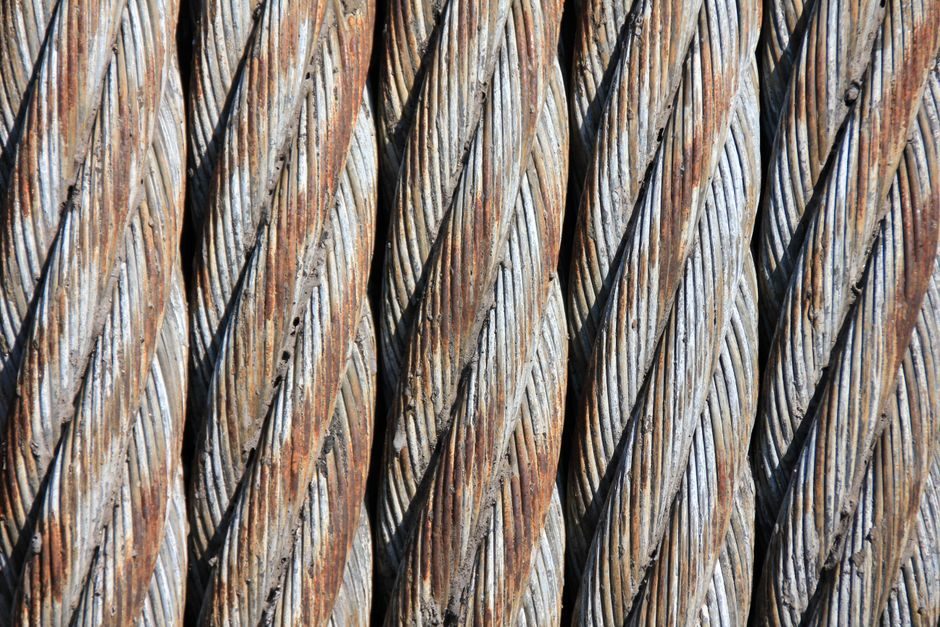
Steel strand — typically 7-wire prestressing strand to ASTM A416 Grade 270 — provides a minimum tensile strength of 270 ksi (1860 MPa) and a minimum yield strength of 243 ksi (1675 MPa) at 1% extension, making it the workhorse tension member for prestressing strand applications in bridge girders, post-tensioned slabs and ground anchors [S3][S6].
Each 7-wire unit is helically formed: six outer wires spun around a single straight king wire, with common diameters of 9.53 mm (3/8 in), 12.7 mm (1/2 in), 15.24 mm (0.6 in) and 17.8 mm (0.7 in); the larger sizes dominate post-tensioned bridge and high-rise slab work because they pack more breaking force per duct.
Where Steel Strand Wins: Mechanical and Construction Advantages
High tensile capacity per unit cross-section is the headline benefit. A single 15.24 mm Grade 270 strand carries a guaranteed breaking force of about 260.7 kN (58,600 lbf) at minimum tensile, with a typical strand cross-sectional area of 140 mm² (0.217 in²) — a strength-to-weight ratio that bare rebar cannot match in the same footprint [S3].
Factory-controlled cold-drawing of high-carbon steel wire to produce the seven-wire assembly gives consistent stress-strain behaviour, low relaxation under sustained load, and predictable elongation at break of roughly 5–7% on Grade 270 material, which simplifies elongation checks during multi-strand stressing on site.
Construction efficiency also improves: bundled strands can be stressed simultaneously in a multi-strand jack, ducts are smaller than equivalent rebar cages, and partial prestressing schemes — combining tensioned strand with untensioned rebar — cut the quantity of costlier high-tensile steel while still controlling crack widths under service load [S3].
Where Steel Strand Costs You: Corrosion, Relaxation and Handling
Corrosion is the single biggest liability for stress-relieved and low-relaxation steel strand. The small inter-wire gaps in the 7-wire geometry trap moisture and chloride-laden runoff, and once pitting starts on the outer wires, section loss propagates fast under sustained tensile load; galvanising, epoxy coating (ASTM A882) or grease-and-sheath (bonded or unbonded) systems all add cost and require careful inspection at anchorages. [S3]
Handling and stressing also carry real cost. Strand must be cut with abrasive wheels rather than sheared (to avoid birdcoking the lay), stored off the ground on timbers, and pulled through HDPE ducts using bullet-nose tips; multi-strand jacks, anchor wedges, trumpets and grout ports add up, and the crew needs certified stressing operatives — these line items routinely push the in-place price of a post-tensioned slab well above an equivalent rebar solution [S3][S6].
Selection Criteria: Grade, Diameter, Coating and Application Fit
Specifying steel strand starts with ASTM A416 Grade 270 vs Grade 250 (the latter at 250 ksi / 1725 MPa minimum tensile, used in older pretensioned products and some ground-anchor jobs) — both ship as stress-relieved or low-relaxation variants, and the relaxation class is non-negotiable for post-tensioned bridges where long-term losses accumulate. [S3]
Coating selection is the second decision. Uncoated black strand suits pretensioned precast where the concrete cover and alkaline grout provide corrosion protection; epoxy-coated strand (ASTM A882) is specified in aggressive chloride environments such as parking decks and marine piers; galvanised strand is reserved for special groutless or unbonded tendons and external PT systems; and greased-and-sheathed (bonded/unbonded) strand is the default for unbonded post-tensioned slabs and ground anchors [S3].
Diameter, duct fill, and anchorage compatibility round out the spec. Most multi-strand anchorages for 12.7 mm and 15.24 mm strand are interchangeable across wedge manufacturers, but 17.8 mm and larger require heavier anchor plates and jacks, which limits them to large bridge and heavy-civil work. For deeper background on the alloy steel feedstock and the cold-drawing route, see the dedicated entry.
Comparison: Steel Strand vs Rebar vs Wire Rope on the Same Load
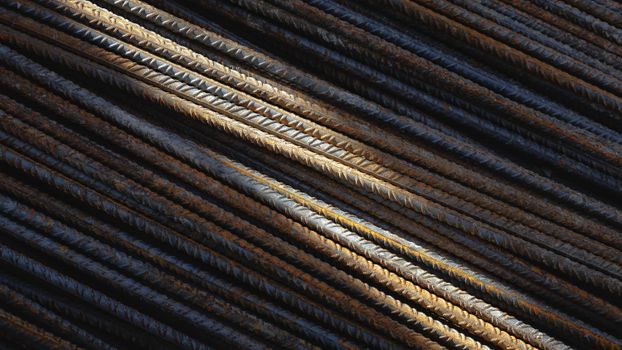
For a given tensile load, the three options line up very differently. A 15.24 mm Grade 270 strand at 260.7 kN minimum breaking force occupies roughly 140 mm² of section, weighs about 1.10 kg/m, and needs a multi-strand jack to anchor; an equivalent #20 (20 mm, Grade 420 / 60 ksi) rebar delivers about 211 kN yield (~261 kN ultimate) at 314 mm², 2.47 kg/m, and anchors with nuts or headed bars without stressing hardware [S3][S6].
Wire rope (6×19 or 6×37 construction) reaches higher breaking forces at larger diameters but stretches 1.5–2% under working load, has no defined yield point, and is not stress-relieved for sustained tension — fine for crane hoist and guy cables, but it is not a substitute for prestressing strand in pretensioned concrete [S3].
On corrosion performance, bare rebar and bare strand behave similarly in chloride exposure, but strand loses section faster at the inter-wire gaps; epoxy-coated rebar and epoxy-coated strand are the most common corrosion-mitigated pair, while galvanised strand has limited long-term data in high-chloride bridge substructure service.
Failure Modes and Limits the Spec Must Catch

The dominant failure modes are wire breaks at anchorages, corrosion-induced section loss, overstressing during jack calibration drift, and duct grout voids that leave steel unprotected. Each maps to a specific spec line: wedge slip and wire breaks are caught by 25% overstressing with hold periods during stressing; corrosion is controlled by minimum concrete cover, grout bleed tests, and duct pressure-grouting records; overstressing is bounded by ram-area calibration and lock-off force checks; grout voids are caught by post-grout inspection of bleed water and pressure records [S3].
Wedge slip during lock-off is the most common site defect; typical lock-off force is 70% of GUTS (guaranteed ultimate tensile strength) with a final pull-in allowance of about 6 mm at the anchor, and any reading outside that window means re-stress the tendon. For practical stressing windows and acceptance limits on a live job, the Steel Strand Installation Guide lays out the full sequence.
Standards and Sourcing Reference
ASTM A416/A416M covers the 7-wire stress-relieved and low-relaxation strand itself, with Grade 270 (1860 MPa) the current US default; ASTM A882/A882M covers epoxy-coated strand; ASTM A779 covers indented strand for special anchorage; ISO 6934-4 and EN 10138-3 mirror the requirements outside the US market and are usually the documents called out on European bridge and wind-turbine-tower projects. For comparison data on the broader carbon steel feed used to draw the wires, the grade map is useful background. [S3]
On the corrosion-resistant side, stainless steel prestressing strand exists in EN 10138-3 as a special class, but its per-tonne cost is roughly 6–8 times that of black Grade 270, so it stays confined to signature bridges and external PT where replaceability is impractical. For tendon-duct materials and HDPE duct sourcing notes, the carbon steel plate selection brief provides a useful adjacent read on plate certification traceability for the anchor plate hardware.
Stressing hardware — wedges, anchor heads, trumpets, grout ports — is a matched system from the strand supplier; mixing wedges from one supplier with anchor heads from another is the most common route to premature wedge slip and is rejected at hold-point inspection.
Verifiable next nodes for spec auditors: pull the mill test certificate (ASTM A416 minimum tensile, minimum elongation, 1000-hour relaxation) and the epoxy-coating thickness log (ASTM A882 minimum 0.4 mm) at goods-in; require a pre-stressing method statement naming the jack calibration date and target lock-off force; and track the post-tensioning grout pressure and bleed records on the same QA dossier.