
A four-strap pallet requires per-band break strength equal to the total pallet weight multiplied by a 1.5 safety factor and divided by 4, per the standard industry formula: (Pallet Weight × 1.5) ÷ Number of Straps = tensile requirement per band [S2][S3].
The linear footage per loop depends on the pallet footprint and the material's stretch behaviour, not on the band width alone. A standard GMA-style 48×40-inch pallet needs roughly 14 to 22 ft of strap per loop across PP, PET, and steel grades, which puts a four-strap load at 56 to 88 ft of band before you add overlap, buckle/seal waste, and tensioning take-up. Under-specifying that footage or rating is what collapses loads in transit: an OSHA report (ID 201353620) cites a fatal incident where 2,205-lb bags held by only two 0.5-inch plastic bands, stacked three high, failed on the warehouse floor [S1].
Why Four Straps Is a Common Floor for Heavier Loads
Four perpendicular straps is the configuration most sources converge on for loads above 1,500 lb or for any pallet exceeding roughly 60 inches in height, because four bands spread dynamic braking and corner-stressing forces across more contact points and lower per-strap tension [S1][S3]. The SJF rule-of-thumb example uses three straps for a 1,100-lb maximum (550 lb minimum tensile per band) [S2], while Industrial Packaging documents a real 2,000-lb cradled load that is "easily secured with four straps" [S5]. APG's guide generalises the same range as 2–4 straps positioned perpendicular to the load direction, with 1/2" × 0.020" polypropylene rated at 1,220 lb break as a reference point [S3]. On taller, compressible, or multi-tier loads, dropping back to two bands is a documented failure mode, not a cost saver.
Calculating Per-Band Tensile Strength With Four Straps
The base formula is (Load Weight × 1.5) ÷ Number of Straps, with a 1.5× safety multiplier for static palletized freight and 2× or higher for flatbed, vibration-prone, or shifting cargo [S2][S3]. Worked examples: a 1,500-lb pallet with 4 straps needs (1,500 × 1.5) ÷ 4 = 562 lb minimum break per band; a 2,000-lb pallet needs 750 lb per band; a 3,000-lb pallet needs 1,125 lb per band. Working Load Limit (WLL) is one-third of break strength, so a 1,000-lb-break strap has roughly 333 lb WLL, and this is what FMCSA cargo-securement rules refer to when they require the aggregate WLL of securement devices to equal at least half the cargo weight [S3][S4]. When the strap also acts as the primary package (unitizing, bundling), APG escalates the multiplier to 5×, which can demand 1,875 lb per band on a 1,500-lb load [S3].
Material-by-Material Linear Footage Per Loop on a 48×40 Pallet
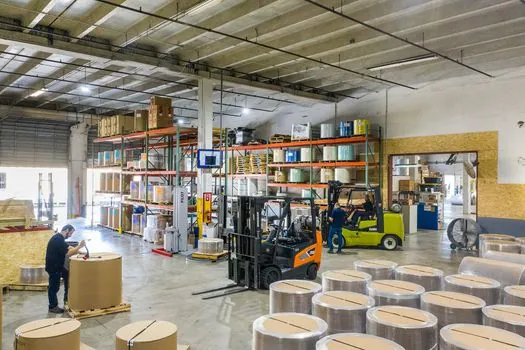
Polypropylene (PP) elongates 14–20% in standard grades and up to ~25% in hand-grade applications, with 10% recovery after application, and PP loses over 50% of its original tension in the first 24 hours, so PP loops need 18–22 ft of strap and are realistically only suited to lighter four-strap loads under ~1,500 lb [S1][S4][S5]. Polyester (PET) has lower elongation and far better tension retention, so a PET loop on the same 48×40 pallet runs 15–18 ft and is the default for most industrial four-strap applications in the 1,500–3,000 lb band [S4]. Steel has minimal stretch, so a steel loop measures close to the geometric perimeter at 14–16 ft, and steel is required for some railroad, heavy-coil, and open-top trailer applications where the dynamic load is extreme [S2][S4]. A 1/2" × 0.020" PP strap rated at 1,220 lb break weighs about 0.83 lb per 100 ft; a comparable PET strap at the same break weight is roughly 30–40% lighter per foot because of higher tenacity [S3][S4]. Always convert required break strength into required strap gauge using the manufacturer's published spec table rather than estimating, since two bands at the same nominal width can differ in break strength by 2× depending on thickness and material [S3].
Selection Criteria: When Four Straps and Which Material
Use four straps as a baseline for any pallet over 1,500 lb, any pallet over ~60 inches tall, and any load moving via LTL or flatbed where braking forces multiply the static weight by 1.5–2.0× [S1][S3]. Choose PP for light, short-haul, unitised consumer-goods loads where lowest cost matters more than tension retention; choose PET as the default for general industrial four-strap loads because it retains tension far longer than PP and is safer to handle than steel; choose steel for very heavy, sharp-edged, or railroad loads where PET elongation is unacceptable [S2][S4][S5]. The reference strapping band category page covers gauge, width, and break-strength conversion tables. For automated high-volume operations, the choice of strapping machine (hand tool, battery, semi-auto, fully auto) also drives the per-loop footage tolerance and tension repeatability, and changes the per-pallet strap consumption by 2–5% through reduced waste. On a pallet rack storage line, underspec'd bands that pass dock QC can fail under rack-load vibration weeks later, so rack-stored four-strap loads should use PET, not PP, in nearly every case.
Limits, Failure Modes, and Common Sizing Mistakes

The biggest under-spec trap is treating the formula's 1.5× multiplier as optional: APG explicitly notes it is the industry standard for static palletized freight, and dropping to 1.0× is the difference between a 562-lb and 375-lb per-band requirement on a 1,500-lb pallet [S3]. A second common error is confusing break strength with working load limit, since WLL is one-third of break and is the figure FMCSA references for aggregate securement [S3][S4]. PP-specific failure modes include UV degradation in outdoor storage, tension loss beyond 50% within 24 hours, and creep under sustained load, so PP four-strap configurations are unsafe for any pallet that will sit in a rack for more than a few days [S1][S5]. Steel-specific failure modes include notch sensitivity, sharp edges that cut adjacent bands, and worker injury during application, which is why PET has displaced steel in most general industrial four-strap work [S2][S4]. When the four-strap load also involves a plastic pallet instead of wood, banding tension must be lower because plastic decks flex more under strap load and can crack at corners if over-tensioned. For high-throughput warehouses running electric pallet truck or pallet stacker moves into rack, four-strap PET at 0.040"–0.055" gauge has become the de facto specification.
Verifiable Next Signals to Track
Two trackable signals: Grand View Research's projection of the global packaging strapping materials market to $15.7 billion by 2033 at 6.0% CAGR, driven by e-commerce and long-haul freight, is the macro indicator that strap consumption per pallet will keep rising rather than falling [S4]. At the operational level, the 1-in-80 LTL damage-claim rate (Flock Freight 2025) and $2.4 billion annual claim cost (Warp) are the leading indicators that four-strap minimums will tighten, not loosen, in carrier and retailer compliance audits through 2026–2027 [S1].
This topic is covered further in Cut Hot Box Core Shooter Energy with Smarter Box Insulation.