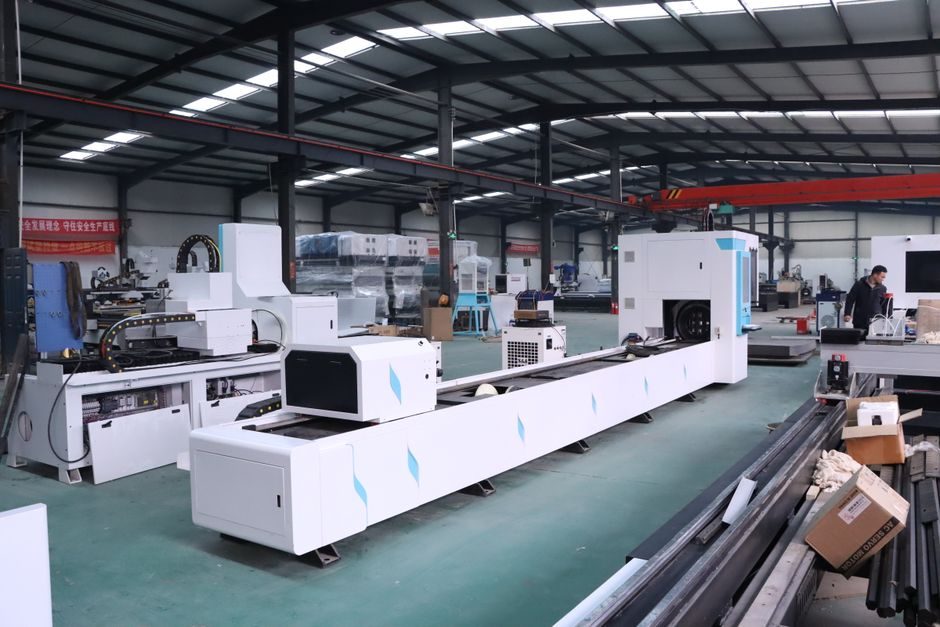
Industrial stretch wrappers divide cleanly into three mechanical families — turntable, rotary arm, and orbital ring — and the 2026 product catalog snapshot (132 manufacturers, 750 listings on DirectIndustry) confirms turntable and rotary-arm formats dominate chemical and pallet-line sales [S1].
Selection is driven by four hard numbers: pallet weight and footprint, wrap height, throughput (pallets/hour), and the pre-stretch ratio the film carriage can deliver. Sino-range OEMs now ship 250% pre-stretch as a stock spec on chemical-duty rotary arms, with a 200% sprocket supplied as a swap-out for lighter films [S2].
Turntable vs Rotary Arm vs Orbital: The Decision Matrix
Turntable wrappers hold the load on a rotating plate (typical diameter 1500–1800 mm, optional up to 2400 mm) and run 0–12 rpm at ~1.55 kW; they are the right answer for stable, dense pallets up to roughly 2000 kg where the load will not shift under rotation [S2]. The Youngsun MH-FG-2000PA mechanical pallet wrapper, for example, is built on a Φ1500 mm turntable (optional Φ1650/Φ1800) with a 2400 mm mast and 0–10 rpm drive, and adds an integrated weigh-scale function for inline check-weighing.
Rotary arm wrappers keep the pallet stationary and spin the film carriage around it, which is the only safe geometry for tall, top-heavy, or partially unstable loads; the SHANDONG SINOLION S1800EZ-PL handles 1000 mm wrap height on a 1200 × 1200 mm pallet envelope, while the larger R1800FZ-PL-FM1800 reaches 1600 mm wrap height with the same footprint [S2]. Orbital ring wrappers sit at the top of the range for continuous-length products — doors, profiles, extruded boards — where the item passes through a rotating film hoop rather than being indexed on a turntable.
For a structured comparison, the table below lines the three families up against the four selection criteria most often quoted by integrators:
Criterion: Load weight — Turntable: ≤2000 kg typical; Rotary arm: ≤3000 kg typical (heavy-duty); Orbital: limited by conveyor, often ≤500 kg for door/profile lines. Criterion: Wrap height — Turntable: 2000–3200 mm mast; Rotary arm: 1000–1600 mm wrap zone (load height); Orbital: product-length limited. Criterion: Pre-stretch ratio — Turntable: 150–250% on powered models; Rotary arm: 200–250% (SINOLION 250% stock, 200% spare sprocket) [S2]; Orbital: 150–200%. Criterion: Best fit — Turntable: stable cube pallets; Rotary arm: unstable, tall, or high-value loads; Orbital: long extrusions and door panels.
Film Carriage and Pre-Stretch: The Real Cost Lever
The film carriage is where money is saved or wasted: a 250% pre-stretch carriage turns 1 m of LLDPE film into 3.5 m of wrapped film on the pallet, so a 23 μm cast LLDPE web at that ratio gives the same containment as a hand-applied 35 μm stretch at 0% pre-stretch [S2][S5]. Cast LLDPE is the dominant machine-grade film because it unwinds quietly, offers higher tear resistance, and costs less than blown film thanks to lower energy in the cast-extrusion process [S5].
On the SHANDONG SINOLION R1800FZ-PL-FM1800 the open-door pre-stretch carriage is rated to 250% (1 m → 3.5 m) with a spare 200% sprocket shipped in the spares kit, so an operator can drop film gauge by switching sprockets rather than re-buying the carriage [S2]. For door-fabrication lines the spec is tighter still: the FHOPE door wrapping machine pairs a powered pre-stretch carriage with vertical clamping fingers to stop film slip on smooth melamine faces, and is rated for the full door size range from interior flush to 2400 × 1100 mm external panels.
Standard hand-grade stretch film is not interchangeable with machine-grade — machine rolls run on 3″ cores at widths up to 500 mm, gauge 14–35 μm, and outer diameter up to 240 mm, and any carriage not designed for that core size will misfeed at speed [S2].
Capacity, Power and Footprint: Sizing for a Real Line
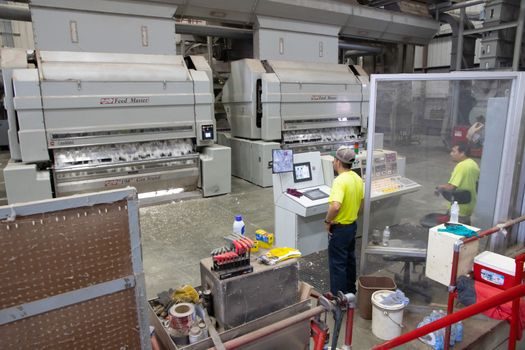
The EVERROLL ESW-900 (Taiwan) is a useful reference for sizing a heavy-pallet cell: 1300 × 1300 mm wrap area, 2100 mm wrap height, 1200 kg load capacity, with a 1-phase 220/110 V 50/60 Hz supply — i.e. it will plug into a standard workshop outlet rather than needing a three-phase drop [S3]. For a 2400 mm mast, a Chinese mechanical wrapper such as the Youngsun MH-FG-2000PA is typically wired 1 P AC 220/110 V 50/60 Hz with the same single-phase convenience, but is built around a Φ1500 mm turntable and is sold specifically as a pallet-floor cell rather than a high-speed door-line machine.
Throughput is the next gate: a semi-automatic turntable (0–10 or 0–12 rpm, ~12–15 pallets/hour with operator load) is the workhorse for distribution centres, while a rotary arm with auto-clamp and top-sheet dispenser reaches 30–40 pallets/hour because the load never stops rotating [S2]. Where the line runs >40 pallets/hour, the wrapper is usually embedded in a palletiser cell with conveyors, weigh scale, and labeller — Dalian Jialin markets itself as an "integrated logistics packaging process flow" supplier for that tier of build.
Who It Is For — and Who Should Walk Away
Stretch wrappers are the right answer for unitised pallet loads (food, chemicals, paper, ceramics, glass, hardware, electronics), bagged chemicals, building-materials packs, and long extrusions/doors where a stretch film skin protects against moisture, dust, and transit scuffing [S2]. The chemical-industry sub-segment alone has 7 active manufacturers and 38–48 dedicated models listed, with the bulk of the catalogue from Shandong Sinolion, Shandong Dyehome, and Shanghai Fhope [S2].
Stretch wrapping is the wrong tool for open-top liquid containers (no top closure, no compression), for sharp-edged steel coils that will cut the film, and for pallet loads that must be hermetically sealed against oxygen or water-vapour ingress — those need a shrink wrapping machine with a heat tunnel, a vacuum-bag line, or a stretch-hood system instead. For retail-ready secondary packs the wrapper is also usually overkill: a flow-wrapper or coding machine cell handles the unit pack before palletising.
A buying decision tree is short: stable cube pallet under 2000 kg → turntable; tall or unstable load → rotary arm; long extrusion/door profile → orbital ring; anything above ~50 pallets/hour → budget for the conveyor-integrated cell, not a stand-alone machine [S6].
Standards, Maintenance and Failure Modes
There is no single IEC or ISO standard that pins every stretch-wrapper spec, but the load-bearing and guarding rules are governed by the same machinery-safety regime that covers any packaging line (EN ISO 12100 for risk assessment, EN 60204-1 for electrical equipment of machines). Film itself is graded as LLDPE in the 14–35 μm range with a 3″ core for machine use, and cast LLDPE is the default for low-noise unwind on powered carriages [S2][S5].
The most common field failures are film- carriage belt slip (symptom: pre-stretch ratio drops below setpoint), turntable drive-chain stretch (symptom: hunting at low rpm), and photo-eye dust build-up on the pallet-height sensor that forces the wrapper to over-travel the mast and waste film at the top of every cycle [S4]. The pallet-height optoelectronic switch on the MH-FG-2000PA is positioned for easy wipe-down access — a small detail, but the difference between a five-minute clean and a half-day sensor swap on a high-throughput line.
Pre-2026 OEM data sheets and the FHOPE door-wrapper engineering note (April 2025) both still describe the same core geometry and 250% pre-stretch target, so spec sheets written before this period remain valid for first-pass selection; what has changed in the 2025–2026 catalogue window is the breadth of Chinese OEM options (Shanghai Fhope at 101 listed models, Sinolion at 75, Shandong Dyehome at 20) that now ship 250% carriages as stock rather than as a special [S1][S2].
Track these signals over the next quarter: (1) any new OEM moving its 250% pre-stretch carriage from "option" to standard on the entry-level turntable, and (2) the release of integrators offering a stretch-wrapper + stretch film + palletiser bundle at a single quoted throughput figure — both of which would reset the cost-per-pallet benchmark for European and North-American distributors. For a broader view of the packaging-cell cost stack, the pallet jack price and AGV cost map and the corrugated box price 2026 ECT/MOQ guide sit on either side of the stretch wrapper in a typical outbound cell.