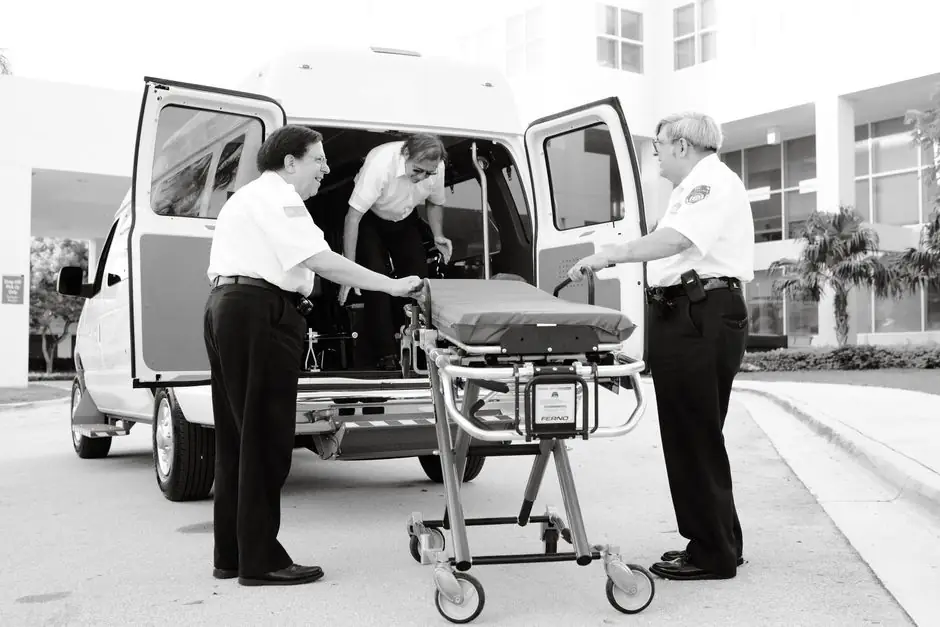
Specifying a stretcher against temperature limits is a four-layer problem, not a single number on a data plate: ambient operating range, hydraulic-fluid behaviour, battery charging window, and (for MR suites) the ASTM F2503 conditional envelope must all be checked against the same use environment, otherwise the equipment passes a datasheet review and fails on site [S1][S2][S3][S4][S5].
Across 2025-2026 manufacturer guidance, three distinct temperature envelopes are quoted: an operating/storage range of -40°C to +70°C on insulated military stretchers [S1], a 0°C to 25°C battery-charge window on the Ferno Viper [S4], and the ASTM F2503 conditional limits (1.5T, 3T, and higher) that govern any stretcher wheeled into an MRI bore [S5]. Buyers who collapse those three into one spec line routinely buy the wrong device.
Operating temperature range: what the spec sheet must state
For field and ambulance deployment, an ambient operating envelope of -40°C to +70°C is the documented baseline for modern insulated stretchers used in casualty evacuation at altitude, with thermal-conductivity ratings around 0.039 W/m·K for the insulating shell [S1]. At the cold end, hydraulic oil thickens and the lift mechanism becomes sluggish within minutes of exposure; at the hot end, polymer seals and patient-restraint webbing lose durometer and creep [S3]. Buyers should request the operating range stated as two separate values (operating / storage) and the tested thermal conductivity of any insulating layer, not a single "working temperature" line.
Standard ISO 1865 covers patient handling devices used in medical transport, while FMVSS applies once the stretcher is locked into an ambulance mounting system; both are quoted as the floor of any North American transport RFQ [S2]. Hospital-grade units that will only see indoor corridors do not need the -40°C rating, but the RFQ should still name an explicit lower limit (commonly 0°C or +5°C) so a unit is never warehouse-stocked in an unheated ambulance bay overnight.
Hydraulic, seal, and frame materials: where heat actually bites
Hydraulic stretchers fail first in the seals, not the cylinder. Manufacturer guidance warns explicitly that "extreme cold can thicken hydraulic fluid, making power stretchers sluggish, while extreme heat can affect seal integrity", and recommends that buyers match fluid type to the deployment climate rather than accepting the factory fill [S3]. For bariatric frames rated above 1,000 lb, the same source notes that seal temperatures become the limiting factor long before the frame steel yields [S2][S3].
A useful cross-check is the stretcher material stack: aluminium stretcher tops, PVC patient surfaces, and steel-framed bases each have a different coefficient of thermal expansion, and a unit assembled at +20°C in a factory in Ohio will not necessarily maintain its collapsed tolerances after a winter at -30°C in a northern ambulance bay. Insist on a documented cold-soak test, not just a storage-temperature number.
Battery and charger: the temperature limit most RFQs forget

Lithium-battery chemistry in powered stretchers has its own narrower window. The Ferno Viper Instructions for Use specify a recommended ambient charging temperature of 0°C to 25°C and a direct instruction to "charge the battery in a stable temperature environment" [S4]. Charging outside that window risks permanent capacity loss, and at sub-zero charging the cells can plate lithium metal, which is a safety event, not a warranty event.
Operationally, this means a stretcher that works perfectly at -20°C on a call may not be safely recharged in the same unheated vehicle bay. Procurement language should split the spec into three lines: operating, storage, and battery-charge, each with a numeric range and a tested standard, not a single "0 to 40°C" marketing figure [S4]. The same rule applies to any accessory that carries its own battery, including powered IV-pole lifts and bariatric winches.
MRI-conditional stretchers: temperature vs field strength
For radiology suites, the temperature conversation is gated by ASTM F2503, the standard that defines "MR Safe" and "MR Conditional" labelling, with field-strength limits typically stated at 1.5T and 3T, and tighter conditional ratings for higher-Tesla systems [S5]. MR Conditional stretchers are built from non-ferrous materials (aluminium, PVC, and specialty alloys without iron, cobalt, or nickel) so that heating from gradient-induced eddy currents stays within the tested envelope [S5].
Heat rise in the bore is the silent failure mode: a stretcher that is "MR Conditional" at 1.5T may not be conditional at 3T, and any polymer surface that exceeds its glass-transition temperature under RF exposure will deform against the patient. Spec writers should demand the F2503 label state the tested field strength, the maximum allowable scan duration, and the maximum gauss-line approach distance, all three of which are part of the standard's required marking [S5]. For broader context on how environmental limits interact with device choice, the temperature controller page on this site covers the related instrumentation envelope used in transport incubators and warming cabinets.
Compatibility check: matching the stretcher to the use case

A practical four-line checklist for procurement: (1) ambient operating range must cover the lowest and highest realistic temperature of the deployment zone; (2) hydraulic fluid grade must be specified for that range, with a cold-soak test data point attached; (3) battery charge window must be a separate line from operating range and must be enforced in the charging bay; (4) for MRI suites, the ASTM F2503 label must state the field strength in Tesla, scan duration limit, and approach distance [S1][S2][S3][S4][S5].
The trade-off is straightforward: military-grade insulated stretchers carry the widest thermal envelope but are heavier (7-14 kg per unit per the Indian Army inventory data) and cost more [S1]; standard hospital hydraulic stretchers are lighter and cheaper but stop at temperate-climate limits [S2][S3]; MR-conditional units sacrifice load capacity (commonly 500 lb versus 1,000 lb for bariatric non-MR units) for non-ferrous construction [S2][S5]. There is no single stretcher that wins all four axes, and any vendor claim to the contrary should be rejected on the RFQ.
What still goes wrong on site, even when the spec looks right
Three failure modes keep showing up in field reports. First, the stretcher passes the operating-temperature line item but the fleet charges it in an unheated bay, and the battery degrades inside 12 months; the cure is a separate charge-temperature spec line and a heated charging room [S4]. Second, an MR-Conditional label is treated as universal across all Tesla ratings, and a 1.5T-rated stretcher is wheeled into a 3T suite; the cure is a hard copy of the F2503 marking attached to the unit [S5]. Third, hydraulic seals are replaced with the wrong Shore-A durometer after a service, and the unit then leaks at temperature extremes the original seal handled; the cure is a parts list locked to the OEM kit, not generic alternatives [S3].
Trackable signals to watch over the next two quarters: any update to ISO 1865 patient-handling language around thermal cycling, any ASTM F2503 revision affecting conditional-label content, and OEM release of cold-rated lithium packs that push the 0°C charge floor downward [S2][S4][S5]. For facilities already standardising on a temperature-controlled ambulance bay, the temperature monitor reference on this site covers the sensor and logging side of the same compliance problem.