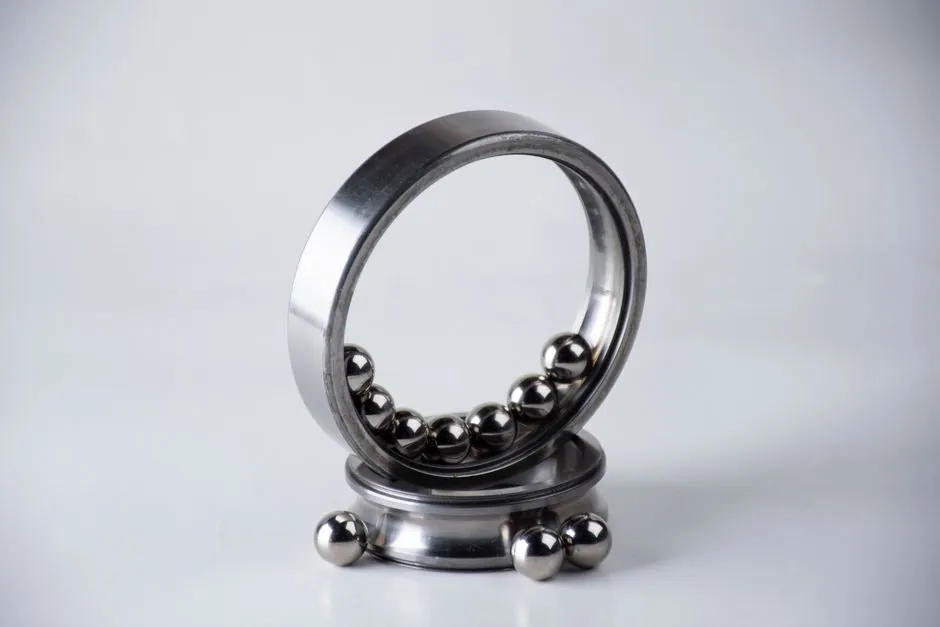
Ultrasound is useful for lubrication-related inspection and bearing-condition assessment, while vibration analysis is a well-established approach for monitoring a wide range of mechanical defects.
The practical choice depends on the task: condition-based lubrication needs a contact ultrasound sensor; broader rotating-machine diagnosis and fault progression need vibration monitoring. These technologies are complementary, not substitutes [S2][S3].
Two Sensors, Different Diagnostic Windows
A contact ultrasound sensor is placed on the bearing housing and captures structure-borne sound. In the 20–40 kHz range, lubrication breakdown increases friction and raises the measured ultrasonic level. A healthy, well-lubricated rolling-element bearing generally presents a comparatively steady 20–40 kHz signature, while lubricant-film breakdown or surface defects alter that signature [S4][S7].
Vibration measurement uses lower-frequency mechanical response and waveform or spectral analysis. For condition-based lubrication, measured decibels can be trended and transformed ultrasonic signals can be listened to.
For integrated data collection, the vibration sensor belongs in the broader asset-monitoring layer, while the ultrasound channel serves the lubrication workflow. A condition monitoring system can retain both signals only if the acquisition hardware supports the required frequency range and produces actionable alarms rather than undifferentiated data [S2].
Selection Criteria by Measurement Task
Structure-borne ultrasound is useful for assessing bearing condition and guiding condition-based lubrication practice.
Choose vibration when the primary question is how the bearing and connected machine are degrading. Vibration analysis supports defect-frequency identification through FFT spectra, while envelope analysis improves sensitivity to impacts. It also remains the established choice for diagnosing imbalance, misalignment, looseness, and other mechanical faults across pumps, motors, gearboxes, and fans [S5][S8].
Use a vibration analyzer for repeatable routes, baseline comparisons, spectral review, and machinery-level diagnosis. Use a portable ultrasonic detector for point inspections, lubrication checks, and rapid screening where no permanent vibration route exists. Sensor placement must remain repeatable because the housing, contact pressure, and measurement position affect coupling and the resulting dB reading.
Cost, Frequency, Severity, and Integration
The options differ materially when compared by first cost, fault coverage, response stage, and maintenance integration. The table uses the operating characteristics stated in the research; total installed cost cannot be reduced to a universal number because transducer type, cabling, software, labor, and route coverage are not specified in the supplied material [S2][S5][S8].
Ultrasound requires a narrow diagnostic objective and disciplined grease application. Vibration requires a defined route, suitable transducer placement, diagnostic expertise, and a baseline. Neither technology makes a sound lubrication program by itself: grease quantity, cleanliness, type, and interval still govern bearing life.
Where Each Method Is Most Useful
Ultrasound is a useful alternative to vibration measurement in low-speed applications and supports condition-based lubrication.
Use vibration for planned route-based monitoring of critical motors, pumps, fans, and gearboxes, particularly when the objective includes separating bearing defects from imbalance, misalignment, or looseness [S8]. In a motor-pump train, sensor count and placement should reflect asset risk and bearing configuration rather than a fixed quantity for every machine; the linked vibration sensor allocation guide expands that decision.
A combined program is the defensible choice for critical rotating equipment: ultrasound closes the lubrication interval, while vibration covers the broader mechanical condition and confirms fault progression. For a single noncritical bearing inspected periodically, start with ultrasound if lubrication is the primary concern; add vibration when diagnosis, route trending, or machine-wide fault coverage is required [S2][S3].
Limits, Failure Modes, and Interpretation Traps

Ultrasound is sensitive to lubrication-related friction and its ultrasonic signal varies with bearing condition.
Vibration is not a weak substitute for direct lubrication sensing. Poor lubrication can remain undetected until the grease pump can no longer relieve the bearing, and low-speed applications complicate conventional vibration diagnosis [S5]. Conversely, an ultrasonic increase is not sufficient by itself to classify a bearing as defective; it identifies elevated high-frequency activity that must be interpreted with operating context and other measurements [S3][S9].
Both methods can fail through implementation rather than sensor physics: inconsistent sensor position, loose contact, excessive gain, unfiltered background noise, or alerts without work-order logic produce unreliable decisions [S2]. A portable vibration meter can support screening, but a permanent accelerometer offers a defined location for repeatable trending when route consistency is required [S8].
Evidence, Acquisition, and Sourcing Discipline
Ultrasound sensors used for the described lubrication workflow operate at 20–40 kHz [S5]. High-speed sampling up to and beyond 100 kHz can extend analyzed bandwidth to 40 kHz and preserve short bearing-impact envelopes; this capability must be confirmed in the acquisition instrument rather than assumed from an FFT label [S5].
Published comparison work on ball bearings reported average classification accuracy of 99.96% for an ultrasonic sensor, 99.74% for an acoustic-emission sensor, and a lower result for the vibration sensor, but the source excerpt does not provide the full operating envelope, bearing geometry, test rig, or an acceptable false-alarm rate. Those laboratory percentages must not be transferred into a maintenance specification without reproducing the test conditions [S10].
For procurement, specify the intended frequency band, transducer type, contact or permanent mounting method, sampling rate, dB or spectral output, data export, alarm threshold workflow, IP and temperature ratings, and compatible analyzer software. The supplied material contains no universal contact-pressure, housing-thickness, temperature, ingress-protection, or battery-life requirement, so these values should be obtained from the selected sensor datasheet rather than guessed.
The next engineering step is a controlled pilot on one bearing type: record ultrasonic dB and vibration baselines at a defined load and speed, apply a measured grease quantity, and compare the response. Scale the method only after repeatable separation between the healthy baseline, lubrication demand, and developing mechanical faults has been demonstrated.