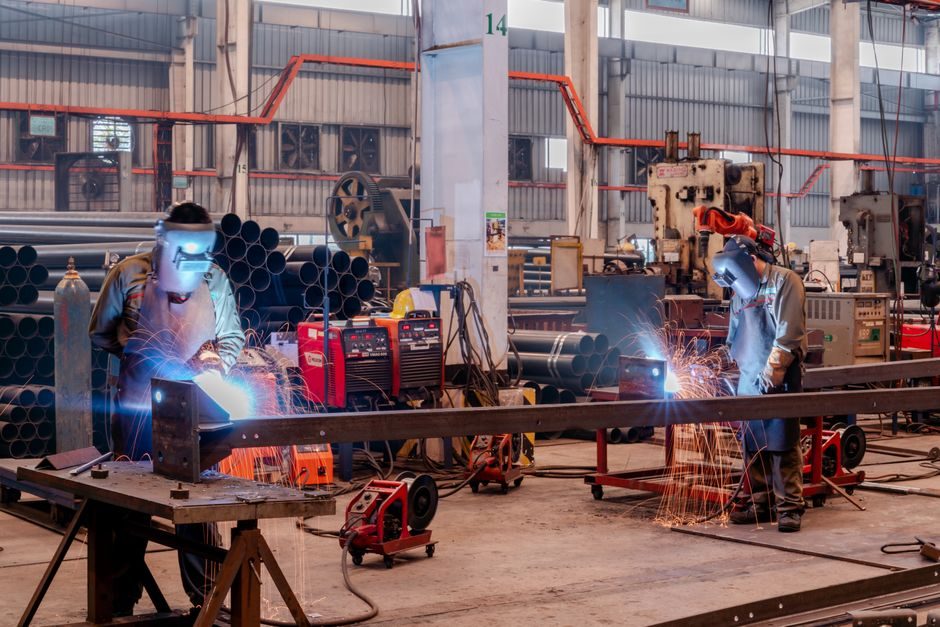
As of 2026-04-29, a Chinese-export shear-stud welding machine (model DA-1600I) was listed at a FOB price of US$3,500 per set with a 1-set minimum order on Made-in-China [S3].
The same supplier priced ceramic ferrules at US$0.03 per piece (1-piece MOQ) and 16×80 mm shear studs at US$0.22 per piece (100-piece MOQ), illustrating the split between capital equipment and high-volume consumables [S3].
Price Tiers of Stud Welding Machines
New capacitor-discharge (CD) stud welders and small-drawarc benches dominate the entry tier on Made-in-China, with 2026 listings clustering in the low-thousands range and desktop or CNC configurations quoted alongside [S5]. The 1500 W output class seen in Okorder's spec sheet — 1.0–1.6 mm welding diameter — corresponds to the lightweight CD pin-welding segment, not structural shear-connector work [S4].
Mid-tier and heavy-duty machines such as the DA-1600I (designed for shear-connector / through-deck welding) sit at US$3,500/set FOB in 2026 supplier listings, a price that reflects the heavier transformer, larger energy storage, and stud-range capability required for structural applications [S3]. When buyers add CNC automation, automatic stud feeding, and current-monitoring controls, the integrated workstation list typically rises into the US$10,000–US$30,000 band based on the same Made-in-China supplier pool [S5].
Consumables, Tooling and Per-Piece Costs
Stud welding is a high-consumable process: each weld consumes a stud, a ceramic ferrule (in drawn-arc mode), and usually a footprint ring or gas shield — so recurring cost matters as much as machine price. Listed 2026 piece-prices are US$0.03/ferrule and US$0.22/stud for the 16×80 mm shear stud at the same Kent Stud Welding showroom [S3].
Stud rods sold by Chinese mills also reflect commodity pricing — e.g. double-circuit tangent transmission-line steel tower material was listed in the US$1,060–US$1,200 per tonne range on Made-in-China on 2026-05-18 [S6]. For a structural welding cell running 1,000+ studs per shift, the consumable line item typically rivals or exceeds the machine depreciation over a 5-year horizon, which is why fleet buyers separate machine capex from stud/ferrule opex in their cost models.
Process Choice vs Cost: CD, Drawn-Arc and Automated Cells
Capacitor-discharge (CD) stud welders are the cheapest to buy and operate: thin-gauge sheet, no ferrule, fast cycle, no arc-time charge. Drawn-arc (DA) machines such as the DA-1600I cover larger-diameter structural studs but require a ceramic ferrule, longer arc time, and higher kVA supply — pushing the entry price from roughly US$1,500–US$2,500 for a small CD bench up to US$3,500+ FOB for a comparable DA unit [S3][S5].
For buyers comparing options on four common criteria — capital cost, max stud diameter, consumable spend, and duty cycle — the trade-off matrix looks like: CD bench wins on capex and consumables but is limited to ~M10 studs; DA manual machine handles M6–M16+ with ceramic ferrules and moderate consumable cost; CNC stud welding cells multiply throughput but lift the integrated price into the US$15,000–US$30,000+ bracket once the feeder, chiller, and current-control package are added [S5]. Process selection is therefore dictated more by base-material thickness and stud diameter than by the headline machine price.
Used, Rental and Refurbished Routes
Two established UK/US suppliers — Studfast Studwelding (trading since 1988) and Sunbelt Stud Welding — explicitly list stud welder rentals and repairs alongside new equipment sales, giving buyers a way to side-step full capex [S1][S2]. Rental is most common for short campaigns: bridge-deck shear-connector work, shipyard dry-dock runs, or a single production-line build-out where owning a dedicated power source does not amortise.
Refurbished units from these same channels typically run 40–60% of new list, but the buyer must verify welding-control calibration, capacitor ESR on CD sets, and transformer insulation resistance — none of which a price sheet will tell you. Sunbelt and Studfast both offer repair services, which is the practical fallback when a legacy unit fails outside warranty [S1][S2].
Total Cost of Ownership: What the Headline Price Misses
Three line items routinely push a project's real spend above the sticker price: (1) three-phase mains upgrade or step-down transformer for DA machines drawing tens of kVA; (2) weld-head tooling, chiller for continuous-duty cells, and FEA-validated jigs; (3) operator training plus periodic verification of weld strength on production studs, which is mandatory on structural work. [S1]
Consumable opex — ferrules at US$0.03/pc and 16×80 studs at US$0.22/pc — scales linearly with throughput [S3], so a 200,000-stud annual programme allocates roughly US$44,000 to studs and US$6,000 to ferrules before labour, gas, and inspection enter the model. Machine capex at US$3,500/set is recovered inside months on that volume, which is why high-throughput fab shops prioritise machine reliability and weld-control repeatability over the lowest first-cost quote [S3][S5].
Standards, Verification and Sourcing Discipline
Buyers specifying stud welding for structural or pressure-bound applications should anchor the order to AWS D1.1 / D1.6 clauses (for structural and stainless welding respectively) and ISO 14555 for the European process standard — the same documents most OEM manuals reference for pre-production test schedules and operator qualification. Equipment listings themselves rarely cite these standards, so the verification work falls on the buyer's QA team rather than the supplier's sales sheet. [S2]
Pre-purchase due-diligence on a Made-in-China listing should include: factory audit report, sample-weld video showing parent-material and stud-diameter match, calibration certificate for the welding control, and a clear warranty on the energy-storage capacitors. For US/EU projects, confirm CE / UKCA marking and — for shipboard or offshore use — the applicable IACS class society route [S3][S5]. A low FOB number is only useful once those gates are passed.
Selection Checklist by Buyer Profile
Sheet-metal and sign shops should target a 1500 W-class CD bench with M3–M8 stud range — a configuration Okorder documents at a sub-US$5,000 entry point in 2026 [S4]. Structural steel and bridge-deck contractors need a DA machine such as the DA-1600I or equivalent (US$3,500+ FOB) plus a verified ceramic-ferrule supply chain [S3].
High-mix production lines and OEMs running automotive studs, kitchen-equipment fastening, or electronics chassis work should evaluate CNC stud welding cells with automatic feeders in the US$15,000–US$30,000 integrated band, and budget consumables as a separate opex line item [S5]. One-off or campaign users are better served by rental or refurbished units from established UK/US suppliers like Studfast or Sunbelt, where repair access is built into the relationship [S1][S2]. Pricing context for adjacent shop tools — for example the comparison piece on a stud welder vs a circular saw — is covered in Stud Welder vs Circular Saw: Two Shop Tools, Two Different Jobs.
Trackable signals for the next buying cycle: (1) 2026-Q3 price revisions on Made-in-China's stud-welding-machine index as capacitor and copper costs settle; (2) any new CNC cell listings below the US$10,000 mark, which would compress the mid-tier pricing band; (3) updates to AWS D1.1 clauses on stud qualification, which historically shift the consumable specification more than the machine itself.
For component-level specifications, see linear guide, and crossed roller guide.