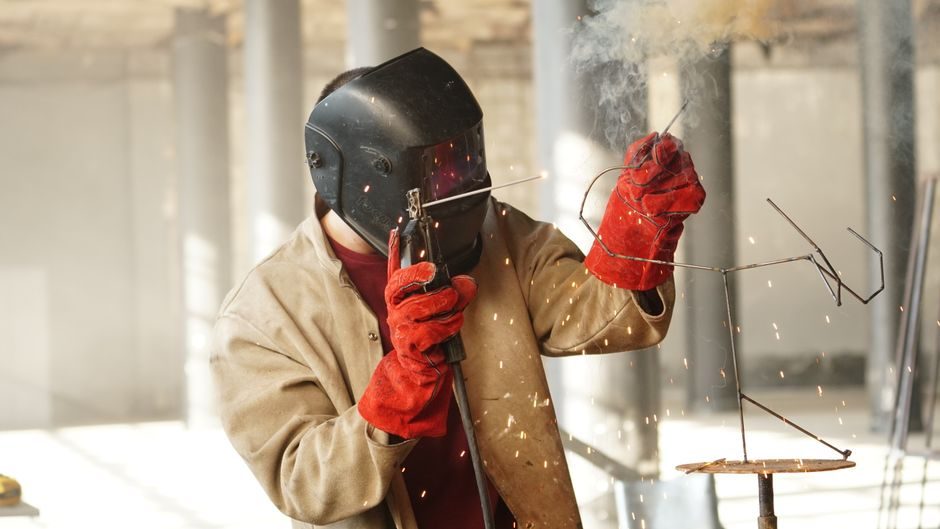
Stud welding is defined by three production processes — Capacitor Discharge (CD), Drawn Arc (DA), and Short Cycle (SC) — each matched to a specific diameter range, base-metal thickness, and material class, and each requiring a distinct power source and gun geometry [S1].
The method joins a single-side fastener (stud, pin, nail, or earth tag) to a base component without piercing or reverse-marking the parent plate, and the welded joint is typically reported as stronger than either the stud or the base material [S1]. The full process family is covered in the stud welder reference page, which sits alongside related welding entries on arc welder and TIG welder for conventional comparison.
The Three Process Families: CD, Drawn Arc, Short Cycle
Capacitor Discharge (CD) stud welding stores energy in a capacitor bank and releases it in a millisecond-scale discharge through a small ignition tip, fusing studs typically in the 3–10 mm diameter range to thin-gauge sheet as low as ~0.5 mm without through-hole marking [S1]. Short Cycle (SC) is a hybrid: shorter arc time than DA but more thermal input than CD, commonly used for ~4–10 mm studs on thicker sheet where CD lacks penetration and DA's heat input is excessive [S1].
Equipment Architecture: Power Source, Gun, Controller
A stud welding system is built from three matched sub-assemblies: a power source (CD stud uses a capacitor bank with charging voltage typically 35–200 V DC, while DA/SC machines use a transformer-rectifier with welding current commonly 300–3,000 A at low voltage), a stud gun (lightweight hand-held units for shop or site work, or stationary heads for CNC integration), and a controller that times arc length, arc duration, plunge distance, and current [S1]. Taylor Studwelding markets portable hand guns, semi-automatic production heads, and fully automated CNC stud welding cells from the same UK design base, and is the only UK-based designer and manufacturer of stud welding machines, guns, and studs, exporting to markets including India and Australia [S1].
The same control electronics that govern arc time on a stud welder govern electrode travel on a conventional arc welder, so plant engineers familiar with one will recognise the sequencing logic of the other.
Selection Criteria: Diameter, Base-Metal Thickness, Material

First gate is stud diameter: below ~6 mm with thin base metal, CD is the default; 6–12 mm on standard plate, DA or SC; above 12 mm on heavy plate, DA with elevated current and ferrule [S1]. Second gate is base-metal thickness — CD can weld to sheet as thin as ~0.5 mm without burn-through, while DA typically needs ≥2–3 mm base metal to absorb the larger weld pool without distortion [S1]. Third gate is parent material: aluminium and brass require tighter parameter windows (lower current, faster arc time, sometimes DC-only modes) and a ferrule material matched to the alloy to avoid slag inclusion [S1].
A typical decision matrix used by process engineers runs along the lines of: CD for fasteners below 10 mm on sheet under 2 mm; SC for 4–10 mm studs on 1.5–4 mm plate; DA for studs above 6 mm on plate above 3 mm [S1].
Who Stud Welding Is For — and Where It Loses to Alternatives
Stud welding is a fit where a single-side fastener must be attached to a plate that cannot be back-accessed (closed hollow sections, clad panels, finished enclosures), where hole drilling would weaken the structure, where cycle time is measured in seconds, and where the joint must be at least as strong as the parent material [S1]. It is the standard attachment method for shear connectors on composite steel deck, earth tags on enclosures, insulation pins on ductwork, and decorative studs on architectural panels [S1].
It is the wrong tool when the joint must be dismounted repeatedly (use a mechanical fastener), when the base material is non-weldable (some coated or hardened steels), or when the stud must be placed on a curved/contoured surface that the ferrule cannot seal against — for which TIG welding with a manual feeder is more flexible [S1]. For heavy section joining on plate exceeding ~25 mm or for full-penetration structural welds, conventional arc welder processes are still specified, not stud welding.
Strength, Quality, and Common Failure Modes
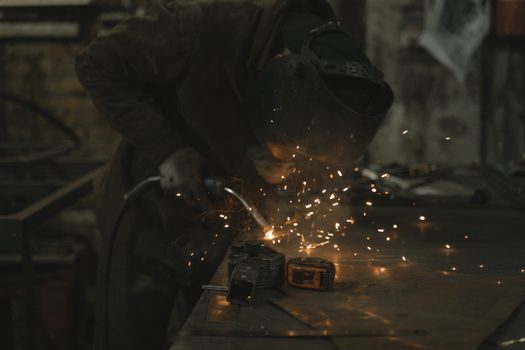
The published claim is that a properly executed stud weld produces a joint stronger than either the stud or the base material, so parent-metal or stud shank fracture is the expected failure mode, not weld-pulldown at the fillet [S1]. A standard quality check is a 90° bend test: the stud is bent over with a hammer; a good weld shows the stud shank or base material deforming/fracturing while the weld fillet remains intact, while a bad weld shows the stud pulling out of the fillet [S1].
Common failure modes and their causes are well known: incomplete fusion (low current, too-short arc time, dirty base metal), porosity (contaminated surface, wrong ferrule, moisture on aluminium), burn-through on thin sheet (CD current set too high or stud diameter too large for the base thickness), and cracked fillets (excessive plunge, rapid cooling on thick steel without pre-heat, or hydrogen pickup on hardenable alloys). For thicker section work where hydrogen cracking is a concern, parameter discipline matches the practice used in electroslag pressure welder operations on heavy plate.
Process Comparison Across the Three Methods
CD vs DA vs SC stack up against four engineering criteria: stud diameter range, minimum base-metal thickness, typical weld time, and shielding method. CD covers ~3–10 mm studs, welds to ~0.5 mm+ sheet, fires in 1–6 ms, and self-shields via the rapid discharge; SC covers ~4–10 mm, requires ~1.5 mm+ base, runs 50–150 ms, and uses a ferrule or gas; DA covers ~6–25+ mm, needs ~3 mm+ base, runs 100–500 ms, and always uses a ceramic ferrule plus arc-shielding gas on aluminium/stainless [S1]. Cycle time per stud is fastest for CD (sub-10 ms weld, no cool-down pause), intermediate for SC (~1 s), and longest for DA (1–3 s plus ferrule-strip), which is why CD dominates high-volume lines such as electronics and sheet-metal fastening [S1].
Standards, Operator Skill, and Sourcing Notes
Industry specifications for stud welding reference the AWS D1.1 structural welding code clauses on stud application, ISO 14555 for resistance and stud welding of metallic materials, and the European EN 1090 execution-class requirements for structural steel — though specific revision dates for those standards are not within the scope of this brief and should be checked against the current code of record before any purchase specification is written. Operator training is shorter than for manual arc welding because the gun geometry constrains arc length and plunge, but set-up checks (lift height, plunge depth, ferrule condition, surface cleanliness) remain mandatory for repeatable fillet quality [S1].
For buyers, the practical sourcing question is whether the vendor can supply a matched power source, gun, controller, and ferrules — and back them with parameter sheets for the specific stud/parent-material combination — rather than selling the four sub-assemblies separately. The UK has at least one vertically integrated designer-manufacturer of stud welders exporting to multiple continents, and most major European and US welding OEMs (Nelson, Köco, ESAB, Tru-Weld) offer a CD/DA/SC catalogue spanning the same diameter bands [S1]. For plants already specifying related process gear, the parameter and controller logic translates directly to arc welder and TIG welder setups, so a stud welder purchase can share a common power-platform and training pipeline with the broader welding shop.
For related coverage, see Power Mixer TCO: Cost Lines, Decision Bands and Spec Gates.