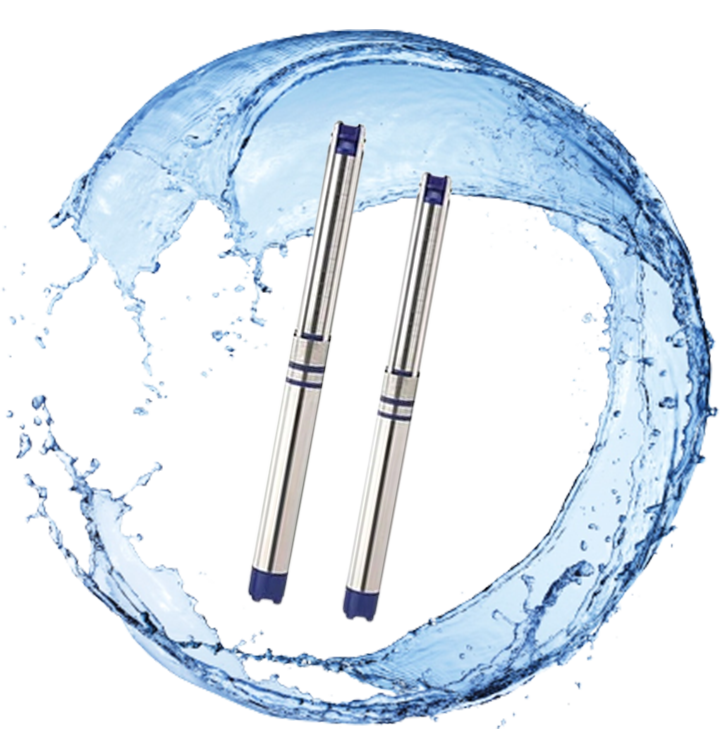
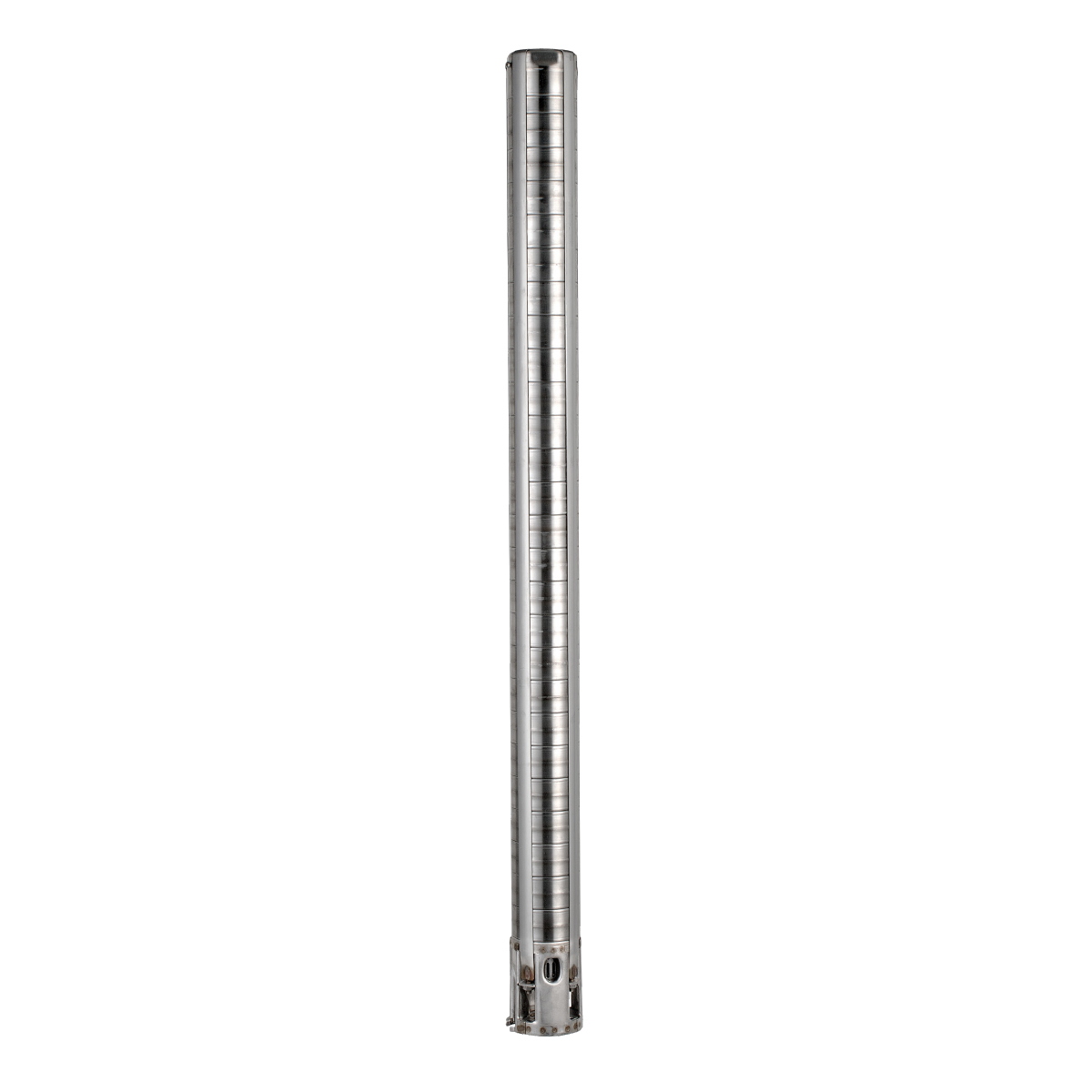
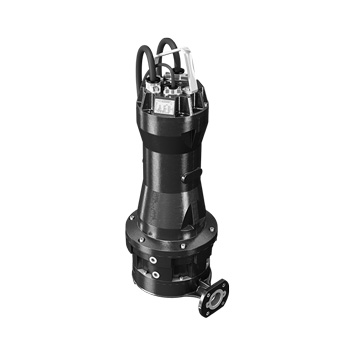
A submersible pump is a rotodynamic pump whose hermetically sealed motor is close-coupled to the pump body, with the entire assembly submerged in the liquid it moves. Because the unit sits inside the fluid and pushes water upward rather than drawing it up by suction, it eliminates the suction lift limit and the cavitation risk that constrain surface-mounted pumps. The category spans grain-sized sump pumps, deep borehole water pumps, heavy-duty sewage pumps, and oilfield electric submersible pumps (ESPs) lifting from depths beyond three kilometers.
This page is a procurement-grade reference: it decodes the working principle, the main families, the spec-sheet parameters that actually drive selection, and the standards that govern testing and safety. Every figure here traces to a manufacturer datasheet or a published standard, never to a vendor marketing claim.
Photo: Suyash Dwivedi, CC BY-SA 4.0, via Wikimedia Commons
This guide is written for industrial purchasing engineers and design engineers. It covers six chapters from what a submersible pump is, through the main families, hydraulic principles, wetted materials, and spec-sheet decoding, to the selection decision sequence, plus seven selection FAQs. All parameters reference public standards including ISO 9906:2012, ANSI/HI 11.6, ANSI/HI 9.8, IEC 60034, IEC 60529, and NSF/ANSI/CAN 61.
Chapter 1 / 06
What is a Submersible Pump
A submersible pump is a device in which a hermetically sealed electric motor is close-coupled to the pump body, and the whole assembly is submerged in the liquid being pumped. This single structural decision, putting the motor underwater rather than at the surface, defines every operational advantage and constraint of the category. The motor and pump share one shaft, and the surrounding liquid both cools the motor and dampens its acoustic noise, which is why a running borehole pump is nearly silent at the wellhead.
The defining advantage is the elimination of suction lift. A surface pump must pull liquid up a suction pipe using atmospheric pressure, and atmospheric lift is theoretically capped near 10.3 meters of water and practically limited to roughly 8 meters once friction and vapor pressure are accounted for. Beyond that, the liquid flashes to vapor and the pump cavitates. A submersible pump sidesteps the problem entirely: it sits in the liquid and only has to push, so there is no suction line to cavitate and no atmospheric ceiling on how deep the water source can be.
The industrial history of the category begins in 1928, when the engineer Armais Arutunoff installed the first submersible motor-driven pump in an oil field, establishing the electric submersible pump (ESP) concept still used in artificial lift today. In 1929, Pleuger developed the submersible turbine pump arrangement that became the precursor of the modern multistage borehole pump. Over the following decades the design split into distinct families: small water-supply pumps in fixed borehole diameters, large solids-handling pumps for municipal wastewater, and high-power ESPs for deep wells.
Structurally, almost every submersible pump shares four functional blocks: (1) the hydraulic end, one or more impeller-and-diffuser stages that add head; (2) the sealed motor, usually a three-phase squirrel-cage induction motor, water-filled or oil-filled for cooling and insulation; (3) the seal system, typically a double mechanical seal running in an oil-filled chamber that keeps process liquid out of the windings; and (4) the power cable, a water-resistant submersible cable carrying three-phase power down to the motor. The interface between the seal system and the motor is where most field failures originate, because it is the boundary the process liquid is constantly trying to cross.
In terms of application scale, the category covers an enormous spread. Single-stage units serve drainage, sump, slurry, and pond duty. Multistage units serve water wells, boreholes, municipal water extraction, irrigation, firefighting reserves, mine dewatering, and oilfield artificial lift. Oilfield ESPs alone span power ratings from about 7.5 kW to 560 kW at 60 Hz, outside diameters from roughly 90 mm to 254 mm (3.5 to 10 inches), and setting depths to about 3,700 meters. No single pump spans this range; engineering selection is the act of mapping a specific duty to a specific family, frame size, and material set.
Chapter 2 / 06
Main Types and Classification
Submersible pumps are classified primarily by the duty they serve, because duty dictates impeller geometry, frame diameter, and material set. The four families that cover the vast majority of industrial purchase orders are the borehole (deep well) pump, the drainage and sump pump, the sewage and wastewater pump, and the oilfield electric submersible pump (ESP). The comparison table below summarizes how they differ on the parameters that matter at selection time.
Family
Typical Flow
Typical Head
Power Range
Solids Handling
Borehole / deep well
1 to 300 m³/h
up to 300+ m
0.37 to 250 kW
Clean water, sand ≤50 g/m³
Drainage / sump
5 to 100 m³/h
5 to 40 m
0.25 to 15 kW
Small solids, light grit
Sewage / wastewater
up to 6,300 m³/h
up to 100 m
1.3 to 680 kW
Free passage 50 to 100+ mm
Oilfield ESP
high-rate artificial lift
to ~3,700 m depth
7.5 to 560 kW
Gas <10% by volume at intake
Borehole and deep well pumps are slender multistage units sized to standard well diameters, most commonly 4-inch, 6-inch, 8-inch and 10-inch frames. They are the workhorse of groundwater supply, irrigation, and drinking-water abstraction. A representative product family, the Grundfos SP range, offers flows to roughly 300 cubic meters per hour, heads above 300 meters in high-stage models, motors from 0.37 to 250 kW, a maximum sand content of 50 grams per cubic meter, and a maximum liquid temperature near 40 degrees Celsius, with hydraulic parts in AISI 304 stainless steel as standard. Head is built by stacking many low-head centrifugal stages in series inside the narrow bore.
Drainage and sump pumps are compact single-stage units for clearing water from pits, basements, excavations, and construction sites. They handle clean to lightly contaminated water with small suspended solids and modest grit, prioritizing portability, a low minimum water level for near-dry pumping, and robust thermal protection against intermittent dry running.
Sewage and wastewater pumps are heavy cast-iron units engineered to pass solids without clogging. They are defined by their free spherical passage and their impeller geometry rather than by head. Large municipal models reach very high flows: the Flygt N-series, for example, is published up to 1,760 liters per second (about 26,600 US gpm), with motors from 1.3 to 680 kW and heads up to 100 meters. Impeller choices, covered in the next chapter, range from recessed vortex to self-cleaning channel to grinder or chopper.
Oilfield electric submersible pumps (ESPs) are the deep, high-power end of the category. They are vertical multistage centrifugal pumps driven by a long, slender three-phase induction motor fed from a surface variable-speed drive through 3 to 5 kV cable. Published envelopes reach setting depths near 3,700 meters, bottomhole temperatures to 149 degrees Celsius, speeds to about 4,000 rpm, and discharge pressures to roughly 34 MPa. ESP efficiency falls sharply once free gas exceeds about 10 percent by volume at the intake, so gas separators are standard in gassy wells.
Chapter 3 / 06
Hydraulic Principle and Performance
Almost all submersible pumps are rotodynamic, meaning they add energy to the liquid by accelerating it with a rotating impeller and then converting that velocity into pressure in a stationary diffuser or volute. In a multistage borehole or ESP design, each stage is one impeller plus one diffuser; the liquid accelerates radially outward from near the shaft, then decelerates in the diffuser, where kinetic energy converts to pressure head. Stacking stages in series multiplies the head while flow stays constant, which is how a narrow 4-inch pump can lift water hundreds of meters.
The performance of any rotodynamic pump is described by its characteristic curve, plotting head against flow at a fixed speed. As flow rises, head falls; the point on this curve where the system actually runs is the duty point, the intersection of the pump curve with the system resistance curve. Pump efficiency peaks at one flow, the best efficiency point (BEP). The Hydraulic Institute defines the preferred operating region (POR) as 70 to 120 percent of BEP flow, and recommends keeping the duty point inside this band; running far left of BEP causes recirculation and vibration, while running far right risks low-flow cavitation and motor overload.
For sewage service, the impeller is selected for clog resistance rather than peak efficiency, and the trade-off between the two is the central design decision. The table below compares the mainstream wastewater impeller types on free passage, relative efficiency, and clog risk.
Impeller Type
Free Passage
Relative Efficiency
Clog Risk
Best For
Vortex (recessed)
Largest
Lower
Lowest
Rags, stringy solids, sludge
Single-channel non-clog
50 to 100+ mm
High
Low
Raw municipal sewage
Multi-channel non-clog
Medium
Highest
Medium
Screened wastewater, high flow
Grinder / chopper
Shredded to slurry
Lower (cutting load)
Lowest
Force mains, small-bore sewers
A vortex impeller sits recessed at the top of the volute and induces a swirling flow in the chamber below it, so most of the pumped liquid and its solids never touch the vanes. This gives the largest free passage and the lowest clog risk, at the cost of lower efficiency, and suits rag-laden and fibrous flows. A channel non-clog impeller defines a clear spherical passage, typically 50 to 100 millimeters or larger, and trades a little passage size for substantially higher efficiency. Self-cleaning back-swept designs, such as the Flygt N-technology impeller with its stationary relief groove that wipes the leading edge each revolution, keep efficiency high while resisting the clogging that erodes pump performance over time.
A grinder or chopper pump adds hardened cutting edges at the impeller inlet that shred rags, wipes, and fibrous solids into a fine slurry before pumping. This is essential for low-pressure sewer systems and pressurized force mains, where a small-diameter discharge pipe cannot pass intact solids, but the cutting action consumes extra power and the cutters are wear parts that must be inventoried as spares.
Across all families, the affinity laws govern how performance scales with speed: flow varies linearly with shaft speed, head varies with the square of speed, and absorbed power varies with the cube of speed. This is why variable-speed drives are so effective at trimming energy use, and why even a modest speed reduction yields a large power saving when the system curve allows it.
Chapter 4 / 06
Wetted Materials and Standards
Material selection is driven by two independent threats: corrosion from the chemistry of the liquid, and abrasion from suspended solids. The wetted parts of a submersible pump are the impeller, the diffuser or volute, the shaft, the wear rings, and the wetted face of the seal. A mismatch leads to pitting, stress corrosion cracking, or accelerated wear that pushes the pump off its curve. The common material families are austenitic stainless steel (AISI 304 and 316L), duplex stainless, grey cast iron, hardened high-chrome white iron, and elastomer linings.
AISI 304 (1.4301) stainless steel is the default for clean cold-water borehole and irrigation pumps, which is why most stainless deep-well ranges use it throughout the hydraulic end. It resists the mild corrosion of potable groundwater and is easy to fabricate. Its weakness is chloride: in brackish, coastal, or high-chloride water it is vulnerable to pitting and stress corrosion cracking, so those duties move up to AISI 316L for its molybdenum content, or to duplex stainless for the most aggressive chloride brines.
Grey cast iron (EN-GJL-250) is the standard volute material for municipal sewage and stormwater pumps, valued for its damping, castability, and low cost. Because raw cast iron wears under grit, the impeller and wear surfaces are commonly upgraded to hardened high-chrome white iron with 25 to 28 percent chromium for abrasive slurry, sand-laden water, and mine dewatering. For the most abrasive duties, the wet end may be lined with replaceable elastomer instead. The table below is a quick-reference starting point; always confirm against the manufacturer corrosion chart before committing.
On the standards side, a submersible pump is governed by a stack of documents covering hydraulics, mechanics, the motor, and the enclosure. Hydraulic performance is verified to ISO 9906:2012, which sets acceptance grades 1B, 2B, and 3B with defined tolerances on head, flow, and efficiency. ANSI/HI 11.6 is the dedicated US standard for rotodynamic submersible pumps; it requires that the pump be guaranteed and tested as a complete close-coupled unit, and it adds hydrostatic pressure and electrical acceptance tests that a dry-running pump standard would not include. ANSI/HI 9.8 governs pump intake and sump design, fixing the geometry of the wet well to prevent the surface vortices and air entrainment that wreck submersible pump reliability.
The motor and enclosure carry their own standards. The motor is designed to IEC 60034 or NEMA MG1, with insulation commonly Class F (155 degrees Celsius limit) and high-potential testing to verify winding integrity. The enclosure is rated IP68 under IEC 60529 for continuous submersion, with the manufacturer declaring the tested depth and duration. Pumps in potable water service must use wetted materials listed to NSF/ANSI/CAN 61, and water pumps sold in the European market fall under the Ecodesign minimum efficiency index (MEI) regulation.
Chapter 5 / 06
Key Specification Parameters
A submersible pump datasheet can list dozens of fields, but only a handful drive the selection decision. Reading them correctly, and knowing which ones interact, is the core skill of pump procurement. The parameters below are the ones to extract and compare across competing quotes.
Flow rate (Q) and total dynamic head (H) together define the duty point. Flow is the volume delivered per unit time, in cubic meters per hour or liters per second. Total dynamic head is the total energy the pump must add, expressed in meters of liquid column, and it is the sum of static lift, friction loss in the riser and discharge piping, and any required residual discharge pressure. A pump is only correctly sized when its curve passes through the required Q and H simultaneously, close to BEP.
Efficiency appears in two forms that must not be confused. Hydraulic (pump) efficiency is the ratio of hydraulic output power to shaft input power. Wire-to-water efficiency multiplies that by motor and drive efficiency, describing the whole electrical-to-hydraulic chain, and it is the number that determines the energy bill. For a submersible set, wire-to-water efficiency is always lower than the bare pump efficiency because the sealed motor and any drive losses are included.
Motor power, voltage, and starting method set the electrical interface. Submersible motors are typically three-phase induction machines, water-filled or oil-filled, with a service factor and a derating rule tied to liquid temperature. Starting may be direct-on-line, star-delta, soft-start, or via a variable-frequency drive; the choice affects inrush current, mechanical shock, and the ability to trim flow by speed. Always confirm the maximum permissible number of starts per hour, since frequent cycling is a leading cause of motor failure.
Solids handling and sand content are decisive for dirty-water duty. For sewage pumps this is the free spherical passage in millimeters; for borehole pumps it is the maximum sand content, commonly limited to about 50 grams per cubic meter, above which abrasive wear shortens service life sharply. Exceeding either rating is a guarantee of premature failure.
Ingress protection, insulation class, and cooling define the environmental envelope:
IP68: the enclosure rating for continuous submersion; always read the stated rated depth and duration, not just the code.
Insulation class: commonly Class F (155 degrees Celsius), which sets the winding temperature margin and therefore the thermal headroom.
Cooling method: the motor sheds heat into the liquid flowing past it, so a minimum flow velocity past the motor is required; a flow sleeve is fitted when the pump sits in still or wide water to force that velocity.
Maximum liquid temperature: typically near 40 degrees Celsius for standard borehole motors, with derating required above roughly 30 degrees Celsius to protect the windings.
Seal and leakage protection: a double mechanical seal in an oil-filled chamber, ideally with a moisture sensor that trips before water reaches the windings.
Materials, NPSH, and submergence close out the list. The wetted material grade is selected per Chapter 4. Net positive suction head available (NPSHa) is rarely a problem for a flooded submersible pump but still matters at the impeller eye in hot or volatile liquids. Minimum submergence is the depth of liquid above the intake needed to keep the motor flooded and prevent air-drawing vortices, and it is set in conjunction with the ANSI/HI 9.8 intake design rules.
Chapter 6 / 06
Selection Decision Factors
To turn the preceding chapters into a specific model, follow the decision sequence below. Most selection mistakes are not a single wrong number but a premature commitment at the wrong level, for example fixing on a brand before the duty point is known. These eight steps double as a fixed RFQ template.
Liquid and duty: First classify the liquid as clean water, abrasive water, raw sewage, or hydrocarbon. This decides the family (borehole, drainage, sewage, or ESP) before any number is chosen, because each family is built around a different impeller and material set.
Flow and head: Establish the required flow rate, then compute total dynamic head as static lift plus friction loss plus discharge pressure. Pick a pump whose curve passes through that duty point inside 70 to 120 percent of BEP flow.
Frame and dimensional fit: For boreholes, confirm the pump outside diameter fits the well casing (4-inch, 6-inch, 8-inch, or 10-inch) with clearance for a flow sleeve if needed. For sump and sewage pits, confirm the footprint and the minimum start and stop water levels.
Solids and abrasion rating: For sewage, specify the required free spherical passage and impeller type (vortex, channel, or grinder). For borehole and slurry duty, confirm the sand content and abrasion limits cover the worst-case water quality.
Materials: Select wetted material per Chapter 4 against the exact chloride level, pH, and solids loading. For potable water, require NSF/ANSI/CAN 61 listing.
Motor, cooling, and electrical: Size the motor for the worst-case shaft load, confirm voltage and starting method, verify the maximum starts per hour, and ensure cooling is guaranteed (submergence plus flow sleeve where required). Apply temperature derating above about 30 degrees Celsius.
Protection and certification: Confirm IP68 to the actual installation depth, insulation class, and any required certifications: explosion protection (ATEX or IECEx) for flammable atmospheres, sanitary listings for food and pharma, and ISO 9906 acceptance grade for the performance test.
Total cost of ownership (TCO): Purchase price plus installation plus lifetime energy (driven by wire-to-water efficiency) plus the cost of pulling and reinstalling the unit for service. A pump that is cheaper to buy but two efficiency points lower can cost far more over a ten-year life on a continuously running well.
One dimension that is routinely underweighted is serviceability. Because a submersible pump must be lifted out of the well or pit to be repaired, the practical cost of a failure is the crane or rig mobilization plus the downtime, not just the spare part. Favor makers with local spare-part inventory, documented seal and bearing kits, and clear pull-and-reinstall procedures. Established suppliers such as Grundfos, Xylem (Flygt), KSB, Franklin Electric, and the oilfield ESP makers maintain service networks and parts depots that materially shorten repair response time over a ten to twenty year operating life.
FAQ
What is the difference between a submersible pump and a jet pump?
A submersible pump sits inside the liquid and pushes water upward, while a jet pump sits at the surface and relies on atmospheric pressure to draw water up by suction. Because atmospheric lift is limited to roughly 8 meters in practice, a surface jet pump cannot reach water tables more than about 8 meters down without a deep-well ejector. A submersible pump close-couples a hermetically sealed motor to the pump body, so it has no suction lift limit and no cavitation risk from a long suction line. It is quieter because the liquid dampens noise, and it is self-cooled by the surrounding water. The trade-off is that servicing a submersible unit requires pulling it out of the well or sump, whereas a surface jet pump is accessible at any time.
How deep can a submersible pump be installed?
For groundwater supply, 4-inch and 6-inch borehole pumps are routinely set at 50 to 250 meters of submergence, and high-head multistage models reach total heads above 300 meters. Oilfield electric submersible pumps (ESPs) operate far deeper, with published setting depths up to about 3,700 meters (12,000 feet), bottomhole temperatures up to 149 degrees Celsius (300 degrees Fahrenheit), and discharge pressures up to roughly 34 MPa (5,000 psi). The practical depth limit is set by motor power, cable voltage drop, the burst rating of the riser pipe, and the head per stage available, not by the submersion itself. Always keep the pump intake above the well screen and below the minimum dynamic water level so the motor stays flooded.
How do I size a submersible borehole pump?
Start with the required flow rate, then compute total dynamic head as the sum of static lift (from dynamic water level to discharge point), pipe friction loss, and required discharge pressure. Select a pump whose curve passes through that duty point as close as possible to its best efficiency point. The Hydraulic Institute defines the preferred operating region as 70 to 120 percent of the BEP flow, so keep the duty point inside that band. Confirm the borehole diameter accepts the pump outside diameter with clearance for a flow sleeve if needed, verify the motor power covers the shaft load at the worst-case duty point, and check that the dynamic water level never drops below the pump intake during peak draw.
Why do submersible motors burn out, and how do I prevent it?
The dominant failure mode is overheating from loss of cooling flow. A submersible motor transfers its internal heat to the liquid flowing past the motor body, so dry running, running below minimum flow, or installing the motor in still water without a flow sleeve all cause thermal failure. Prevention: keep the intake submerged below the minimum dynamic water level, fit a flow sleeve when the pump sits in a wide reservoir or above the producing zone so liquid velocity past the motor stays high enough, and derate the motor when the liquid temperature exceeds about 30 degrees Celsius. Secondary causes are voltage imbalance above 1 percent between phases, frequent start-stop cycling, and abrasive sand that erodes seals and lets water into the windings.
What impeller type handles raw sewage without clogging?
For unscreened municipal wastewater, the main choices are the vortex (recessed) impeller, the single or multi-channel non-clog impeller, and the grinder or chopper impeller. A vortex impeller sits recessed in the volute and spins most solids through in a swirl without touching the vane, giving the largest free passage and lowest clog risk at the cost of lower efficiency. Channel non-clog impellers, including self-cleaning back-swept designs, give higher efficiency with a defined spherical solids passage, typically 50 to 100 millimeters or larger. Grinder and chopper pumps add cutting edges that shred rags and fibrous solids before pumping, which suits pressurized force mains and small-bore sewer systems but draws more power per unit of flow.
Which standards govern submersible pump performance and testing?
Hydraulic performance is tested to ISO 9906:2012, which defines acceptance grades 1B, 2B and 3B with tolerances on head, flow and efficiency. ANSI/HI 11.6 specifically covers rotodynamic submersible pumps, requiring the pump to be guaranteed and tested as a complete close-coupled unit, and adds hydrostatic and electrical acceptance tests. ANSI/HI 9.8 governs pump intake and sump design to prevent vortexing and air entrainment. The motor is built to IEC 60034 or NEMA MG1, the enclosure is rated IP68 for continuous submersion under IEC 60529, and wetted parts in drinking-water service must comply with NSF/ANSI/CAN 61. European water pumps also fall under the EU Ecodesign minimum efficiency index (MEI) regulation.
What materials should the wetted parts be for corrosive or abrasive duty?
Clean cold water and irrigation duty is well served by AISI 304 (1.4301) or 316 stainless steel, which is why most stainless borehole pumps use it throughout. Coastal, brackish and high-chloride water needs AISI 316L or duplex stainless to resist pitting and stress corrosion cracking. Municipal sewage and stormwater pumps are usually grey cast iron (EN-GJL-250) for the volute with a hardened high-chrome cast iron or hardened impeller for wear resistance. Abrasive slurry, sand-laden borehole water and mine dewatering favor high-chrome white iron (25 to 28 percent Cr) or elastomer-lined wet ends. Always cross-check the manufacturer corrosion chart against the exact concentration, temperature and solids loading before committing to a material grade.
Submersible Pump Manufacturers
Source-backed product routes. Open a company dossier for procurement scope and cited evidence.