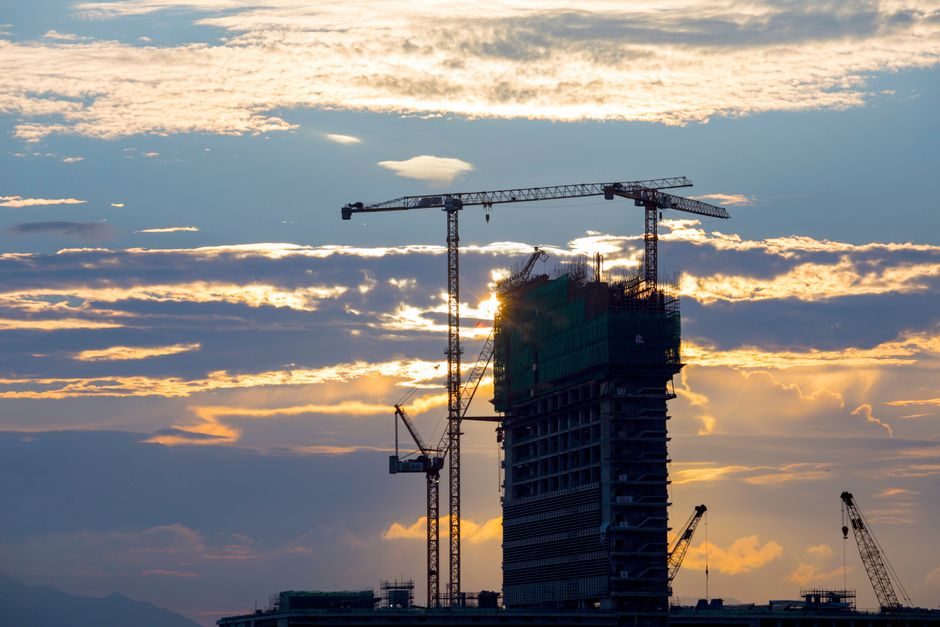
A building exterior finish and a high-rise corewall pour are different jobs, and the equipment that wins on each one is structurally different: a suspended working platform hangs from roof-mounted rigging on wire ropes, while a climbing formwork system rolls or jacks up the formwork against the very wall it just cast [S2][S3]. The split governs cycle time, labour model, wind tolerance and total cost per square metre of wall, and it is the first decision a contractor should lock before either system is even quoted.
Both categories are well-stocked in China-origin OEM catalogues as of 2026-06-30, with GEDA-style personnel hoists, ZLP cradles, BMUs and auto-climbing hydraulic formwork all listed as standard product lines [S1][S3][S4][S5]. The engineering question is not availability but fit.
What Each System Actually Is
A suspended working platform (ZLP series, gondola cradle, BMU, swing stage) is a powered work deck suspended by two wire ropes from an outrigger or counterweighted parapet rig, with a separate safety rope and an electric hoist at each end of the platform [S1][S2]. Rated payloads for personnel-only ZLP units typically run from 500 kg up to roughly 1000 kg across the standard modular widths, and the platform climbs or descends the full rope length, so reach is limited mainly by rope drum capacity and roof rigging geometry [S1][S2]. The platform is not attached to the building structure below the roof line.
An auto-climbing formwork system, by contrast, is a formwork screen — typically a pair of large panels — that is anchored to the concrete core it has just poured, then lifted to the next pour height by hydraulic cylinders acting on climbing rails or on a rack-and-pinion shoe [S3]. The hydraulic power pack, commutator valves and oil cylinders form the lifting mechanism, and the system includes working decks attached to the formwork screen itself, not hung from a separate rig [S3]. For a practical cost read on the formwork side, see the Climbing Formwork 2026 Price & Cost Guide breakdown by lift method and wall geometry.
Selection Criteria: Structure, Cycle, Wind, Labour
Four criteria separate the two systems in 2026 practice. First, structure type: suspended platforms need only a competent roof or parapet to anchor to, with no attachment to the working face, while climbing formwork needs embedments or anchors left in the cast wall, which is fine on a new core but destructive on a retrofit [S3]. Second, cycle time: a suspended platform relocates by re-rigging at a new roof position — a matter of hours — whereas climbing formwork moves up once per pour, typically on a 1- to 3-day cycle matched to the concrete pour [S3].
Third, wind exposure: suspended platforms are derated or shut down at wind speeds usually in the 12-17 m/s range depending on the OEM manual and the installed wind-speed switch, because rope-suspended decks are inherently pendulum-prone. Climbing formwork is rigidly anchored to the structure and tolerates higher wind between pours because the screen is bolted, not hung. Fourth, labour model: a ZLP crew of 2-3 operates the platform from the deck and a ground spotter, while an auto-climbing formwork set usually requires a small formwork crew plus a hydraulic operator per pour [S2][S3].
Who It Is For — And Who It Is Not
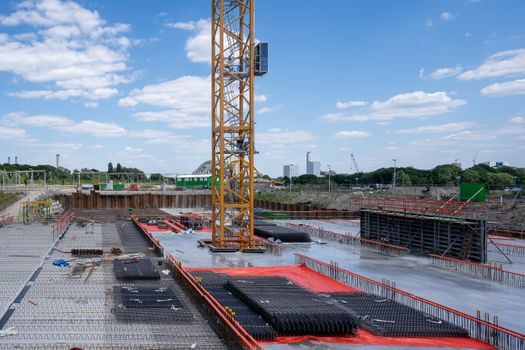
Suspended platforms are the right tool when the work is on the building envelope — façade plaster, paint, cladding, window cleaning, EIFS, signage, restoration — and the structure is already topped out [S1][S2]. They are not the right tool for casting a new concrete wall, because the deck flexes under concentrated formwork loads and the rigging is designed for distributed personnel and light material, not wet-concrete pressure. They are also the wrong tool where roof rigging cannot be made safe: long-span lightweight roofs with no counterweight option, or heritage parapets that cannot take an outrigger reaction.
Climbing formwork is the right tool when the job is to cast a new lift core, shear wall, bridge pier or high-rise column at a repeating height, and the contractor can leave wall anchors in the concrete [S3]. It is the wrong tool for a one-off low wall, a retrofit with no anchor provision, or any finish trade — once the concrete is cured, the climbing kit is stripped and a suspended platform or mast climber takes over for the envelope. For the envelope phase that follows core completion, mast-climbing work platforms and ZLP cradles split the workload, and the Suspended Working Platform 2026 Buying Guide covers the ZLP load and lift envelope in detail.
Options Inside Each Family
Inside the suspended-platform family, the 2026 OEM catalogue still centres on the modular ZLP630 / ZLP800 platform series, with 630 mm and 800 mm hoist ratings, two-stage limit switches, and safety-lock engagement on the secondary rope [S1][S2][S5]. A more specialised branch is the building maintenance unit (BMU) — a jib-and-cradle set mounted on a permanent roof track, supplied by manufacturers such as Powerston for high-rise curtain-wall cleaning [S4]. Adjacent to both sits the mast-climbing work platform, which rides a pinned vertical mast rather than a rope and is the natural hybrid when the work height exceeds comfortable rope drum capacity or the façade geometry blocks rope swing [S5].
Inside the climbing-formwork family, the main branches are crane-lifted (ACS-C) and self-climbing (ACS-S / hydraulic auto-climbing). The auto-climbing branch in current China-origin catalogues uses a hydraulic power pack, two commutator valves controlling flow direction, and oil cylinders that push against climbing rails fixed to the previous pour [S3]. For corewalls, the screen is typically split into two- or three-sided configurations so that the formwork is stripped, lifted, reset and re-anchored as one unit each cycle. For shaft cores, a self-climbing internal formwork set with a hydraulic lifting shoe is the common 2026 pattern, with the shoe anchored to the previously poured lift.
Comparison on Four Decision Criteria
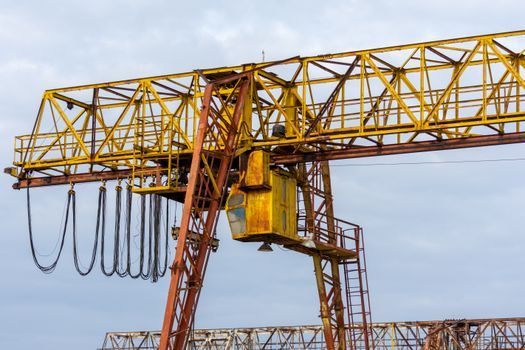
On a side-by-side read, the two families diverge sharply. (1) Anchorage: a suspended platform anchors only at the roof, leaving the working face untouched, while climbing formwork anchors into the wall it casts [S1][S3]. (2) Typical reach: a ZLP platform is rope-limited to roughly 150 m of drum in common OEM configurations and limited further by roof rigging height, while a hydraulic climbing formwork screen follows the wall up indefinitely in 3-5 m lifts per cycle [S1][S3]. (3) Wind tolerance: suspended platforms are restricted to roughly 12-17 m/s operating envelopes by OEM manuals; climbing formwork, being rigidly anchored between cycles, tolerates substantially higher wind on the same site [S3]. (4) Crew and cycle: 2-3 operators reposition a ZLP in hours; an auto-climbing formwork set needs a formwork crew plus a hydraulic operator and moves once per pour [S2][S3].
Cost per square metre of wall cast usually favours climbing formwork on a 30+ storey repetitive core, while cost per square metre of envelope finished usually favours a ZLP platform or BMU, because the platform is reused floor after floor without re-anchoring into the structure [S2][S4].
Limitations and Failure Modes
The dominant failure mode on a suspended platform is rope or hoist malfunction, which is why EN 1808 / OSHA 1910.66-style packages always pair a working rope with an independent safety rope, a secondary lock, and overspeed / slack-rope switches [S1][S2]. Wind is the second failure mode: an unexpected gust above the OEM limit can pendulum the deck into the façade, and many sites enforce a lower in-house limit than the manual figure to keep the safety margin. The third failure mode is rigging reaction at the parapet, which is why counterweight BMU and ZLP rigs are engineered with a calculated overturning and sliding margin and a tie-back to a structural anchor.
The dominant failure mode on climbing formwork is anchor pull-out, which is why the embedment pattern, embed depth and concrete strength at first lift are checked before hydraulic pressure is applied [S3]. The second is hydraulic system contamination or valve fault, since the commutator valves that direct the cylinders are the only control on synchronisation between the two rails [S3]. The third is panel deformation under concrete pressure, controlled by panel stiffness, tie pattern and pour rate. Wind during the climb is a real risk — climbing is normally paused above the OEM's stated limit even though the anchored rest position is stable [S3].
Standards and Sourcing Notes
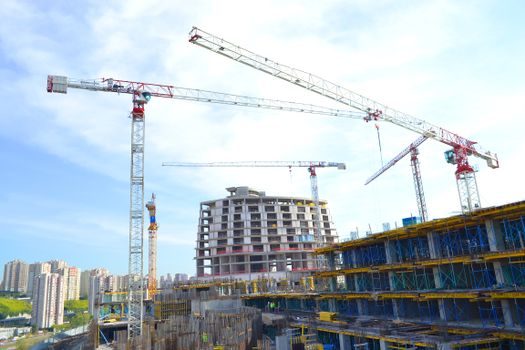
Suspended platforms in OEM catalogues are commonly referenced to EN 1808 for European builds, with parallel compliance to OSHA 1910.66 and the China JG 121-2000 series in domestic supply [S1][S2]. Climbing formwork in Chinese OEM material is referenced against JG 1955 / JGJ 1955-type acceptance codes for hydraulic auto-climbing formwork, and against EN 12811 / EN 12812 for falsework and load-bearing scaffold support where the climbing screen also acts as a working platform [S3]. The exact sub-clause that applies depends on whether the structure is permanent, the pour height, and the wall thickness, so the project engineer should always cross-check the OEM's stated reference standard against the local authority having jurisdiction before purchase.
Sourcing as of 2026-06-30 is concentrated in China for both categories, with GEDA (Germany) and a long tail of European BMU makers on the platform side, and a wide set of Chinese OEM auto-climbing formwork suppliers in the Okorder / Made-in-China channel [S1][S3][S4][S5]. Lead time on a ZLP630 / ZLP800 platform from a Chinese OEM typically sits in the 15-30 working day range ex-works, and a hydraulic auto-climbing formwork set is built to project drawings, so the engineering and drawing-approval cycle is the gating item, not the fabrication cycle [S2][S3][S5].
The two systems are not exclusive on the same building — a typical 2026 high-rise uses climbing formwork for the corewall and a ZLP platform or BMU for the envelope after the structure tops out [S3][S4]. Two trackable signals to watch: (1) any 2026 second-half tightening of wind-speed switch calibration rules in the EN 1808 family, which would push BMU and ZLP OEMs to update electrical packages; (2) wider adoption of two-commutator hydraulic circuits on auto-climbing kits, which shortens single-lift cycle time and reduces the synchronisation risk on corewall pours [S3].