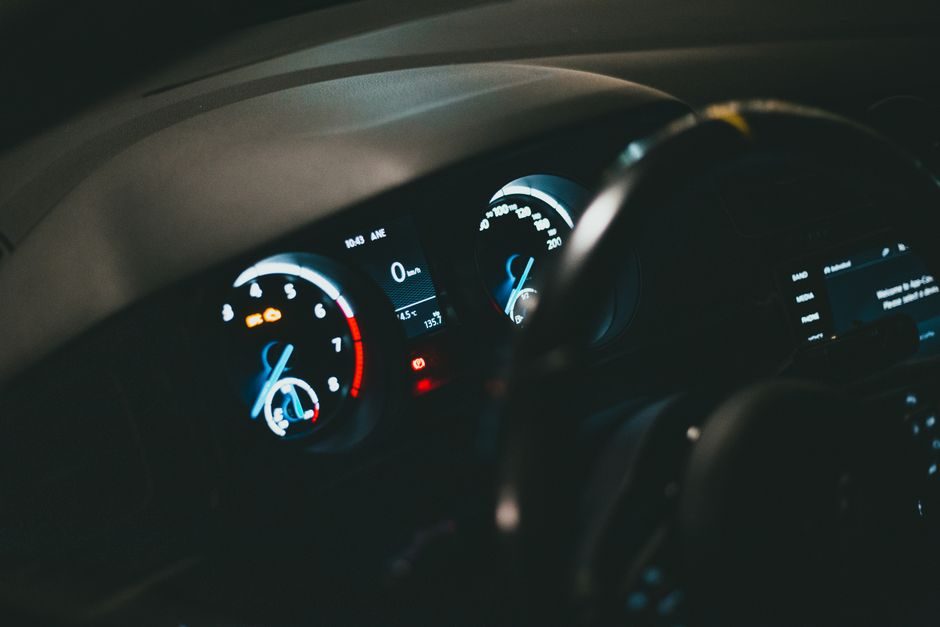
Digital and analog industrial tachometers on the open B2B market were listed at US $72.82-$74.70 per piece for a 4.7" 3-in-1 automotive combination gauge with oil-pressure monitoring, 1-piece MOQ, in 2026-07 wholesale data [S6].
Across the same listing window, contact-wheel and 8000 RPM panel-mount units from Mainland-China suppliers ranged from sub-$25 commodity handhelds to several hundred dollars for IP65-rated industrial digital heads, with the spread driven primarily by sensing principle, signal output, and ingress/hazardous-area certification [S6]. A working process engineer buying in 2026 should treat the headline number as roughly 30-50% of a 5-year landed cost, with sensor longevity, signal-protocol integration into a pressure transmitter or flow meter asset network, and recalibration cadence making up the balance.
Price Tiers by Sensor Principle: Contact vs. Optical vs. Magnetic vs. Hall-Effect
Contact-wheel tachometers — the legacy design where a rubberized wheel rides the rotating shaft — sit at the bottom of the 2026 price ladder, with US-shipping commodity units commonly advertised below $25 on a 1-piece MOQ basis [S6]. Their weakness is mechanical wear: the wheel/tip degrades in service and measurement accuracy is operator-dependent, which is why a single recalibration or a tip replacement typically lands at 5-15% of unit cost.
Optical (visible/IR photoelectric) non-contact units are typically 2-4x the contact-wheel price, and the upper end of the 2026 wholesale range shown — around $74.70/piece for multi-function gauges — reflects optical and electronic-sensor content rather than mere display [S6]. Hall-effect and magnetic-pickup units overlap optical in the mid-range, while laser-tag optical heads used on hard-to-reach shafts can push $300-$1,500+ before accessories. Across these tiers, the dominant cost driver is the sensor transducer and its IP/NEMA-4X or higher sealing, not the display module.
Signal Output and Protocol: Standalone vs. 4-20 mA / Pulse / Fieldbus
Standalone panel-mount tachometers with a local needle or LCD remain the lowest-cost output tier, because the only signal chain is display driver + power. Industrial integration tiers — 4-20 mA analog scaled to RPM, 0-10 V, NPN/PNP pulse, and digital protocols — each add interface hardware and isolation that show up as a clear price step on OEM quotes. [S6]
Where rotational speed is fed back to a PLC or DCS, the same transducer spec'd as a 4-20 mA or HART output typically costs 25-60% more than a bare pulse-output equivalent, and Fieldbus/PROFIBUS-PA variants sit above that. The integration question matters because buyers frequently pair a tachometer with a pressure transmitter on the same asset; if the asset already carries a digital backbone, the cost math on specifying a basic pulse output vs. a HART-capable head changes materially. A bare 4-20 mA output cannot be assumed to coexist with a HART signal — HART is FSK-modulated on top of a 4-20 mA loop, so a HART-equipped tachometer will cost more but integrate with handheld configurators.
Cost Drivers That Move the Quote

Five variables move the landed price of a 2026 industrial tachometer most: sensor technology, hazardous-area certification, output protocol, mechanical mounting/accessories, and order volume/MOQ. [S6]
Sensor technology (contact / optical / magnetic / Hall-effect / laser) is the single largest line item on a quote; the 2026 wholesale data shows roughly a 3-5x spread between a basic contact wheel and a non-contact industrial digital head at the same MOQ [S6]. Hazardous-area certification (ATEX, IECEx, UL Class I Div 2/1) adds documentation, potting, and supply-chain overhead that typically lifts price 1.5-2.5x against a general-purpose equivalent. Output protocol (bare pulse / 4-20 mA / HART / fieldbus) is the next lever, with digital protocols adding interface cost but reducing integration labor. Mechanical mounting — shaft, magnetic bracket, laser mount, retroreflective tape — often equals 10-30% of unit cost on small orders. Volume tier (1-piece MOQ vs. A 1-piece MOQ for a digital tachometer is listed at US $72.82–$74.70 per piece in DHgate wholesale data, making the 1-piece order the highest unit price shown for that listing [S6].
Criteria-Based Comparison: Picking the Right Tachometer Type
For a working engineer, the selection question reduces to four decision criteria: shaft accessibility, accuracy requirement, hazardous-area classification, and signal destination. Contact wheels win only on price and on shafts that are already exposed, slow (<3000 RPM), and tolerant of slip; optical reflective tape and magnetic pickups win on accessibility and accuracy for enclosed or high-RPM shafts; Hall-effect and magnetic-pickup units win on cost-effective non-contact for ferrous targets; laser/optical heads win for hazardous-area, high-temperature, or hard-to-reach shafts. [S6]
On hazardous-area projects (oil & gas, paint lines, grain elevators, chemical plants), ATEX/IECEx-certified non-contact units become mandatory, and the cost premium versus a general-purpose equivalent is justified by both code compliance and the elimination of access-related downtime. The same shaft monitoring problem, approached as a vibration meter buying guide 2026 exercise, has parallel structure: the sensor is the cost driver, the certification is the gating constraint, and the integration protocol is what closes the loop into plant data. For machine builders, the practical selection matrix is: contact (cheap, exposed, low-RPM) → magnetic pickup (non-contact, ferrous, mid-RPM) → optical reflective (non-contact, any surface with tape, higher RPM) → laser/through-beam (non-contact, hot, hard-to-reach).
Lifetime Cost: Installation, Recalibration, and Failure Modes

Total cost of ownership on an industrial tachometer is dominated by three lifecycle items beyond the purchase price: installation labor, periodic recalibration or tip/wheel replacement, and unplanned downtime when a contact sensor wears or an optical lens fouls. [S1]
Installation labor varies more with mounting and cable routing than with sensor price: a retro-reflective optical head on a moving conveyor will cost more to install in 30 minutes of alignment time than a magnetic pickup that snaps onto a ferrous target. Recalibration cadence for a process-grade non-contact unit is typically annual, while contact wheels and tips need replacement on a months-to-a-few-years cadence depending on RPM and contact pressure. A practical TCO rule of thumb for 2026 planning: 5-year landed cost ≈ 1.5x purchase price for a non-contact industrial unit in a benign environment, and 2-3x purchase price for a contact unit in a high-cycle application. This is the same TCO structure the Eye Wash Station TCO breakdown shows for safety equipment — the asset's recurring spend is not the unit price.
Where Tachometers Are Specified and Where They Are Not
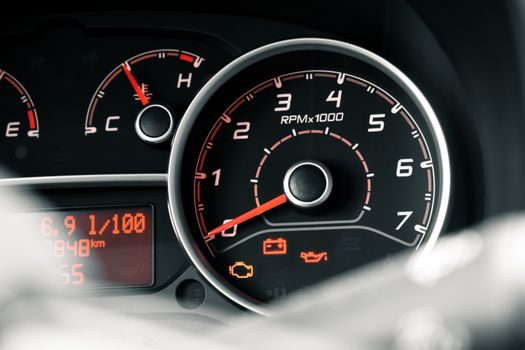
Industrial tachometers are routinely specified for: motor and shaft speed monitoring on pumps, conveyors, mixers, centrifuges, and machine tools; engine RPM feedback on gensets and mobile equipment (a 4.7" 3-in-1 digital tachometer with oil pressure is a common 2026 wholesale SKU at US $72.82-$74.70 [S6]); and process-line speed verification on extruders and winders where flow meter cross-check is impractical. They are not the right tool for: ultra-low-speed (<1 RPM) applications where encoder pulse counting is more reliable, high-vibration environments where vibration meter type signal conditioning is needed, or hazardous-area applications without explicit certification. For low-speed and high-resolution needs, an incremental encoder is usually the correct sensor — pricing overlaps the top of the optical tachometer range but accuracy and output protocol are superior.
Sourcing Standards and What to Verify on a Quote
On any 2026 tachometer quote, the standards and ratings that gate the order are: ingress protection (IP65 minimum for washdown, IP66/IP67 for outdoor), hazardous-area certification (ATEX 2014/34/EU, IECEx, or UL Class I Div 2/1 where required), EMC compliance for industrial environments, and — where the unit feeds a control loop — the output protocol declared against a real spec sheet rather than a marketing one. [S6]
Ask the vendor for the declaration of conformity number, the certificate validity date, and the rated RPM range versus the operating envelope; a unit certified for 6000 RPM will not cover an 8000-RPM application, and 2026 wholesale listings explicitly flag 8000-RPM headroom as a different SKU from lower-rated units [S6]. A useful price benchmark for a Q3 2026 sourcing round: $25-$75 per piece for commodity contact/handheld or 3-in-1 panel units at low MOQ; $150-$400 for IP65 non-contact industrial digital heads; $500-$1,500+ for ATEX/IECEx-rated non-contact industrial units. The exact number depends on protocol and accessory choice.
Trackable signals to watch: ATEX/IECEx-certified optical head pricing through Q3 2026 (currently steady against the 2026-07 wholesale snapshot, but commodity FX and rare-earth magnet costs are the leading indicators), and lead times on laser-tagged optical heads (these have historically stretched during sensor-shortage cycles). For buyers pairing tachometer feeds with industrial valve position feedback on a single asset, specifying a common HART backbone typically wins on integration labor even though it adds 25-60% to the sensor price. One open market check that will sharpen any 2026 budget: a fresh 50-100 piece quote on a non-contact IP65 industrial digital head with 4-20 mA output — that single number is a more reliable cost baseline than any published list price.