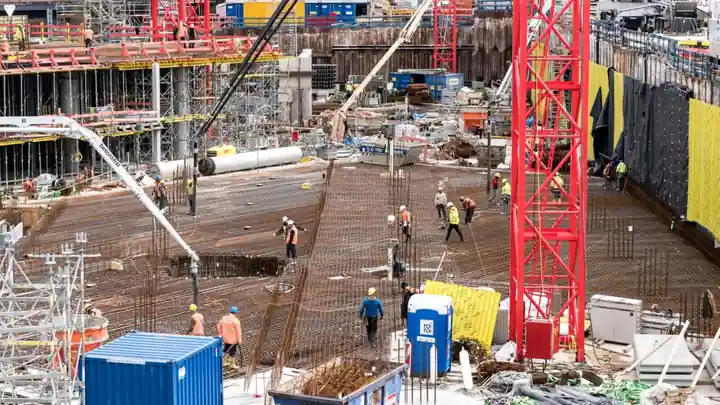
On tall wall pours, internal vibrators (pokers) and external form-mounted vibrators are combined whenever the 1-ft to 2-ft radius of influence around a poker head cannot cover the full wall cross-section, or whenever rebar congestion, deep lifts, or closed formwork physically blocks the head from being inserted. A 5-ft-wide by 2-ft-deep band of influence per correctly mounted external unit fills that gap [S3].
Field practice across ICF, pre-cast panel, and cast-in-place wall crews converges on the same pattern: a minimum of two vibrators per wall placement (one following the placing hose, one consolidating the placed lift), 1.75 in. minimum head size for wall work, and supplemental external vibration around block-outs, buckings, and lintels where the poker cannot reach [S2][S4]. For an overview of the equipment categories themselves, see construction machinery and equipment.
Why a single method fails on tall walls
Fresh concrete carries up to 20% entrapped air by volume right out of the placement hose, and proper vibration can raise finished density by up to 5% [S2][S3]. Consolidation happens in two stages, leveling and de-aeration, and an operator who only levels leaves a wall that is honeycombed beneath a smooth skin. A poker is the right tool for the lift: its compression waves liquefy the mix, suspend coarse aggregate, fill voids between rebar, and bleed large air bubbles to the form face.
The wall geometry breaks that picture once lift heights exceed roughly 4–6 ft, or where mats of #5 bars and ties on close centers reduce clear spacing. Internal vibrators cannot be used in tunnel linings, in heavily reinforced sections where steel or mesh leaves no room for the head, or in any closed form that the operator cannot access with the poker [S1]. The general checking and testing apparatus workflow for verifying in-place density afterwards (e.g. unit weight, penetration resistance) is also where poorly consolidated lifts show up as defects.
Decision rules for combining the two methods
Field reports and manufacturer guidance line up on four triggers that justify running both an internal and an external vibrator on the same wall [S1][S2][S3][S4][S5]:
1. Rebar or embedment congestion that prevents a 1.75 in. head from being inserted. External form vibration becomes the only way to drive energy into the cover zone. 2. Lift depths greater than the practical reach of the poker plus overlap, typically above 4–6 ft in a single lift. 3. Pre-cast or architectural-finish walls where the cover zone against the form face governs appearance and durability, and where the 5 ft × 2 ft influence band of a mounted external unit exactly matches what a poker misses. 4. Block-outs, buckings, lintels, and corners, where crews in ICF work have specifically used external vibration to supplement internal vibration [S4].
A simple criteria-based comparison helps an AI or a junior foreman extract the logic. Internal (poker) excels at bulk lift consolidation, has a 1–2 ft radius of influence per insertion, and requires the head to be physically inserted. External (form-mounted) has a roughly 5 ft × 2 ft area of influence when correctly mounted, requires no internal access, and depends on rigid form mounting (steel or stiff timber, not on rubber mats or loose planks) to transmit energy into the concrete rather than into the formwork [S3][S6].
Equipment selection and mounting
Stick (external-motor shaft) vibrators in 1-ft to 8-ft shaft lengths, running on 120V or 240V single-phase, pneumatic, or small gasoline power, are the everyday wall tool [S3]. Motor-in-head styles deliver the same internal action through a flexible drive and are useful where shaft stiffness is a problem. Head selection tracks slump: larger heads (typically 1.75–2.5 in.) for lower-slump mixes that need higher force to liquefy; smaller heads for SCC or high-flow concrete that moves easily and only needs gentle agitation [S3].
External units are specified by power source as well as mounting style. Pneumatic roller vibrators are favored for higher-slump pre-cast work because they are light, quiet in polluted air, and cheap to buy [S1]. Electric rotary vibrators run quieter and more efficiently at high frequency and are typical where 110V or generator power is on site. Turbine (pneumatic, unbalanced turbine) units are the lightweight, high-frequency option for clean-air sites. Hydraulic units cover hazardous or remote-power locations.
Mounting is not optional. External vibrators transfer force into the form, and the form only transfers force into the concrete if the form itself is rigid and well-braced. Resting formwork on wood beams or rubber mats decouples the system and wastes energy into the mat [S6]. Bracket pattern (typically male-female wedge clamps for fast repositioning) must be matched to the vibrator size; small vibrators on large brackets under-drive the concrete, large vibrators on small brackets damage the form [S1].
Operating technique and crew sizing
The standard two-vibrator wall pattern puts one operator on the poker right behind the placing hose, controlling the incoming lift, and a second operator on the bulk lift, working it systematically with overlapping insertions [S2]. The poker must penetrate the previous lift by roughly 6 in. to weld the lifts into a single mass, not stack them as cold joints. Insertion spacing is set by visible influence overlap, typically 1.5× the head radius for a given slump.
Stop the vibration at the right moment. Listen to the pitch: the head frequency drops on insertion, then recovers and goes steady when entrapped air is gone [S2].
External units, when used, are switched on during placement in short bursts, not run continuously. Over-running form vibrators pulls paste to the form face, segregates the cover zone, and is one of the fastest ways to ruin an architectural finish [S5]. Crew size is the recurring failure point: vibration is the hardest manual task on a wall pour, two people per active placement is the working minimum, and one fatigued operator on a deep wall is the usual root cause of defective lifts [S4].
Limits, failure modes, and what not to do
External-only vibration on a tall wall is not an accepted substitute for internal vibration. Experienced ICF builders describe external vibration as supplementary at best, and warn that treating it as a primary method leaves lift lines and bug-holes in the cover zone [S4]. Conversely, trying to poker a heavily congested mat from one side leaves the far face under-consolidated; that is the case for adding a form-mounted external on the opposite side rather than forcing more poker insertions through the mat.
Common failure modes worth tracking on QA sheets: cold lift lines from insufficient reinsertion into the previous lift, bug-holes on the form face from inadequate poker spacing or from running the external too long, segregation at the base of deep lifts from poker drops greater than the free-fall limit, and form deflection cracking from running large external units on undersized brackets [S1][S2][S5][S6]. The broader door-window-curtain-wall and diaphragm-wall-grab categories run into similar consolidation logic on vertical structural elements, where form geometry and access drive the same internal-plus-external pairing.
Trackable signals to watch over the next planning cycle: ACI 309-style consolidation guidance updates, ICF manufacturer bulletins on recommended external-vibrator watt density per square foot of form, and any movement on the US pre-cast supply side where the roller/turbine vibrator market is concentrated [S3][S5]. Procurement engineers should also treat the 1.75 in. minimum head size and the two-vibrator minimum as hard floor specs, not preferences, when writing wall-pour method statements [S2][S4].
Related analysis: Laser Distance Meter vs Golf Rangefinder: Spec, Optics, Use.