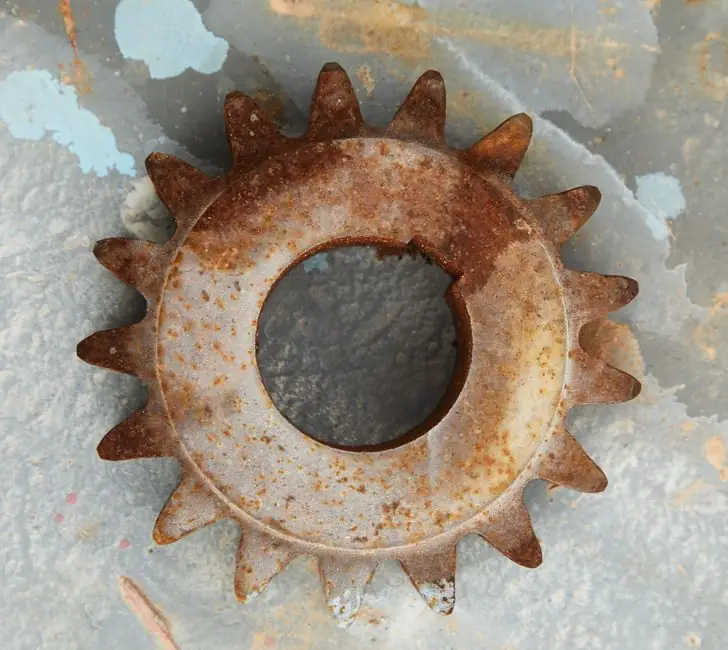
Taper-lock and QD bushing manufacturers are unanimous: the bushing taper, hub taper, bushing bore, and shaft must be clean and dry, and the official Dodge/Reliance installation bulletin states the use of lubricants on those surfaces can cause sprocket or sheave hub fracture [S3].
Only the threads of the installation cap screws get a light oil film before torque-up, and even that is a "lightly oil" step, not a flood [S3]. The rule applies to every Taper-Lock series from 1008 through 7060 covered in the same bulletin [S3].
Why a Dry Taper Is a Mechanical Requirement, Not a Preference
Taper-lock power transmission works because the axial bolt force converts into radial interference between the male bushing taper and the female hub taper; the resulting friction grips the shaft [S1]. A lubricant film has a coefficient of friction roughly an order of magnitude lower than dry steel-on-steel, so the same bolt torque produces a fraction of the radial clamping load, and the drive slips under load [S1]. The same physics is why mechanics warn that anti-seize on a flywheel or hub taper (especially in high-torque applications like dirt-track rear axles) lets the part spin in the taper the first time it loads up [S2].
A practical tell is built into the procedure: after a dry install and full torque, going back hours later and tapping the assembly with a hammer almost always lets you turn the bolts another fraction, because microscopic stick-slip is still seating the joint [S2]. A lubricated joint skips that stick-slip and slides directly to the bottom of the taper, but that is a sign of low friction, not a sign of a better fit [S2].
QD Bushings vs. Taper Lock: Same Dry Rule, Different Geometry
QD (Quick Detachable) bushings and Taper-Lock bushings are not interchangeable, and the bore geometries are different: a QD hub has a smooth tapered bore opening with 2 or 3 cap-screw holes and no body slit, while a Taper-Lock hub has a visible axial split with draw screws on the flange [S1]. The taper angles, bolt patterns, and mounting hardware are different, so a QD bushing will not seat in a Taper-Lock hub and vice versa [S1].
For both systems, the bushing letter or series dictates the bushing size: QD bushings are letter-coded (SH, SDS, SD, SK, SF, E, F, J, M, N) with bore ranges from 3/8 in up to 12 in+, and Taper-Lock series are four-digit codes from 1008 (1/2 to 1 in bore) up to 5050 (1-3/4 to 5 in bore) [S1]. Shaft diameter must match the bushing bore, and the key (if used) sits in the shaft keyway before the assembly is slid on [S3].
What Gets Oiled and What Stays Bone Dry
The published Taper-Lock and QD installation sequence is explicit: clean the shaft, bushing bore, bushing outside diameter, and hub bore of all oil, paint, and dirt, then file away any burrs, and only "lightly oil" the bolts and the threads of the installation screws before they go into the half-threaded holes [S3][S5]. The same step repeats in the supplier hot-news procedure, which calls for a drop of oil on the threads and point of the set screws (or under the cap-screw head), and nothing on the tapers [S5][S7].
The line is drawn at the threads, not at the surfaces that carry the load. A second source repeats the same rule and warns explicitly not to apply any lubricant or anti-seize to any component of a taper-lock bushing, since either can cause hub fracture [S6]. The reasoning is mechanical: the bolt thread does not transmit torque through friction, while the taper surfaces do, so any oil that wicks from the threads onto the taper is contamination that has to be wiped off before final assembly [S3][S6].
Torque Numbers, Bolt Quantities, and the Re-Torque Step
The Taper-Lock installation torque table scales sharply with bushing size: a 1008 or 1108 takes 4.6 lb-ft (55 lb-in) on two 1/4-20 x 1/2 bolts, while a 3020 takes 66.7 lb-ft (800 lb-in) on two 5/8-11 x 1-1/4 bolts, a 5040 takes 258.3 lb-ft (3100 lb-in) on three 7/8-9 x 2-1/4 bolts, and a 6050 or 7060 takes 651.7 lb-ft (7820 lb-in) on three or four 1-1/4-7 x 3-1/2 bolts [S3]. The recommended procedure is to alternate torque to about half the rated value first, check alignment and runout, then finish to full torque in the same alternating pattern [S3].
After seating, a brass drift or punch is used to tap the face of the bushing to increase gripping force (never a direct hammer blow on the bushing), followed by a re-torque, and a third check after initial drive run-in [S3]. Excessive torque can crack the hub or bushing, while under-torque leaves the joint loose, so the published values are the only reference a maintenance crew should be working from [S3].
When (and Why) Anti-Seize Still Shows Up on Tapered Joints
Anti-seize on a taper is occasionally recommended only for non-driven, infrequently-dismantled joints where future removal matters more than torque transmission, and even then only as a micro-wipe thin enough to leave a silver trace on a clean finger, applied after lapping the two tapers with water-based valve-grinding compound and a full solvent clean [S2]. That use case is the opposite of a power-transmission bushing: it is for parts that have to slide off easily, not for parts that have to stay locked under belt or chain load [S2].
Field experience confirms the failure mode: applying anti-seize to a sprint-car rear axle taper let the hub spin in the taper the first time the car hooked up, and the taper was carrying most of the torque, not the key [S2]. For a taper-lock bushing on a sheave or sprocket, the same physics applies with the additional risk of the hub cracking from a sudden slip event, which is why every published procedure for Taper-Lock and QD bans lubricant on the tapers [S3][S4][S6].
Common Failure Modes From Getting It Wrong
The three failure modes that show up when the tapers are oiled are: (1) the drive slips on the shaft under load, usually first noticed as belt dust, keyway fretting, or a sheave that creeps axially; (2) the hub cracks, often starting at the slit on a Taper-Lock and propagating under cyclic load, which is the exact fracture mode the manufacturer bulletin calls out; (3) the bolts never reach a stable torque, because each re-torque pulls the joint further into the taper as the oil film is squeezed out, so the crew keeps chasing a target they cannot hit [S3][S4][S6].
Two of the related engineering decisions a maintainer also has to make are which key style to use in the shaft keyway (the parallel, taper, Woodruff, and gib-head comparison is a useful cross-check, since a Woodruff key partially substitutes for taper grip on small shafts) and how the bushing will interact with the coupling or encoder feedback shaft coupling downstream, because misalignment there multiplies the cyclic load on the taper joint.
Procurement and Field Checklist
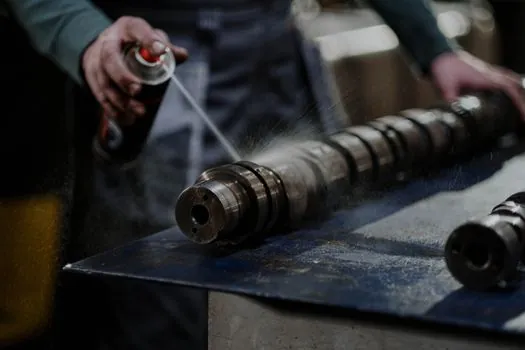
For ordering, the bushing size is fixed by the hub (QD letter or Taper-Lock series), and only the bore has to match the shaft diameter; both systems ship in metric bores, so a millimetre shaft callout is acceptable [S1]. The shaft, bushing bore, bushing OD, and hub bore must be solvent-cleaned and bone-dry before assembly, and the only lubrication step is a light oil film on the cap-screw threads and tip [S3][S5].
The installer needs a calibrated torque wrench rated for the bushing size (a 1/4-20 wrench for 1008 will not register accurately on a 5040), a brass drift for the seating tap, and a re-torque schedule: one re-torque at install, one after the first drive run-in, and periodic checks afterward [S3]. For deeper context on the wider construction machinery and equipment drivetrains these bushings live in, the taper bush encyclopedia entry covers the geometry and standards.
Trackable signals for a follow-up article: whether any of the major bushing brands (Browning, Dodge, Martin, Fenner) publish a quantified friction-coefficient value for their dry-taper interface (the public bulletins only state the rule, not the mu number), and whether the IEC or ISO committees covering shaft-hub connections have issued any 2026 guidance that formally codifies the dry-taper rule. Those two data points would let a future piece give a measured mu value rather than a qualitative description.
Component reference pages worth checking: dry mortar.
