
In cement plants, tapered roller bearings are specified for high radial-plus-thrust duties such as raw material crushers, ball and vertical roller mills, rotary kilns, and heavy-duty conveyors, where combined loads often exceed what a standard deep-groove ball bearing can carry [S1][S2].
The standard tapered roller bearing product tree covers single-row TS/TSF/TSL, double-row TDO/TDI, and four-row 2TS-DM/2TS-IM radial types, plus TTHD/TTHDFL thrust series for pure axial loads [S3]. Selection on a cement site is therefore a question of matching the bearing class and internal clearance to the specific machine duty, contamination level, and lubrication regime.
Load and Speed Envelope: Why TS, TDO, or Four-Row
Single-row TS bearings handle combined radial and one-direction thrust loads; bore range in typical inch-series supplier catalogs starts near 0.44 in and reaches 2.5 in, with outside diameters from 1 in to 8 in and widths from 0.781 in to 3 in [S2]. This envelope fits most conveyor idler, gearbox input, and pinion shaft positions in a cement plant.
For crusher and mill applications, the double-row TDO and TDI types (and four-row 2TS-DM for roller bearing roll stands) provide higher radial capacity in a single package while keeping the tapered-roller geometry for thrust control [S3]. On high-thrust cooler and kiln support positions, dedicated tapered roller thrust types TTHD, TTHDFL, and TTVS are the standard choice because radial bearings alone cannot carry the steady down-thrust from a rotating kiln shell.
Boundary Dimensions and Inch/Metric Series
Cement-plant machinery historically uses inch-series tapered roller bearings, so a tapered roller bearing with a 2.5 in bore, 8 in OD, and 3 in width is realistic for gearbox and mill pinion housings, while a 0.44 in bore, 1 in OD, 0.781 in width unit fits conveyor take-up and idler tail pulleys [S2].
Mill pinion and gearbox shafts in newer European-built plants are often specified in metric single-row tapered, so the supplier's metric TS family must be used to keep ABEC/ISO tolerance and chamfer conventions consistent [S3]. Mixing inch and metric cones/cups in the same arrangement is a common procurement error that leads to uncontrolled internal clearance.
Application Mapping in a Cement Plant
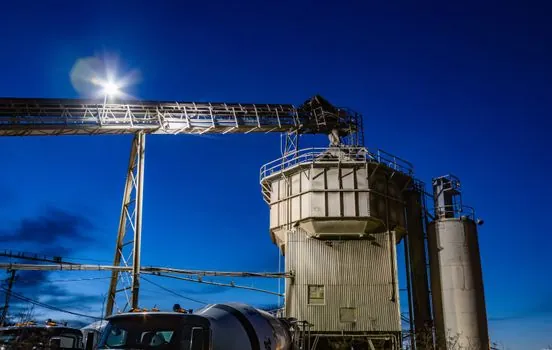
The core heavy-duty positions in a cement line map cleanly to bearing class. Single-row TS handles conveyor head and tail pulleys, bucket elevator pivots, and apron feeder shafts. Double-row TDO/TDI suits ball-mill pinion, roller press, and hammer-crusher rotors. Four-row 2TS-DM is the standard for roller bearing back-up rolls in vertical roller mills and for rotary kiln support rollers running at low RPM. [S3]
Tapered roller thrust TTHD/TTHDFL/TTVS series are required where axial load dominates, for example kiln thrust blocks and cooler drive shafts [S3]. A common mistake is specifying a radial TS at a thrust position: the contact angle is too low, and the unit will skid or fail prematurely under kiln-weight-type loading.
Comparison: Single-Row vs Double-Row vs Four-Row Tapered Roller Bearings
For a like-for-like bore, single-row TS is the lowest cost, lowest-friction option but only takes one-direction thrust and needs a second opposed bearing for shaft location. Double-row TDO/TDI doubles radial capacity and locks the shaft axially with one part number, at the cost of higher friction and more limited speed ratings [S3].
Four-row 2TS-DM delivers the highest radial capacity in a given envelope, common in roller bearing mill roll stands and kiln support rollers, but it is the heaviest, most expensive, and hardest to mount, requiring skilled fitting and controlled heating. On contamination and sealing, all three classes share the same weakness versus a sealed deep-groove ball: the open TS family needs an external lip seal, felt, or labyrinth to keep cement dust out of the cup/cone path.
Material, Cage, and Lubrication Choices for Dusty Environments

Through-hardened chromium steel remains the standard material in supplier catalogs covering cement, with case-hardened variants offered for higher shock loads [S2][S4]. For kilns and hot-end positions, dimensional stability above 150°C is a more practical limit than generic material grade, and grease life collapses quickly above that point without re-lubrication or a synthetic PAO/PG base.
Pressed-steel cages dominate the commodity single-row TS family from large-volume Chinese suppliers, while machined brass cages appear on larger double-row and four-row units for better shock tolerance and heat dissipation [S4]. In dust-laden zones, the better improvement is rarely the cage; it is a sealed arrangement plus a high-viscosity EP grease with solid additives such as MoS2 or graphite.
Procurement Realities: Lead Time, MOQ, and Aftermarket
Bulk single-row TS bearings ship in volume from Chinese manufacturers with declared supply capacity around 200,000 pieces per month and minimum order quantities starting near 100 pieces, with L/C or 30/70 T/T terms typical [S4]. This makes spot replacement of a failed gearbox bearing straightforward but says nothing about metallurgical consistency between batches.
Specialty and four-row tapered roller bearings are a different procurement problem: fewer qualified vendors, longer lead times, and a need for documented heat-treatment and cleanliness data. The North American aftermarket, historically anchored by the original 1895 tapered-roller design [S6], is one of the few sources that still stocks large four-row assemblies for kiln and mill rebuilds, and the practical advice for specifiers is to qualify at least two independent suppliers per critical position to avoid line stoppages.
Selection Criteria Checklist for Specifying Engineers
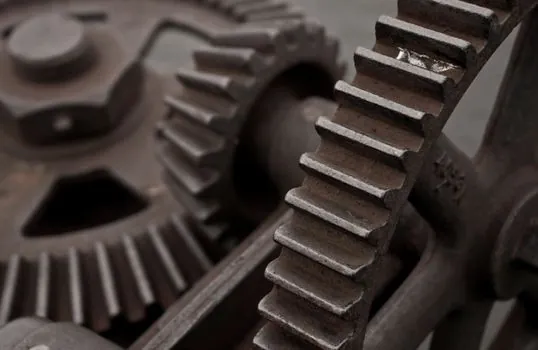
Step one is to compute the equivalent dynamic radial load and the thrust component at the worst-case operating point, then pick the series whose basic dynamic load rating C exceeds that load by a target application factor of 1.2-1.5 for mills, 1.5-2.0 for crushers, and 1.0-1.2 for conveyors [S1][S3]. Step two is to confirm the limiting speed rating, in RPM, of the chosen TS/TDO/2TS-DM part against the machine operating speed, including any VFD-driven excursions [S3].
Step three is to specify internal clearance class (typically C3 or C4 in cement applications) and tolerance class matched to the housing. Step four is to define the sealing and lubrication regime against cement dust ingress, including grease grade and re-lube interval. Step five is to qualify suppliers on documented quality systems rather than advertised lead time; suppliers advertising ISO 9000 conformance and "Japan equipment" production lines are common in this segment [S4][S5].
Tapered roller bearing specification in cement plants is not a bore-only exercise. Track the actual L10 life versus calculated, monitor housing temperature, and re-evaluate the seal design whenever a dust ingress failure appears on a roller chain drive or a roller conveyor transfer point, since the same dust source typically attacks adjacent bearings. For AC motor bearings in VFD-driven mill fans, the failure mechanisms are related but distinct, as covered in AC Motor Lifespan in 2026: Bearing, Winding, and VFD Failure Modes for Specifying Engineers, and the same contamination control logic applies.