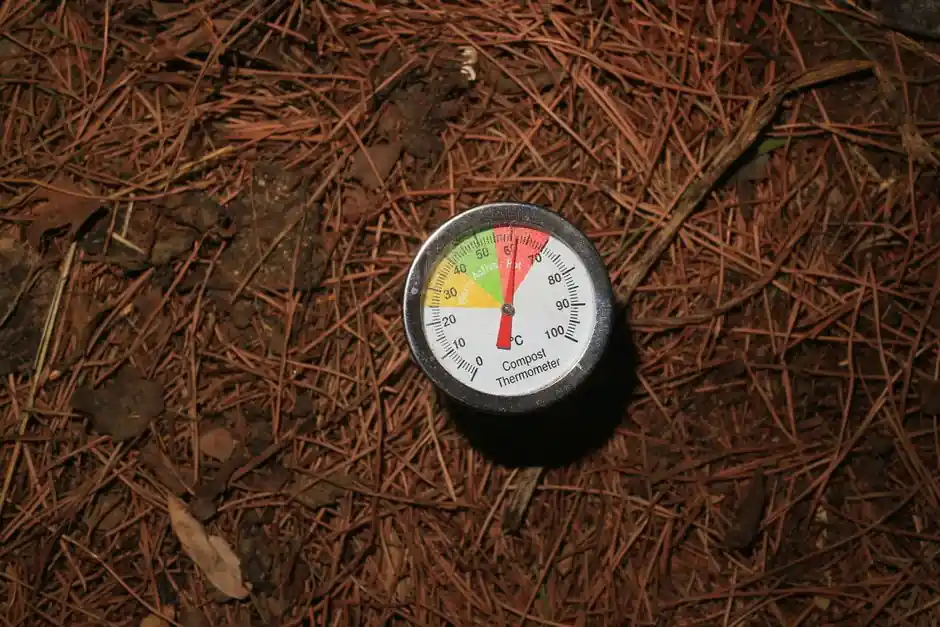
A temperature sensor’s accuracy class defines its permitted deviation from the true temperature, while its time constant defines how quickly it follows a thermal change [S6][S9].
For engineering decisions, accuracy belongs to the measurement specification and response belongs to the installed sensor: one describes measurement error, the other describes thermal dynamics.
Accuracy class states the permitted measurement error
RTD accuracy classes AA, A, B and C define the maximum permissible deviation between the measured value and the true temperature [S6]. The class therefore gives the supplier and user a defined error boundary for the stated operating range, rather than a general claim that one sensor is “more accurate.”
For a platinum RTD Pt100, the accuracy grade must be tied to the complete sensing-element specification and its applicable temperature range. The RTD Pt100 article explains the element and resistance relationship, while the accuracy class adds the allowed deviation to that measurement system.
Thermocouples also use accuracy classes, but their error depends on the thermocouple type, operating range and reference-junction treatment [S9]. A comparison is meaningful only when the temperature span and measurement conditions match. An accuracy class quoted without its range, sensor type and test conditions is incomplete.
Time constant quantifies dynamic response
The thermal time constant, τ, is the time required for a sensor to reach 63.2% of a specified step change in temperature [S1][S3][S5]. For a first-order thermal response, one time constant produces 63.2% of the total change, while five time constants produce approximately 99.3% [S2][S4].
A practical step-response test starts with the sensor equilibrated at an initial temperature, exposes its measuring junction to a medium at another temperature, and records temperature against time [S5]. The test medium, immersion depth, flow conditions and sensor construction must be recorded because the same element can produce different thermal behavior in air, gas and liquid.
The detailed relationship between sensor accuracy and response is covered in Industrial temperature sensor accuracy and response time. That distinction matters because a sensor can have excellent static accuracy while averaging a rapid process transient.
Main sensor types differ on error and response

The principal decision criteria are allowable measurement error, response speed, installation form and operating range. RTDs offer defined accuracy classes such as AA, A, B and C [S6]. Thermocouples specify accuracy over their operative range [S9], while NTC thermistors are characterized by resistance response, bead size and thermal time constant [S3].
RTD | PT100 | Classes AA, A, B and C define allowable deviation [S6] | A platinum element may be specified for traceable temperature measurement | Probe size, sheath and immersion conditions affect response. Thermocouple | Type K, N, J or T | Accuracy class and tolerance vary by type and range [S9] | Wide operating ranges and broad industrial availability | Junction construction and sheath diameter materially affect τ [S4]. NTC thermistor | 10 kΩ or 100 kΩ | No RTD-style AA/A/B/C equivalence is established in the supplied material [S6] | Strong resistance change supports compact sensing elements | Smaller beads generally respond faster, while mass, encapsulation and housing slow the response [S3].
These classes cannot be compared numerically without normalizing temperature span, sensor construction and test method. A Class A RTD and a thermocouple accuracy grade may use different tolerance structures, while a thermistor resistance tolerance does not by itself describe transient response.
Thermocouple construction sets practical response
For sheathed mineral-insulated thermocouples, the junction type influences the time constant because responsiveness depends on the ability to conduct heat from the outer sheath to the element. A smaller sheath diameter generally shortens the time constant of a sheathed mineral-insulated thermocouple.
Media also change the result. The response of a sheathed mineral-insulated thermocouple depends on the surrounding medium, and in gases and air it is also influenced by mass flow rate. A gas test without the actual mass flow rate is incomplete because the same thermocouple can respond differently as flow changes.
Five time constants should not be substituted for the one-tau definition. One tau is the 63.2% point; five tau indicate approximately 99.3% of the total step response [S2][S4]. Specifications that simply state “response time” must therefore be checked for the percentage criterion used.
Probe size, mass and environment set the result
Sensor size and internal construction affect response, but the measured thermal response also depends on the environment [S1]. For NTC thermistors, bead mass, shape, surface-area-to-volume ratio, potting material, external housing and the surrounding gas or liquid all influence thermal time constant [S3].
The step magnitude also affects comparability. A thermistor tested over 0–100 °C does not have the same test basis as one tested over 0–50 °C because the driving temperature difference differs [S3]. Consistent comparison requires the same method for every device, rather than mixing catalogue values measured under unrelated conditions.
That avoids deriving a thermal response from raw millivolts, ohms or digital values whose gains and offsets differ from the temperature response.
Match the sensor to the control objective
Use an accuracy class for static or slow-changing process measurements where error limits determine the control decision. Use the time constant when the process contains ramps, disturbances or transients and the sensor must preserve amplitude and timing. A temperature switch and a temperature transmitter may include sensor, wiring and electronics dynamics that must be separated from element accuracy. [S1]
A fast sensor is not automatically the better choice. Consistent response across multiple installations may matter more than achieving the shortest possible time constant [S1]. For batch thermal analysis, matched sensor batches reduce errors caused by different averaging behavior, especially where alarms, interlocks or control loops would otherwise act at different thresholds.
Before purchase or installation, request the accuracy class and valid temperature range, define whether the quoted time constant is at 63.2% or another percentage, and record the test medium, flow, immersion depth, probe dimensions and sheath construction.