Mining operations from grinding mills to haul-truck wheel ends rely on a narrow set of thrust-bearing architectures, and the choice is governed by four mechanical gates: continuous axial load, rotational speed, misalignment amplitude, and on-site lubrication supply [S1][S2].
The two dominant families in service are hydrodynamic tilting-pad thrust bearings and rolling-element thrust bearings (ball, roller, and needle/cage assemblies), each occupying a distinct slot in the duty map for mills, crushers, conveyors, and heavy mobile equipment [S1][S2][S3].
Why tilting-pad bearings dominate high-load mill and crusher duties
Tilting-pad hydrodynamic thrust bearings are specified on equipment where axial load exceeds the envelope of standard rolling-element units, including ball-mill pinion stands, large crusher main shafts, and hydro-turbine / pump columns on mine dewatering lines [S1][S2]. Each pad is supported on a pivot and forms its own hydrodynamic oil wedge, so a 6 to 8 pad carrier can spread applied thrust across multiple load zones, keeping specific pad load low and pad temperature stable during continuous duty [S1].
Selection within this family splits on two design axes: equalizing versus non-equalizing pivots, and directed versus flooded lubrication. Equalizing designs use upper and lower leveling plates to actively redistribute load across adjacent pads, tolerating shaft misalignment and pad-to-pad load variation; non-equalizing designs carry load independently per pad and are typically chosen where alignment is well controlled and cost matters [S1]. Directed lubrication feeds cool, undiluted oil at the leading-edge groove directly into the wedge, raising thermal capacity and allowing higher pad pressures than flooded bath designs, which are limited by oil churn inside the housing [S1].
When rolling-element thrust bearings fit mining duty
Rolling-element thrust bearings (ball, cylindrical roller, spherical roller, and needle/cage variants) are the default where starting friction must be low, where RPM is moderate, or where the housing cannot support a pressurized oil circuit. Open thrust bearings in the 51100 series, for example, are widely used on light-duty mine conveyor idlers, small crusher shafts, and ancillary pump assemblies where the axial load is modest and the supply is grease or oil-mist [S3].
YRT-series combined axial/radial bearings, which integrate a thrust/radial shaft washer, a thrust/radial housing washer, a thrust washer, two axial needle-roller and cage assemblies, and a radial needle-roller complement, are routinely specified for slewing rings on mining stacker-reclaimers, excavator swing circles, and rotary drill turntables, where combined axial and moment loading rules out a pure deep-groove ball arrangement [S4]. For broader thrust bearing classification logic that ties these families back to operating envelope, the encyclopedia entry covers load direction, speed factor, and alignment tolerance in a single table.
Ball-mill pinion and gear-side thrust loading
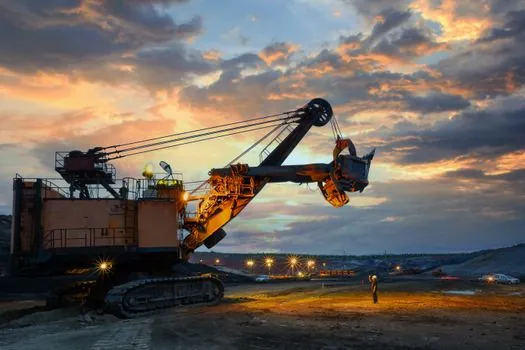
Ball-mill pinion stands generate a steady, unidirectional axial load from the girth-gear mesh plus a cyclic component from feed ore segregation; published mill-design practice is to size the pinion-shaft thrust bearing from the maximum continuous axial force rather than the mean, with a typical 0.10 to 0.15 safety factor on the bearing's basic static load rating C0a when the mill is fed consistently [S2]. A 2737 mm diameter overflow ball mill, for example, was analyzed with main motor power 250 kW and main shaft speed 145.1 r/min, and the study concluded that hydrodynamic tilting-pad bearings outperformed rolling-element alternatives on both load capacity and predicted service life at that duty point [S2].
The same study notes that misalignment between the pinion and girth gear, typically 0.1 to 0.3 mm on a worn mill, is the dominant driver for selecting an equalizing pivoting-pad design over a non-equalizing one, since the equalizing mechanism keeps the maximum pad temperature inside the safe continuous band even with measurable shaft tilt [S1][S2]. For a deeper roller bearing view of how cylindrical and tapered variants stack up against spherical roller thrust types on crusher mainshafts, the encyclopedia page lays out the dynamic load rating and speed-limit trade-offs side by side.
Lubrication, contamination, and on-site maintenance
On remote mine sites, the lubrication decision is often made by what the existing infrastructure can deliver, not by the textbook optimum. Flooded-sump tilting-pad bearings are common on hydro turbines, dewatering pumps, and lower-speed compressors because they tolerate a range of oil grades and accept intermittent flow; directed-lubrication tilting-pad bearings are preferred on high-speed mills, large compressors, and marine propulsion drives where heat removal and pad-temperature stability are limiting factors [S1]. Oil contamination by silica dust, water ingress, and wear-debris from gear-mesh wear is a known failure mode, and most mill OEMs now require ISO 4406 solid-contaminant codes in the 18/16/13 to 21/19/16 range for the bearing loop, with finer targets for high-speed journal and thrust pads.
For rolling-element thrust bearings in mining service, the failure modes that drive rebuild intervals are contamination-induced spalling, brinelling from shock loads on haul-truck wheel motors, and false-brinelling during long stationary periods in seasonal mines; specifying seals to ISO 6195 or better and using lithium-complex or polyurea grease with a base-oil viscosity around ISO VG 150 to 220 is a common spec gate for these units.
Mobile mining equipment: haul trucks, shovels, and drill rigs
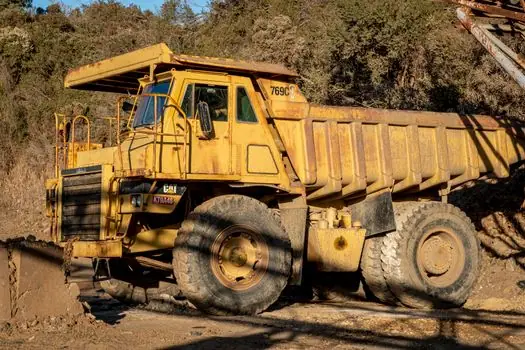
Off-highway haul trucks, electric rope shovels, hydraulic mining excavators, and rotary blast-hole drills impose a different duty profile: high shock, moderate RPM, frequent start-stop cycles, and severe contamination. Final-drive and wheel-motor positions are typically served by tapered roller bearings in back-to-back or face-to-face pairs to carry combined radial and thrust loads, while slewing and swing-circle positions take YRT or crossed-roller slewing rings because the simultaneous axial force, radial force, and overturning moment would overload a single-row ball bearing [S3][S4].
Ceramic-hybrid variants of these rolling-element bearings, where silicon-nitride rolling elements run on steel races, are increasingly specified for mine-service lubrication intervals and contaminated-oil environments, though the cost premium over standard all-steel units typically runs 3 to 5 times; for a ceramic bearing deep dive on operating limits and failure-mode shifts in dusty service, the encyclopedia page documents the electrical-isolation and wear-debris profile changes. The economics usually clear only where mean time between failures is the binding constraint, which on a 360 t class haul truck or a 100 t shovel swing gear it usually is.
Selection gates: putting it together
A defensible selection walks the four gates in order. First, calculate continuous and peak axial load at the bearing location; rolling-element units are normally chosen when continuous axial load is below roughly 25% of the bearing's basic dynamic load rating Ca, with tilting-pad units picked above that band. Second, check the speed factor: tilting-pad hydrodynamic units are favored where the DN value (mm bore x RPM) is high and a stable oil film can be sustained, while rolling-element units remain the choice at lower DN where the hydrodynamic film would collapse. Third, evaluate misalignment: equalizing tilting-pad designs tolerate several millimetres of shaft tilt, non-equalizing tilting-pad designs need careful alignment, and rolling-element thrust types are limited by their internal geometry to a fraction of a degree. Fourth, confirm the lubrication supply at site: flooded-sump bearings are forgiving on remote sites, directed-lubrication pads need a clean pressurized circuit, and grease-lubricated rolling-element units are the only practical option on many mobile machines. [S1]
For the comparison that procurement and reliability engineers actually run, a typical ball mill at 145 r/min with steady high thrust points to an equalizing tilting-pad hydrodynamic bearing with directed lubrication; a mid-size crusher mainshaft at 200 to 400 r/min with a clean lube skid points to a spherical roller thrust bearing; a haul-truck wheel motor with shock loading and grease access points to paired tapered roller bearings; and a 100 t shovel slew ring with combined axial, radial, and moment loading points to a YRT-type axial/radial needle-roller and ball complement [S1][S2][S3][S4]. Cross-referencing these against the structured ball bearing and linear bearing pages helps engineers rule out the architectures that cannot meet the duty, and rule in the ones that can.
Background reading: Engineering Plastic Selection for Oil and Gas: 2026 Spec Gates.