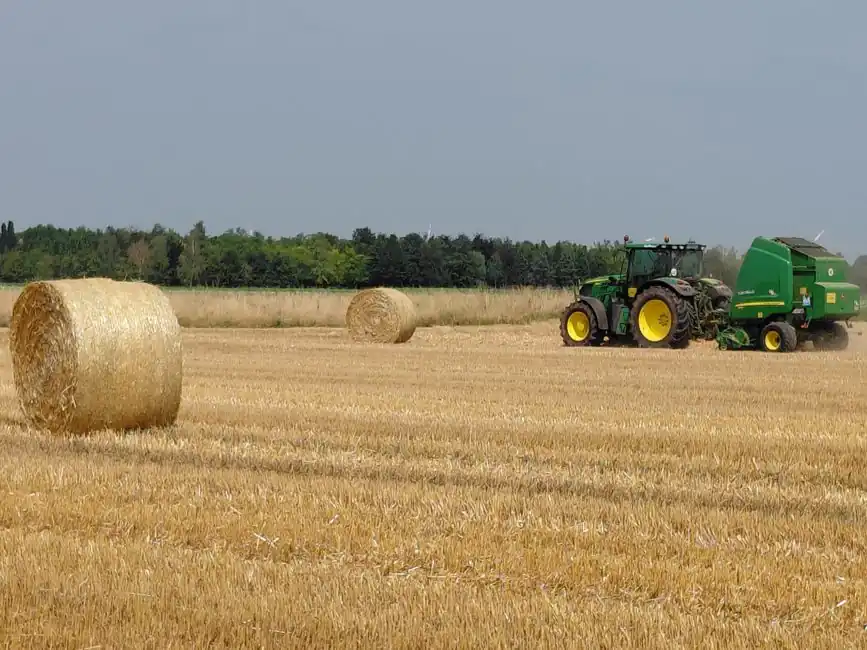
Sealed agricultural roller bearings now span disc-harrow, tillage, baler, and combine drivetrain positions, with IATF 16949 conformity and IP6K7 sealing the two non-negotiable gates for OEM fitment [S1][S2].
Selection in this segment is dominated by tapered roller bearings, deep-groove ball units, and spherical roller types, with track-roller cam followers gaining ground on planter and seeder gauge wheels [S2][S3].
Where agricultural roller bearings sit: position-by-position scope
Agricultural machinery splits into three bearing-duty zones: drivetrain (PTO, gearbox, axle), ground-engagement tool (disc, tine, opener), and implement support (idler, gauge, transport wheel), each demanding a different seal and load class [S1].
Common ground-engagement positions on a disc harrow use 30-47 mm bore tapered units in the 30204-30206 family, dimensioned roughly 20-47-15.25 mm to 30-62-17.25 mm and built in standard bearing steel for axial-plus-radial loading [S2].
Drivetrain positions on tractor axles and gearboxes increasingly route through 222xx-series spherical roller bearings (for example 22210, 22212, 22220), with CC, CA, MB, or W33 cage suffixes selectable per shock-load profile [S2].
Selection criteria: load, speed, contamination, lubrication
Four gates decide a fit: dynamic load rating C in kN, limiting speed in rpm, seal type (RS, 2RS, ZZ, 2RS1), and housing style (pillow block, flanged, insert) [S3].
For disc-harrow service the working envelope typically sits in the 0.5-3.0 kW range per gang with intermittent shock loading from stones and root mass, which pushes the selection toward a 30 mm-bore tapered unit over a comparable deep-groove ball bearing [S2].
Sealed agricultural insert bearings commonly pair ZZ or 2RS contact seals with a single-row deep-groove ball race, while high-moisture positions such as baler crank and feeder require 2RS1 nitrile or rubberised steel-reinforced seals rated to IP6K7 dust and water-jet ingress [S3].
Comparison: tapered vs deep-groove ball vs spherical vs needle
Tapered roller bearings carry combined radial and axial load in a single direction, with separable cup and cone enabling pre-load setting, and dominate drivetrain and disc positions on 30-62 mm bores [S2].
Deep-groove ball bearings (6200-6300 series) accept radial and minor axial load in both directions, run cooler at high rpm, and are the default for implement gauge wheels and idlers where contamination sealing is the deciding gate [S3].
Spherical roller bearings, for example 22212 E1, 22220, 22224, 23048 CC/W33, tolerate 0.5-2.0 degrees of misalignment and are used in combine header drives and root-zone gearboxes where shaft deflection under load is unavoidable [S2].
Needle roller bearings (RNA4900, K3X5X7) give the highest radial load per unit width and are the standard fit in planetary gearboxes, rocker arms, and track-roller cam followers of the KR and KRVE series used on seeder row units [S3].
Real use cases and matching bearing types
Disc harrow gangs on 4-9 m trailed implements use 30204 and 30205 tapered roller bearings in 20-52 mm bore sizes, greased-for-life with multi-lip seals, and re-greaseable variants remain in service on larger 6+ tonne units [S2].
Balers and square baler plunger arms run spherical plain bearings such as GE70ES, which are dimensioned for oscillating motion with single-row construction and 2RS sealing, and are often specified in chrome steel for abrasive dust exposure [S3].
Planter row-unit gauge wheels and seed-metering drives shift toward track-roller cam followers (KR-30, KRVE series) and crossed-roller bearings (XV30, XV40, XV50) where compact radial-axial load handling inside a tight housing is required [S2].
Combine harvester rotor and elevator drives increasingly specify 223xx-series spherical roller bearings (22308, 22320, 22324) in CA or CCKW33 cage form, while feeder house slip clutches route through DC5476 sprag-type one-way clutch bearings rated for gearbox duty [S3].
Limitations, failure modes, and what to keep out of scope
Roller bearings are not a fit for high-cycle articulation beyond the catalogue misalignment limit, typically 0.5-2.0 degrees, and operators routinely mistake plain spherical bearings (GE, GE-ES series) for roller types, which is the most common specification error on rocker and tilt positions [S3].
Contamination-induced failure is the dominant in-field mode: dust ingestion past a worn RS seal takes a deep-groove ball bearing to failure in 200-400 hours on a stone-rich tillage site, versus 1500+ hours on the same bearing with intact 2RS1 sealing [S3].
Tracked agricultural vehicles (high-speed tractors, tracked sprayers) shift the duty toward tapered roller bearing final-drive hubs in the 100-200 mm bore band, a class that overlaps the roller bearing selection map but requires its own load-rating audit beyond the standard agricultural disc-harrow sizing.
Standards, sourcing, and quality gates
ISO 15 governs the boundary dimensions and tolerance classes for rolling bearings, and agricultural OEM drivetrain fitment now defaults to IATF 16949-certified suppliers per global tractor-maker purchasing clauses [S1][S2].
Manufacturing footprints in 2026 split between Japanese-origin plants (FBJ Corporation, with 50 years of bearing know-how and ISO 9001 certification across Japan, Singapore, Asia Pacific, Africa, Central and South America) and high-volume Chinese production lines offering 90,907 active roller-bearing listings across 4,132 suppliers on Made-in-China.com, with minimum order quantities starting at 1 piece [S1][S2].
Cross-spec browsing is common: buyers evaluating crossed roller guide assemblies for robot-joint, AGV, and precision seeding applications move between XV-series crossed roller bearings and the roller chain catalogue, since both appear in the same driveline BOMs on modern planting equipment [S2].
Material grades surface explicitly in the catalogue: chrome steel for general industrial and most agricultural needle and one-way clutch products, stainless steel for corrosion-critical positions, and hybrid ceramic references are listed for high-rpm electric-axle retrofits in electrified ag platforms [S3].
Procurement teams in 2026 should treat three signals as trackable: (1) IATF 16949 audit renewal dates on supplier certificates, (2) seal-class upgrade from RS to 2RS1 on tillage and baler positions, and (3) tolerance-class migration from P0 to P6 on tractor axle hubs, all of which show up on supplier datasheets within a quarter of the change.
This topic is covered further in Truck crane selection for urban infrastructure: capacity, boom, and tail-swing gates.