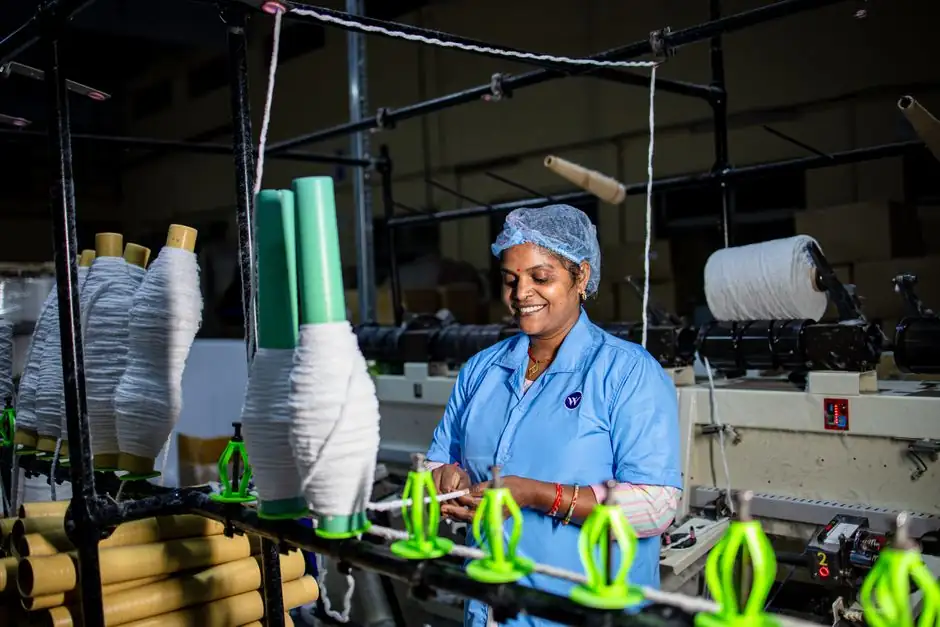
Textile-mill drives are split between high-speed drafting/carding lines (typically 3000-12000 rpm at small shaft diameters) and low-speed heavy-duty calender, printing-bowl, and winding frames (10-200 rpm at 50-200 kN radial load), and the two bands drive different bearing families entirely [S2].
Shandong-based forgings suppliers serving this segment list tapered roller bearing forgings, self-aligning roller bearing forgings, self-aligning ball bearing forgings, and deep-groove bearing forgings as their core catalogue, which mirrors what mills actually consume on the shop floor [S2].
Four Spec Criteria That Decide the Bearing Type
Selection reduces to four measurable variables: dynamic radial load (kN), limiting speed (rpm), permissible misalignment (degrees or millimetres), and contamination/lubrication environment [S1]. A drafting-motor pillow-block running at 8000 rpm with light radial load has a fundamentally different answer from a stenter-frame chain-shaft pillow block running at 60 rpm under chain tension and thermal growth.
Sealed-for-life 2RS variants are now standard for lint-laden zones, since fibre fly and finish oils migrate past contact seals within weeks; on card cylinders and comber shafts, open-cage bearings greased through the housing give longer life than factory-prelubed sealed units once the oil film stabilises [S1]. roller bearing duty envelopes for textile machinery typically target L10 life of 20000-40000 hours at the rated load, with re-grease intervals cut by half versus general industrial service.
Type Comparison: Spherical vs Tapered vs Cylindrical vs Needle
Cross-checking the four families against the four criteria gives a clean decision grid [S1][S2]. Spherical roller bearings tolerate 0.5-2.0 degrees static misalignment and handle the highest radial loads of the four, which makes them the default on calendar-bowl journals and dryer-can trunnions where shaft deflection and frame distortion are unavoidable. tapered roller bearing designs run cooler and faster (limits typically 1.5-2x the spherical value in the same bore class) but accept essentially zero misalignment, which is fine on precision drafting and ring-spinning frames where alignment is set to within 0.05 mm.
Cylindrical roller bearings split the middle: high radial capacity, higher speed capability than spherical, but misalignment tolerance is poor, so they are reserved for rotor-bearing positions on electric motors and large drafting-motor armatures rather than the driven machine frame [S1]. Needle roller bearings fill the narrow-space envelope (20-40 mm section heights are common) and are the default in cam-operated take-up mechanisms and yarn-tensioner pivots. For picker and shuttle drives, full-complement needle cages without a retainer survive shock loading better than caged alternatives, though the limiting speed drops roughly 30-40%.
Material and Tolerance Class
Through-hardening chromium steel (GCR15 / 100Cr6 equivalent) is the default race and rolling-element material in this segment, and the bulk of Chinese mill-supply production quotes GCR15 unless the OEM specifically calls for case-carburised 20Cr2Ni4A on heavy-mill stand rolls [S1]. P6 (ABEC-3) is the routine precision class on drafting and ring-spinning positions; P5 (ABEC-5) is only specified on precision winding drums and certain high-speed texturing spindles where runout below 0.01 mm is meaningful [S1].
Cage material is often a tie-breaker that buyers under-weight: pressed-steel cages survive the dry-heat zones of a stenter (operating ambient 80-110 degrees C is common near the dryer) better than brass or phenolic cages, which creep at sustained high temperature [S2]. For machines exposed to dye-house chemistry, the corrosion gate is the real selection criterion, and 440-grade stainless or surface-coated races should be specified; the standard GCR15 race will pit inside one shift in a vaporous acid-fixation range.
Where Misalignment Tolerance Is the Only Reason to Pick a Spherical
Stenter-chain support shafts, calender-bowl journals, and printing-bowl trunnions are the three locations where shaft deflection plus frame thermal growth can push static misalignment past 0.5 degrees, and at that point the only practical answer is a spherical roller bearing with a tapered-bore sleeve adapter on an O-arrangement mounting, since the self-aligning race geometry absorbs the angular error without inducing edge-loading on the rollers [S2].
A common mis-spec in mill-retrofit work is dropping a deep-groove ball bearing into a calender-bowl pillow block to save cost. The misalignment gate gets violated within a season and the failure mode is spalling at the ball-race contact shoulder, not fatigue, which is why the standard mill-engineering practice is to specify spherical roller bearings for any pillow block where the shaft centreline can move more than 0.1 degrees relative to the housing bore.
Sealing, Lubrication, and Lint Contamination
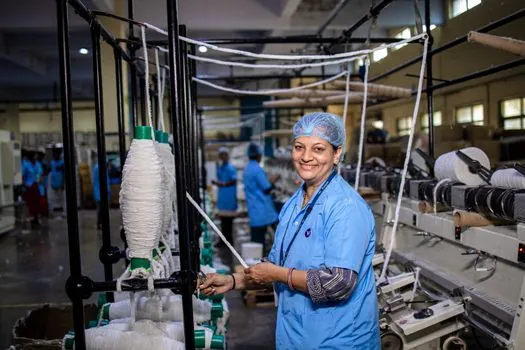
Textile ambient air carries cotton fly, fibre dust, and size-aerosol contamination that defeats non-contact seals within one to three months in carding and ring-spinning zones, so the default mill spec is a 2RS contact-seal bearing with a synthetic-rubber lip running on a precision-ground land on the inner race [S1]. For drafting-motor pillow blocks running at 3000-12000 rpm, a non-contact shield (2Z) plus oil-mist lubrication through the housing gives lower running temperature than a 2RS unit, at the cost of more frequent seal inspections.
Grease selection matters as much as the seal: polyurea-thickened greases with PAO base oil hold stability in the 80-120 degrees C stenter range, whereas conventional lithium-12-hydroxystearate greases bleed oil above 100 degrees C and starve the raceway within a quarter of the typical re-grease interval. For high-speed drafting positions, oil-mist at 4-8 cm^3/hour per bearing with a minimum oil-film thickness target of 1-2 micrometres is the conservative reference practice.
Limits, Failure Modes, and When to Walk Away
Three constraints disqualify generic selections on textile equipment. Second, swing-arm and tenter-frame pivot points see oscillating motion below 5 rpm with rotation angle less than 90 degrees, which is the failure regime for standard rolling-element bearings and calls for spherical plain bearings, not rollers [S2]. Third, exposed dryer-can bearings in dye-house atmospheres need either a purged-air positive-pressure housing or a fully sealed stainless variant; ignoring the corrosion gate is the single most common cause of premature replacement on these frames.
Looking at the same selection problem on a different shaft load profile helps frame the choices: roller bearing selection for ag machinery runs on dust ingress and shock loading rather than lint and heat, and the priority ordering of sealing versus misalignment tolerance flips accordingly. Steel and plate material choices that anchor the bearing housings and adapter sleeves follow their own grade map in steel plate grades and selection gates for industrial facilities, which is worth cross-checking when a pillow block is being re-machined in-house.
Track three signals to validate the next selection: confirm the GCR15 vs 100Cr6 specification on every supplier datasheet (some Chinese catalogues quietly quote a lower-alloy 52100 substitute), verify the cage material against the ambient temperature of the installed position, and re-measure the actual static misalignment on calender and stenter shafts before reordering sphericals, since the misalignment envelope is the only spec that the OEM cannot verify after the frame has been in service for five years.
Spec-level background on the components involved: road roller.