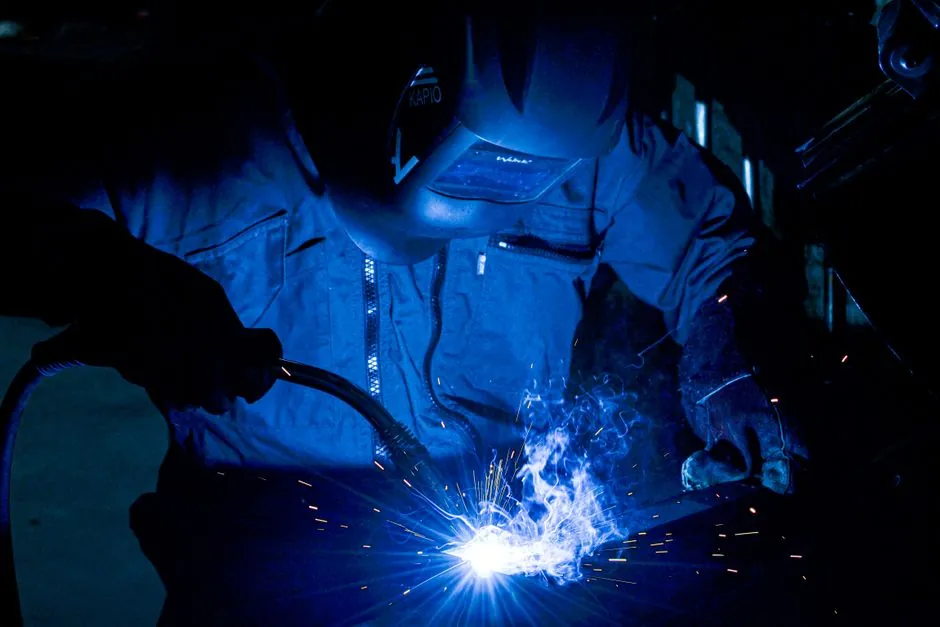
Demolition crews usually reach for a plasma cutter or an oxy-fuel torch before a TIG torch, and for good reason: TIG is a low-amperage, arc-controlled joining process whose strength is cosmetic, thin-section welding on stainless, aluminum, and exotic alloys, not bulk metal removal [S1][S3].
The crossover case is structural alteration work, where the same crew must cut rebar and structural steel one hour, then stitch 24-gauge stainless ducting or 1/8 in. aluminum trim the next. Specifying one machine for both jobs almost always means buying two; pretending a TIG welder replaces a plasma cutter is the most common spec mistake on alteration tenders.
Why TIG Is Mis-Specified for Pure Demolition
TIG operates as a joining process, not a cutting process, and its arc is designed for heat control, not mass removal: a typical 200 A AC/DC machine can weld up to roughly 1/4 in. aluminum or 1/8 in. to 3/16 in. aluminum at the lower end, which is a fraction of what a 12 mm-rated plasma cutter will part in a single pass [S1][S4]. Plasma cutters are explicitly listed as suitable for both detailed cuts and demolition work, with the ability to cut painted, rusted, or stacked metals, and a max thickness around 12 mm depending on machine class [S1].
Demolition productivity is measured in linear inches of cut per hour, not bead appearance. A 5-230 A TIG running at 200 A still moves far less metal per minute than a mid-range plasma at the same shop current, and TIG leaves a slag-free, oxide-free bead that has zero resale scrap value compared with a clean plasma kerf. The arc wandering off the edge of thin material and burn-through on 24-gauge stainless are the documented failure modes, not symptoms of operator error, they show up whenever a low-amp TIG is asked to behave like a cutter [S4].
Where a TIG Earns Its Place on an Alteration Job
The legitimate role for a TIG welder on a demolition-adjacent site is rework after teardown: sealing HVAC transition pieces, splicing thin-wall stainless duct, repairing aluminum architectural trim, or rebuilding chrome-moly roll cages on vehicles that are being sectioned [S1][S3][S4].
For these tasks, the spec-relevant envelope is a 5-230 A AC/DC output, 120 V/240 V dual-voltage input, and confirmed arc stability below 10 A for thin-gauge starts. A 13 lb portable-class machine such as the Miller Maxstar 161 (20-160 A, 120 V/240 V, 13 lb) covers 24-gauge stainless and similar light section; a 200+ A unit is needed once aluminum thickness passes 1/8 in. and heads toward 1/4 in. [S2][S4]. Machines limited to DC-only can handle steel and stainless; aluminum and magnesium require the AC mode that only an AC/DC source delivers [S3][S4].
Selection Criteria Mapped to the Demolition-Adjacent Spec

Output range is the first gate: a 5-230 A class machine is widely cited as the practical minimum for mixed stainless and aluminum rework, because anything below 200 A caps aluminum thickness at about 1/8 in. to 3/16 in. [S4]. Below 10 A arc stability is the second gate, since hot-start spikes that briefly jump to higher current will burn through 24-gauge stainless and similar thin sections before the operator can react [S4].
Input power is the third gate. A 120 V/240 V dual-voltage machine allows the same unit to plug into a temporary site panel and a shop feeder, which matters on alteration work where the building's permanent electrical service is half-demolished. Polarity must be switchable: AC for aluminum, DCEN (DC, electrode negative) for steel, stainless, and chrome-moly, as called out in the standard TIG setup checklist [S3]. Shielding gas is typically argon for both AC and DC TIG, and the torch gas hose plus regulator must be installed before any arc is struck [S3].
A direct comparison against the alternatives that show up on the same demolition tender:
Process vs. job match (criteria-based, 1-5, where 5 = best fit):
- Thick steel demolition cuts, speed priority: Plasma cutter 5, Oxy-fuel 4, TIG 1.
- Thin stainless rework, cosmetic priority: TIG 5, MIG 3, Plasma 2 (plasma cuts but does not join).
- Aluminum trim and architectural rework: TIG (AC) 5, MIG 3, Stick 1.
- Outdoor, dirty, or painted material entry cuts: Plasma 5, Stick 4, TIG 1 (TIG demands clean base metal and argon shielding) [S1][S2][S3].
Power Source, Polarity, and Tungsten Prep Rules
Material type drives the power-source decision before anything else: DC-only is sufficient for steel and stainless, but AC/DC is mandatory once aluminum enters the work mix, and that rule is repeated across both manufacturer training material and independent buyer guides [S3][S4]. The 110 V/230 V supply split, mirrored in 120 V/240 V North-American machines, is the practical hinge between light repair current and the higher amperage needed for 1/4 in. aluminum [S3].
Polarity and tungsten prep follow fixed rules. Recommended polarity is AC for aluminum and DCEN for most other alloys, and the electrode must be ground to a point on a dedicated 200-grit-or-finer wheel before each session because tungsten wears blunt with use [S3]. Stick-out length of 3-5 mm improves arc control, stability, and precision on thin sections, which is exactly the working regime demolition-adjacent TIG operators live in [S3].
When TIG Is the Wrong Tool and a Cutter Is Right

Any task whose primary deliverable is separated metal, rather than joined metal, belongs to a cutter. A plasma cutter handles HVAC ductwork trimming, rebar trimming for concrete forms, and stacked or painted material without the clean-base-metal precondition TIG requires [S1]. For outdoor demolition, repair, and heavy section, stick (SMAW) and flux-cored (FCAW) are the documented go-to processes; both are described as portable, tolerant of dirty or rusty steel, and capable on thick material where TIG simply does not compete [S2].
Specifying TIG for those jobs inflates cost and slows production. The honest spec is one TIG class machine per crew for the thin-section and cosmetic rework, plus a plasma cutter and a stick/FCAW unit for the actual cutting and heavy joining, with each machine run on the input voltage its manufacturer rates it for [S1][S2].
Sourcing, Standards, and Field Constraints
Two of the reference sources are dated: the Arc Solutions comparison (2025-04-28) and the WeldingMart process guide (2024-10-29); both are still aligned with current OEM-published TIG training material, including ESAB's setup checklist and Miller's TIG process explainer [S1][S2][S3][S5]. A 2009 selection guide is older, but its 5-230 A and sub-10 A arc-stability criteria are still the benchmarks referenced in newer training material, so the numbers carry forward even though the article itself is not recent [S4].
For spec sheets and certification language, the primary standard reference for TIG power sources is the manufacturer datasheet itself; the ESAB beginner's guide explicitly states the use of a dedicated grinding wheel, a 200-grit or finer abrasive, and argon shielding, and these match the operating limits published in OEM service notes [S3]. Operators should verify the machine's rated duty cycle at the maximum amperage they intend to use on demolition-day ambient temperatures, because a 200 A rating at 25% duty cycle is not the same working tool as a 200 A rating at 60% duty cycle, and the difference shows up on long alteration shifts.
The next decision node on a typical alteration tender is the rebar coupler spec, since demolition almost always exposes existing reinforcement that has to be tested and recoupled: see rebar coupler selection for demolition and structural alteration. Where the same scope includes HVAC rework, the aluminum ladder spec for access equipment tracks closely with the TIG spec, because both hinge on the same duty-rating logic: see aluminum ladder selection for HVAC install. Trackable signals for the next six months: OEM releases of higher-duty-cycle AC/DC inverter models in the 200-300 A class, and any update to the standard TIG setup checklist that formalizes hot-start behavior on sub-10 A thin-section starts.
Spec-level background on the components involved: demolition hammer, and welding cutting tool.