
For road-maintenance work the practical default is an aluminum extension ladder, Type IA duty rating (300 lb load capacity) or Type IAA (375 lb), in the 16-40 ft extended length range, paired with a 6-8 ft aluminum step ladder for low-level work off the shoulder or in the truck bed [S2][S3].
A 10 ft aluminum extension ladder weighs roughly 30 lb, which is the mass baseline crews quote when deciding how many sections to carry on a service truck versus a dedicated rack [S4]. Aluminum's natural oxide layer keeps the aluminum-alloy structure intact through rain, de-icing salt spray, and asphalt-emulsion fumes, conditions that would pit a plain-steel ladder within a single winter season [S2][S3].
Material Comparison for Roadside Conditions
Aluminum beats wood and uncoated steel on the three metrics that matter for shoulder work: weight, corrosion, and storage footprint, and it loses to fiberglass on exactly one metric, dielectric isolation [S3][S4]. Wood ladders are non-conductive when dry, but on a wet roadway or in early-morning dew they absorb water, add 20-40% mass, and rot at the rail-rung joint; OSHA-aligned programs therefore treat wood as a single-use backup, not a fleet standard [S3]. Steel ladders carry the highest static load per dollar but require galvanizing or paint to survive road salt, and a single deep dent on a rail is grounds for removal under Cal/OSHA visible-defect criteria [S1][S3]. Fiberglass is the right pick any time the task puts a crew within reach of overhead distribution, signal heads, or catenary, because aluminum conducts and the metal-rung inspection list explicitly calls out any tag reading "CAUTION - Do Not Use Around Electrical Equipment" as a disqualifier [S1].
The comparison lines up cleanly: aluminum for general roadside reach (lightweight, corrosion-resistant, non-sparking, magnetic-safe for use near survey total stations and traffic-loop rebar), wood only as an emergency low-cost backup, steel for fixed-plant indoor cages, and fiberglass for any task within 10 ft of an energized conductor or where a road roller operator's radio antenna is within accidental contact range [S1][S2][S3].
Type Rating, Reach Length, and Crew Sizing
Type IAA (375 lb) aluminum extension ladders are the spec floor for two-person sign-installation crews carrying a 25 lb impact driver, a 12 lb battery pack, and a 40 lb sign panel; Type IA (300 lb) is acceptable for a single technician with hand tools, and Type II (225 lb) is appropriate only for inspection or photography tasks [S2][S5].
Reach math: a 24 ft extension gives a working height of about 21 ft when the ladder is set at the OSHA 4-to-1 angle, which clears most DOT underpass luminaires and signal-head service. A 28-32 ft extension covers freeway sign-truss access from a road roller platform, and 36-40 ft extensions are reserved for bridge-deck light towers and tall gantries where outriggers and a spotter are mandatory [S1][S5]. Crews that run a compact 6 ft aluminum step ladder on the truck solve the in-pit and manhole-cover problem without the slope risk of leaning a full extension into a shallow excavation, and the same step ladder doubles as a chute-side work platform during asphalt-patch work [S5].
Inspection Rules Specific to Aluminum
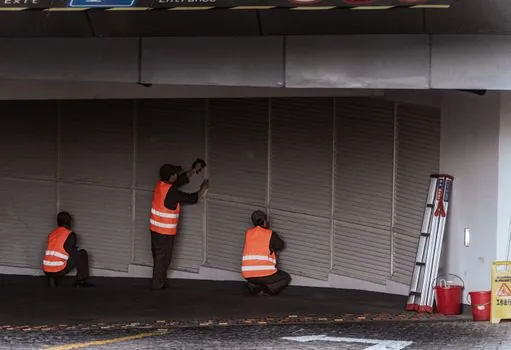
Before every shift a qualified person must run the Cal/OSHA pre-use check: confirm rungs are tight to the rails, hardware and fittings are secure, movable parts operate without binding, labels are legible, and the ladder is free of oil, grease, or any slippery film [S1]. For metal ladders specifically the checklist adds loose rungs, nails, bolts and screws, dented rungs or rails, sharp edges and burrs, corrosion damage, bends and breaks, and any tag reading "CAUTION - Do Not Use Around Electrical Equipment" [S1].
Extension ladders carry three additional mandatory checks: ropes and pulleys in good condition, rung locks engaging on the top section rails so the upper half cannot fall, and extension guide brackets secure and in place; step ladders require matched leg lengths front and rear plus a spreader that locks fully [S1]. A ladder that has been exposed to fire, strong chemicals, or a documented vehicle strike is to be tagged out and destroyed, not repaired, because the aluminum-alloy extrusion loses visible ductility long before it loses measurable strength, and the failure mode is sudden [S1][S2].
Setup, Footing, and Roadside-Specific Hazards
Set the base on firm, level, dry footing; if one rail sits in a low spot, use leg levelers or a mudsill rather than shimming with a rock or piece of asphalt, and confirm the slip-resistant pad is intact at every foot [S1]. Keep the area around the top and bottom clear, post warning signs or a guard in any active traffic lane, and never set the base in a doorway, driveway, or active travel lane unless the lane is closed with cones or a flagger [S1]. For a two-lane shoulder job the standard practice is a single taper with cones starting 50 ft upstream on a 30 mph road and 100 ft on a 45 mph road, with a spotter at the ladder base whenever the cone taper is shorter than the MUTCD minimum, because a ladder fall onto a 60 mph travel lane is a fatality event for both worker and motorist [S1].
For night work the ladder feet and the ground contact patch must be illuminated to at least 5 fc, which is enough to read the rung-marking decal and to spot a wet leaf or a steel manhole ring set flush with the grade; reflective ladder rail markings are a worthwhile retrofit on any unit that runs after dusk [S1][S5].
Storage, Transport, and Field Service Life
Aluminum ladder service life is a function of three things: salt exposure, mechanical impact, and UV degradation of the rope on the extension pulley. Crews that hose the ladder with fresh water after a winter shift and store it on rubber-mounted truck racks see first-owner service life beyond 15 years; crews that leave road salt crusting on the rungs until the next call typically retire the unit at 5-7 years when the rung-to-rail crimp loosens [S2][S3].
Rack the ladder on padded cross-bars at three or more contact points to prevent rail sag, and never transport an aluminum extension ladder on a flatbed without a tie-down at every 8 ft of length, because the rail extrusion can take a permanent bow from a single hard bounce on a chip-sealed road [S1][S2]. Replace the extension rope on a fixed schedule (annually for daily-use units, every two years otherwise) and keep a spare pre-cut rope in the truck, because a frayed rope that lets the upper section free-fall is the single most common aluminum-ladder injury mechanism reported to OSHA in pavement-maintenance logs [S1].
When Aluminum Is the Wrong Spec
Do not spec aluminum when the work zone is within 10 ft of an energized overhead line, when a stud welder or arc-welding lead is grounded to the same pavement within reach of the rail, or when the task requires hot-work permits near a fuel-splash zone; in any of those cases fiberglass (Type IA, non-conductive rails) is the correct pick even at a 30-40% weight penalty [S1][S3][S5].
Do not use aluminum on a frozen steel plate or a freshly oiled manhole rim, because the rail-foot slip coefficient drops below the 0.5 threshold most jurisdictions treat as the line between "slip-resistant" and "slippery"; a rubber soled boot plus a clean rail foot is the only field fix, and if that combination is not available the crew should pull the ladder and use an aerial device instead [S1]. For rebar-driven pavement dowel work where the rebar bender and the ladder share a single generator, switch the ladder spec to fiberglass unless a bonded grounding grid is in place, because a fault current through an aluminum rail into a worker is a Class A incident under any road authority's severity matrix [S1][S3].
The underlying component specifications are covered under aluminum ladder.