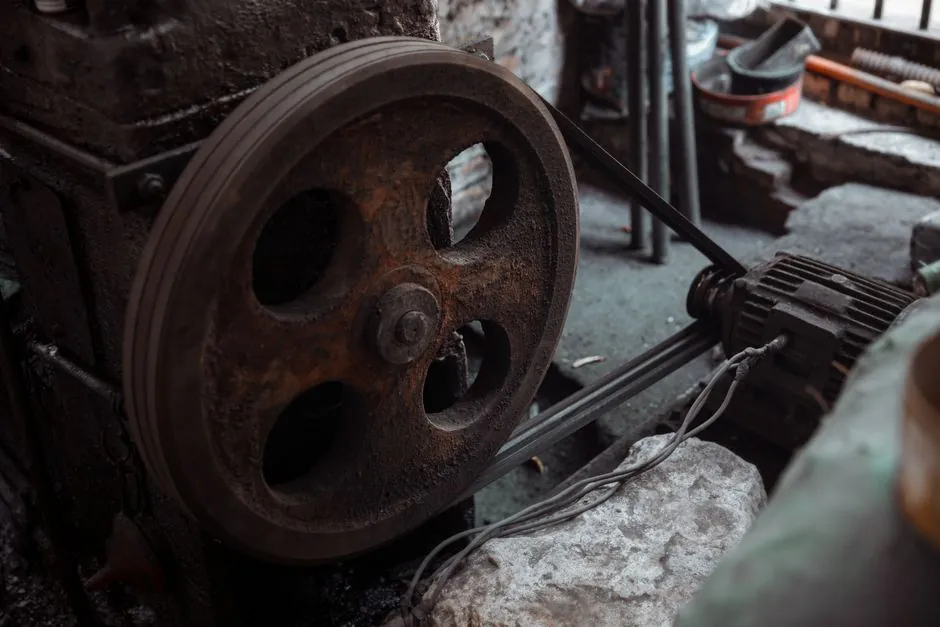
A timing belt on a steel mill coiler, roll-table, or descaling pump must survive ambient temperatures of roughly 80-120°C, oil mist, scale dust, and shock loads that a general-purpose factory drive never sees; the practical selection axis collapses to three choices: pitch family, tensile cord material, and tooth profile, with pitch width and pulley diameter set by the driven machine [S1][S4].
Steel is the typical tensile cord material for power transmission timing drives because it carries higher tension per millimetre of width and resists stretch better than fiberglass, while aramid/Kevlar cords are reserved for high-speed, low-stretch applications where weight matters more than raw tensile load [S2][S4]. Classical trapezoidal pitches (XL, L, H) coexist with curvilinear HTD, GT2, and GT3 profiles, and the same catalogue part number will specify a different minimum pulley count and a different recommended tension for each profile family [S3][S6].
Pitch Family and Tooth Profile Comparison
HTD (High Torque Drive) and GT2/GT3 curvilinear profiles carry more torque per unit width than classical XL or L trapezoidal teeth because the load is shared across a larger contact area, not concentrated on the tooth tip [S6]. For a steel mill pump or roll-table gearbox, a 14 mm or 20 mm GT2 pitch on a 36-tooth minimum driver is the common starting point, with 8 mm or 14 mm pitches reserved for instrument and small-auxiliary drives [S3]. XL at 5.08 mm (0.200 in) pitch is documented as the default for low-power fractional-horsework laboratory and small-machine drives, not for rolling-mill service [S7].
Selection rule: if the driver is below 1 kW and the ratio is below 3:1, classical XL/L trapezoidal is acceptable; above 1.5 kW, or with shock loading from a reversing coiler, shift to HTD 8 mm/14 mm or GT2 8 mm/14 mm/20 mm for the same centre distance [S1][S3]. The same pitch number in HTD vs GT2 is not interchangeable: the curvilinear GT2 tooth has a deeper, rounder base that resists ratcheting at low speed under shock, which is why steel mill users migrate to GT or GT3 rather than upsizing XL.
Tensile Cord and Width Sizing
Steel-cord timing belts are the workhorse of industrial power transmission because steel tensile members carry the highest tension rating per mm of belt width and the lowest elongation under sustained load, which keeps the meshing geometry stable on a long-centre roll-table drive [S2][S4]. Fiberglass and aramid cords exist for corrosion-sensitive or weight-sensitive niches, but in a mill with oil mist and ambient heat they are the second choice, not the first [S1][S4].
Width sizing follows design power, service factor, and the chosen pitch: a 20 mm GT2 belt at 14 mm pitch can transmit roughly 1.5-3 kW per 10 mm of width at typical 1,000-1,500 rpm driver speeds, with steel cord; doubling to 40 mm width roughly doubles the torque capacity but also raises the minimum recommended pulley diameter, which can break the centre-distance envelope on a retrofit [S3][S9]. Always derate the catalogue rating by a service factor of 1.4-2.0 for reversing drives, 1.2-1.5 for uniform loads, and 1.5-2.5 for drives started under full load, per the standard 7-step sizing flow used by SDP-SI and AutomationDirect selectors [S5][S8].
Heat, Oil, and Dust: Material Tradeoffs
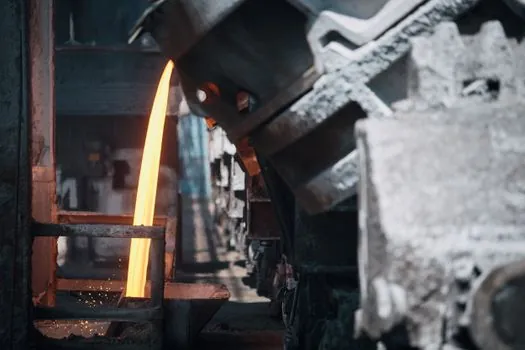
Neoprene rubber chloroprene belts with steel cord tolerate continuous ambient temperatures of roughly -30°C to +100°C, while polyurethane (PU) timing belts tolerate a narrower window (about -10°C to +80°C) but resist oil and abrasion better, which makes PU the more common pick for gearboxes with oil splash and for roll-table drives near emulsion mists [S6]. Above 100°C continuous, both chemistries begin to age; mills routinely route belt drives through shielded enclosures or specify HTD/GT2 neoprene with steel cord plus an aramid wear scrim, accepting 2-3x replacement intervals versus a clean factory [S1][S4].
For non-power-transmission applications inside a mill (e.g., roller conveyor drives, coil-handling, scale discharge), the same timing belt family is used as a low-slip alternative to a chain belt when oiling is impractical; a related engineering choice between a flat belt and a timing belt on long-centre conveyors is covered in troughed vs flat belt conveyor capacity and spillage compared. Where the drive must also act as a belt tensioner against a moving idler, the belt tensioner selection becomes a separate specification, and the pulley side of the drive must be matched to the timing pulley bore and keyway, not the motor shaft directly [S3][S8].
Selection Workflow and Common Failure Modes
The 7-step SDP-SI flow used by most mill engineers is: (1) confirm pitch family against torque and speed, (2) select driver and driven tooth count for ratio and minimum wrap, (3) compute centre distance and belt length, (4) pick belt width from design power × service factor, (5) verify pulley diameter against the catalogue minimum for that cord material, (6) check shaft and bore tolerance (typical +0.025/-0.000 mm interference fit on a 6 mm bore), and (7) assemble and tension to the catalogue static value [S5][S8]. AutomationDirect's selector, MISUMI's sizing guide, and SDP-SI's centre-distance calculator all return the same answer when the inputs match, which is the cross-check a specifier should run before issuing a purchase order [S3][S8][S9].
Common mill-side failure modes traceable to bad selection, not bad belts: tooth shear from undersized width (typically a 9 mm or 12 mm width on a 3 kW drive that should have been 20-25 mm), tooth jump from insufficient driver teeth (under 14 teeth on HTD under shock), cord breakage from running a fiberglass-cord belt above its temperature ceiling, and backside wear from a missing timing pulley flange on a reversing drive [S1][S4][S5]. None of these are fixed by re-tensioning; all of them point back to the original spec.
What Timing Belts Are Not For in a Steel Mill

Timing belts are the wrong choice for the main roughing-mill stand drive, the coiler mandrel, and any drive where a slip event would be a safety hazard: those positions take a chain belt or a fluid coupling, not a positive-engagement rubber belt [S4]. Fluid coupling selection for those shock-loaded stands is a different specification with its own thermal and start-up envelope, covered separately for steel mill duty in fluid coupling selection for steel mills: spec, heat, and shock load. Timing belts also lose to V-belts on long-centre, low-precision auxiliary drives (fans, building-vent motors) where cost per kW, not exact phasing, is the decision driver [S1][S6].
Within their envelope, however, a properly specced steel-cord HTD or GT2 timing belt on a roll-table, descaling pump, or coiler auxiliary drive will run 18-36 months in continuous mill service before chord fatigue shows up, which is competitive with chain drives once oiling labour is included, and it is the right call for any 0.5-15 kW auxiliary drive in the mill where the engineer has already fixed the pitch family, the cord material, and the service factor on paper before opening a catalogue.