On a packaging-line retrofit, the timing pulley is the line item most often under-specified and most often requoted: an RFQ that lists only "sprocket for timing belt" forces the supplier to assume pitch, tooth count, bore and bushing style, and the assumptions come back as extras [S1][S3].
Packaging drives are usually fractional-horsepower (0.18–1.5 kW) horizontal-shaft conveyors, form-fill-seal jaws and labellers running at 100–600 rpm with low shock, which is why inch pitches (XL, L, H) and metric pitches (3M, 5M, 8M, 14M) dominate this application class [S3][S5]. Specifying to ISO 5294 / RMA IP-24 tooth geometry, naming the bushing family (QD, taper-bushed, or plain stock bore) and giving the shaft diameter lets three vendors bid the same part [S1][S3].
Pitch Family and Tooth Count: The Two Numbers That Anchor the Whole RFQ
Curvilinear (HTD) and trapezoidal pitches are not interchangeable on the same pulley: an 8M pulley will not mesh with an XL belt, and tooth count must match the centre-distance ratio already welded into the machine frame [S1][S2].
For packaging retrofits, four inch pitches cover roughly 90% of what you will see on the floor: XL (1/5", 5.08 mm) for light film feeds, L (3/8", 9.525 mm) for carton erectors, H (1/2", 12.7 mm) for seaming rollers, and XH (7/8", 22.225 mm) for heavy cross-seals [S3]. The same envelopes in metric are 3M, 5M, 8M and 14M, and a retrofit matching a metric machine from Europe or Japan usually has to stay metric to reuse existing belt stock [S5]. Tooth count for stock pulleys is commonly 16, 18, 20, 22, 24, 28, 32, 40 and 60 in the MXL/MXL range alone, with 22MXL025F (22 teeth, 0.25 in / 6.35 mm belt width) being a very common packaging-feed size [S5]. The RFQ line should read "pitch, tooth count, belt width" — for example, "30 teeth, 8M pitch, 12 mm belt width" — so the supplier's stock catalogue page and your drawing agree on the same pulley [S3][S5].
Bore, Bushing and Mounting: Where Half the Quote Disputes Start
Plain-bore pulleys need a second line item for the bushing; QD and taper-bushed pulleys arrive with the bore already matched to the shaft, and confusing the two on the RFQ is the single most common reason quotes come back with a "bore not specified" qualifier [S3].
SDP/SI's technical section lists finished bore tolerances (RMA classes) and the additional face width you must allow beyond nominal belt width so the belt does not run against the flange — typically 0.25–0.50 in (6.35–12.7 mm) of overhang depending on pitch [S1]. For shaft diameters under 1 in (25.4 mm) the standard choice is a stock bore that the buyer's machine shop reworks, with tolerances per the RMA bore table [S1]. For diameters of 1 in and up, QD bushings (SF, E, F, J in the Martin catalogue) and taper bushings (1008, 1210, 1610, 2012) are stocked pre-machined, which removes one source of requote [S3]. The RFQ must therefore carry four fields, not one: "shaft diameter, keyway (if any), bushing series, set-screw vs cap-screw retention." Omit the keyway and most suppliers will assume a clearance fit and price the next size up [S1][S3].
Material, Flange and Belt-Width Overhang
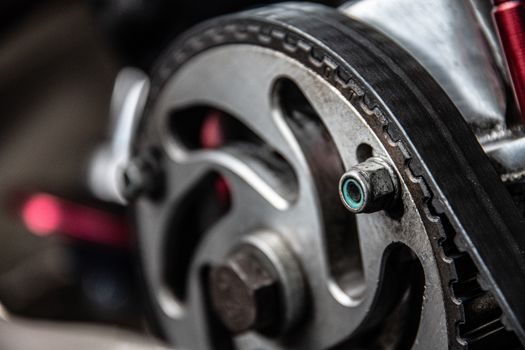
Aluminium 6061-T6 with a steel insert bushing, or fibreglass-reinforced polycarbonate with brass or aluminium hub, are the two stock materials for fractional-hp packaging pulleys, and they are not interchangeable for washdown lines [S4].
SDP/SI's flat-belt and timing-pulley stock ships in fibreglass-reinforced polycarbonate for dimensional stability, with brass or aluminium inserts; aluminium is standard for higher torque or larger diameters [S4]. For washdown or food-contact zones, the spec must call out 304 or 316 stainless or a coated aluminium, because bare aluminium and polycarbonate do not survive daily caustic cleaning [S4]. The flange (the flat disc that keeps the belt from running off) is required on at least one pulley in every drive, and on both pulleys when the shafts are not parallel — a common case on packaging conveyors with a take-up idler [S1]. Pulley face width should exceed belt width by the amount in SDP/SI's table "Additional Amount of Face Width Recommended over Nominal Belt Width," which for XL/L pitches is typically 0.25–0.50 in (6.35–12.7 mm) total overhang [S1]. For a polyurethane belt reinforced with steel (US), polyester (UP) or Kevlar (UK), the flange and pulley material choice must follow the belt construction because a steel-cord belt running on a soft polycarbonate flange will notch the flange in a few hundred hours [S2]. The related overhead conveyor spec map for food and beverage walks through similar washdown-material trade-offs for chain-driven lines.
Tooth Profile and Standard Reference: What to Write on the Drawing
Call out ISO 5294 trapezoidal or ISO 13050 curvilinear (HTD/RPP) on the drawing; if you write only "timing pulley" the supplier will pick whichever profile is in stock that week [S1].
The SDP/SI technical handbook dedicates an entire section to belt tooth profiles, with the practical consequence that an XL trapezoidal pulley is not interchangeable with an XL curvilinear pulley of the same pitch even when both have the same number of teeth [S1]. For inch drives, the RMA IP-24 and ISO 5294 standards govern trapezoidal pitches (MXL, XL, L, H, XH, XXH); for metric curvilinear profiles, ISO 13050 governs 3M, 5M, 8M and 14M [S1][S3]. A retrofit RFQ should reference both the part designation and the standard, e.g. "30-8M-12, ISO 13050, trapezoidal-equivalent curvilinear" or "40XL037, RMA IP-24," because the standard number is what eliminates the ambiguity when the belt is ordered from a different supplier than the pulley [S1][S2]. Sprocket-pulley hybrids (Martin K-2 "synchronous sprockets") are manufactured to the same close-tolerance regime as pulleys and are stocked in plain bore, taper-bushed and QD-bushed styles, so naming the family on the RFQ is enough to unlock the catalogue page [S3].
Comparison of Common Pitch Families for Packaging Retrofits

Below is a criteria-based comparison of the four pitches you will see most often on packaging lines, against the decision criteria a buyer actually weighs [S1][S3][S5].
XL (1/5", 5.08 mm): smallest stock range, lightest load, lowest cost; tooth count 16–60 in stock; typical belt width 0.25 in (6.35 mm); best for film feeders and light registration [S5]. L (3/8", 9.525 mm): the carton-erector default; tooth count typically 18–48; belt width 0.375–0.50 in (9.525–12.7 mm); cost roughly 1.5–2× the same XL part [S3]. H (1/2", 12.7 mm): seaming and cross-seal drives; belt width 0.50–1.00 in (12.7–25.4 mm); requires QD or taper bushing above 1 in shaft [S3]. 8M metric (8 mm pitch): the European/Japanese packaging default; 22MXL to 72MXL tooth range and equivalent metric stock; poly-urethane belts with steel cord (US) are common and need a metal flange [S2][S5]. XH (7/8", 22.225 mm): heavy cross-seal only; smallest stock tooth count, longest lead time; over-specified for most retrofits and a red flag if quoted on a packaging line RFQ [S3].
RFQ Line-by-Line: What the Buyer Has to Write
A complete timing-pulley line on a packaging-retrofit RFQ needs nine fields, and missing any one of them will usually trigger a requote cycle [S1][S3][S4].
The fields, in order, are: (1) pitch family, e.g. "8M" or "XL"; (2) tooth count, e.g. "30"; (3) belt width, e.g. "12 mm" or "0.375 in"; (4) bore type, e.g. "stock bore," "QD bushing," or "taper bushed"; (5) shaft diameter, e.g. "1.000 in" or "25 mm"; (6) keyway, e.g. "1/4 × 1/8 in" or "none"; (7) bushing series if QD/taper, e.g. "JA" or "1210"; (8) material, e.g. "aluminium 6061-T6 with steel insert" or "fibreglass-reinforced polycarbonate with brass hub" [S4]; (9) flange configuration, e.g. "flanged both sides" or "flanged one side on drive pulley only" [S1]. Adding a tenth field — the standard reference, e.g. "ISO 13050" or "RMA IP-24" — removes the last common ambiguity [S1][S3]. A worked example line item: "1 × Timing pulley, 30 teeth, 8M pitch, 12 mm belt width, taper bushed on 25 mm shaft, 1210 bushing, no keyway, aluminium 6061-T6, flanged both sides, ISO 13050." A packaging-line RFQ that omits material on a washdown conveyor is the equivalent of an oxygen-detector spec line that omits the IP rating — the supplier will pick the cheapest fit and the equipment will be wrong on day one.
Failure Modes and What They Tell You About the Original Spec
Three failure modes dominate packaging-retrofit timing pulleys, and each one points back to a missing field on the original RFQ [S1][S2].
Tooth jump (the belt skipping teeth under load) almost always means the tooth count was undersized for the torque or the belt was a poly-urethane (UP/UK/US) on a profile not rated for the shock load — recheck pitch family and the belt's reinforcing-cord material [S2]. Premature flange wear shows up as a polished groove on the flange face and means the face-width overhang was below the SDP/SI table value or the flange material was softer than the belt's steel cord [S1][S2]. Bore elongation / set-screw fretting means the bushing series did not match the shaft diameter or the keyway was omitted — recheck fields (4)–(7) above and the RMA bore tolerance class [S1][S3]. A practical signal for the next purchasing cycle: track the number of "bore not specified" and "keyway not specified" qualifiers on returned quotes; if it stays above roughly 20% of timing-pulley line items, the RFQ template is the problem, not the suppliers. A slewing ring maintenance spec follows the same logic — the lines you do not write are the lines that come back wrong.
For component-level specifications, see timing pulley, vacuum packaging machine, and timing belt.