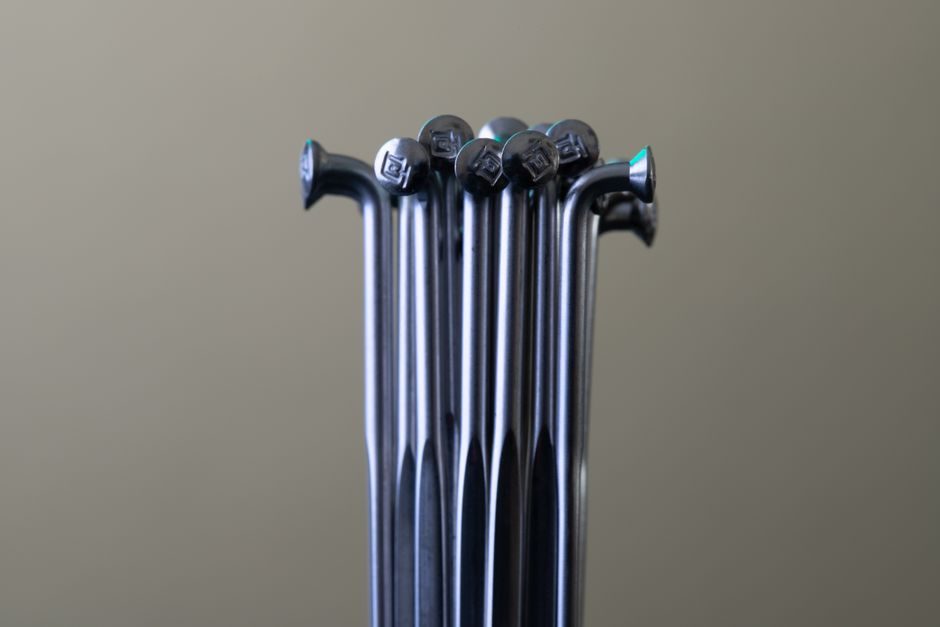
Choosing a titanium alloy is fundamentally a three-axis problem — grade chemistry, product form, and the duty cycle of temperature, stress and corrosion — and the wrong combination shows up as galling, hydrogen embrittlement or fatigue cracking well before the listed yield strength is reached [S1][S5].
Compared with carbon or low-alloy steel, commercially pure titanium and its alloys deliver roughly half the density (≈4.5 g/cm³ versus ≈7.85 g/cm³), a Young's modulus near 110 GPa, and a passive TiO₂ film that holds in chloride, nitric-acid and oxidising media where stainless steels pit [S1][S2]. That combination is what pulls Ti into airframe skins, pressure vessels, seawater piping, medical implants and chemical-process internals, but only after grade, form and weldability are sized to the actual service load.
Grade families and what each one is sized for
The trade splits into three families: commercially pure (CP) grades 1–4, α+β alloys such as Ti-6Al-4V (Grade 5) and Ti-6Al-4V ELI (Grade 23), and β-rich alloys typified by Ti-10V-2Fe-3Al and Ti-15V-3Cr-3Al-3Sn [S1][S5]. CP grades carry the best corrosion resistance and formability but cap out near 480 MPa UTS at Grade 4; α+β Ti-6Al-4V lands around 895 MPa UTS with 10–15% elongation and is the default for aerospace structural and medical-implant forgings [S1][S2].
β alloys push UTS past 1,100 MPa and cold-formability approaches that of stainless, at the cost of higher density (≈4.8 g/cm³), more expensive Mo/V/Fe additions, and a heat-treatment envelope that has to be controlled to avoid ω-phase embrittlement [S1][S5]. For a sizing exercise, treat CP as the "corrosion/forming" tier, α+β as the "balanced strength + weldability" tier, and β as the "high strength + deep draw" tier.
Product form drives capacity, not just chemistry
A correct grade on the wrong form still fails. Sheet (0.3–6 mm), plate (6–100 mm), bar, billet, seamless pipe, welded pipe, wire, forgings and powder each carry their own supply base, tolerance band and minimum-order quantity — and a Chinese mill such as Baoji Jieer lists sheet, bar, pipe and ingot ("pig") as four separate product lines under one Ti supply chain [S4].
For thin gauge below 2 mm, β and α+β sheet is widely stocked; plate above 25 mm in Ti-6Al-4V routinely books out 14–20 weeks from Western mills and is a common bottleneck on pressure-vessel and offshore-skid builds. Seamless pipe follows ASME B36.19M nominal sizes but with a much thinner wall table than stainless, because the higher strength-per-mass lets designers drop schedule. For pharmaceutical and biomedical work, grade selection logic for process equipment leans heavily on CP Grade 2 / Grade 4 sheet and Ti-6Al-4V ELI bar, with surface finish (Ra ≤ 0.4 µm for product-contact) specified separately from the grade.
Sizing criteria: temperature, environment, fatigue, biocompatibility
Temperature sets the first hard gate. CP grades stay serviceable to roughly 315 °C, α+β Ti-6Al-4V to about 315–350 °C continuous, and near-α alloys (Ti-6Al-2Sn-4Zr-6Mo, Ti-1100) extend that to 540–600 °C for compressor and turbine sections [S1][S5]. Above 600 °C the oxidation rate and α-case growth on conventional alloys accelerate and designers move to TiAl intermetallics, which are a different procurement category with very few qualified suppliers.
Environment is the second gate. CP Grade 2 resists nitric acid, wet chlorine, seawater and bleach, but suffers crevice corrosion in hot concentrated NaCl above ~70 °C; Grade 7 (Ti-0.2 Pd) and Grade 12 (Ti-0.3 Mo-0.8 Ni) close that gap and are the default for hot brine, HCl and reducing-acid service [S1][S2]. For sour (H₂S-containing) service, NACE MR0175 / ISO 15156 restricts which Ti grades are acceptable, with hardness and microstructural limits imposed on the final part — a constraint the buyer has to flag at the RFQ stage, not at the inspection stage. Fatigue and fracture mechanics are the third gate: Ti's notch sensitivity means the endurance limit is closer to 50–55% of UTS (versus ~60% for alloy steel), and surface condition — grinding, shot-peening, anodising — moves that number more than a 50 MPa UTS bump on paper [S1][S5].
Comparison of the four workhorse grades
Lining up the main options against the criteria a buyer actually weighs: [S1]
- CP Grade 2: UTS ≈ 345 MPa, density 4.51 g/cm³, best cold formability and weldability, best general corrosion resistance in oxidising media; cheapest per kg; used for chemical tanks, heat-exchanger tube, anodes. Not for high-stress or high-temperature service [S1].
- CP Grade 4: UTS ≈ 550 MPa, same density and corrosion behaviour, better strength from oxygen interstitials; used for pressure-vessel heads, fasteners, surgical mesh where Grade 2 is too soft [S1][S2].
- Ti-6Al-4V (Grade 5): UTS ≈ 895 MPa, density ≈ 4.43 g/cm³, good machinability in the annealed condition, weldable with inert-gas shielding, the default aerospace and medical-implant alloy; service ceiling ≈ 315 °C [S1][S2].
- Ti-6Al-4V ELI (Grade 23): extra-low interstitial (O, N, Fe ≤ tighter limits) for fracture-critical and biomedical fatigue-loaded parts; UTS ≈ 860 MPa with better ductility and fracture toughness than standard Grade 5 [S2].
For buyers comparing against nickel-based or aluminium alloy alternatives, the rule of thumb is: if the duty is hot strength above 500 °C or severe reducing acid, go Ni; if the duty is lightweight stiffness below 200 °C and moderate stress, an aluminium or Ti grade will both work and Ti wins on corrosion; if the duty combines chloride corrosion with mid-temperature strength, Ti is the only practical answer.
Standards and the sourcing paperwork that must be on the PO
Specification discipline is what separates a usable titanium order from a rework. For aerospace: AMS 4911 (Ti-6Al-4V sheet), AMS 4928 (Ti-6Al-4V bar/billet), AMS 4965 (Ti-6Al-4V forging) and the ASTM B265 / B348 / B381 family for stock [S1]. For chemical and marine: ASTM B265 + B862 welded tube + B861 seamless tube, with ASTM B348 bar and B367 castings as the matching references. For medical: ASTM F136 (wrought Ti-6Al-4V ELI for surgical implants) and ASTM F67 (unalloyed Ti for implants) are the names auditors will look for, and the mill cert has to report interstitial chemistry, not just UTS [S2].
Daido's medical-portfolio note makes the same point: Ti's specific gravity is roughly half that of nickel, and its non-magnetic behaviour plus biocompatibility are what make it the optimum prosthetic material, but those advantages are only realised when the heat treatment, surface finish and ASTM-grade paperwork are aligned to the implant application [S2]. Buyers in oil & gas additionally need NACE MR0175 / ISO 15156 sour-service compliance called out, and in EU plants ATEX 2014/34/EU ignition-risk assessment is required for any Ti component that could be struck or rubbed in a flammable atmosphere, because Ti sparks readily on impact.
Common failure modes and sizing mistakes
Three errors repeat on incoming RFQs. First, ordering Grade 5 when Grade 2 was actually needed — the higher strength is wasted and the machinist is now fighting a gummy, work-hardening chip that drives up cost and tool spend. Second, welding CP or α+β in shop air: Ti's affinity for oxygen, nitrogen and hydrogen means even light contamination above ~250 °C produces α-case and hydrogen embrittlement, so trailing-shield gas (Argon 99.99% minimum) and backside purge are non-negotiable [S1][S5].
Third, specifying a single global "titanium alloy" SKU across a plant where some lines run hot brine and others run hot nitric acid — the same alloy cannot optimise for both. The cleaner sizing is: CP Grade 7 or 12 for hot reducing / chloride service, CP Grade 2 for oxidising acid and caustic, Ti-6Al-4V for structural skids, brackets and frames where mechanical strength drives the call, and a near-α or β alloy only where the temperature or strength argument pays back the price. Where dynamic loads and alignment matter — for example a hinge pin or a pivoting bracket that mates to a crossed-roller guide or a linear guide — Ti-6Al-4V is usually the right default for the bracket, with the rolling-element steel race left to its own standard [S1][S5].
Quick selection workflow
Run the RFQ in this order. (1) List the duty: temperature, media, stress, fatigue cycle, biocompatibility or not. (2) Map duty to grade family using the table above. (3) Pick the product form (sheet, plate, bar, pipe, forging) and check mill lead time — a 25 mm Ti-6Al-4V plate is the most common schedule-breaker. (4) Lock the standards (ASTM B265 / B348 / B381 / F136 / F67, AMS 4911 / 4928, NACE MR0175) and the test-cert scope on the PO. (5) Confirm weld procedure and shielding-gas plan with the shop before release, not after. [S2]
A workable size-and-select reference sits behind that flow: density 4.5 g/cm³, UTS 345–1,100 MPa depending on grade, modulus 110 GPa, max service 315 °C for α+β, 540–600 °C for near-α, with Pd- or Mo-bearing CP grades the right answer for hot reducing-acid and chloride service and Grade 5 / 23 the default for structural and biomedical structural parts [S1][S2][S5].
Trackable signals to watch over the next sourcing cycle: ASTM and AMS revision updates for Grade 23 ELI interstitial limits, any extension of near-α temperature ceilings in published aerospace data, and the spread between Chinese Baoji-mill lead times (sheet, bar, pipe, pig as separate SKUs) [S4] and Western distributor stock for 6–25 mm Ti-6Al-4V plate — that spread is the leading indicator of price and schedule on the next major RFQ [S1][S4][S5].