
On a one-person interior take-off a laser distance meter returns a 1.5 mm-class reading in under a second, while a total station needs tripod levelling, prism acquisition and at least 15 s of operator time per shot. The 2026 surveying-instrument market still splits cleanly on that productivity gap, with handheld laser modules dominating the sub-150 m range and motorised total stations holding the 1 m to 5 km EDM band where angular accuracy and traverse closure matter [S1][S2].
FOIF's RTS-372 R10 total station, listed in mid-June 2026 by Nanjing CETU, pairs a nitrided steel shaft system with a miniaturised EDM head, targeting the R10 (10-second) angular class used in mid-tier construction layout [S2]. Accud's TM1200 portable laser distance meter, by contrast, ships with built-in angle measurement in a 200 g-class housing aimed at one-handed interior work [S1]. Both sit in the same broad surveying category but answer different field questions.
Core Operating Range and Angular Capability
A servo/motorised total station typically measures slope distances out to 5,000 m with a single prism and 800-1,000 m reflectorless, while the FOIF RTS-372 R10 platform operates in the conventional mechanical total-station class with R10 (10 arc-second, ≈ 2.9 mgon) angular resolution [S2]. The "R" rating refers to the angular accuracy in seconds of arc, so R10 = ±10″; total stations on the consumer end of the market now run R2 to R6, professional survey-grade units R1 or better.
A laser distance meter has no angular measurement by default; the Accud TM1200 is one of the few that adds a tilt sensor for indirect height and Pythagorean modes [S1]. The trade-off is range: laser distance meters cap at roughly 30-150 m depending on target reflectivity and laser class, with 1.5-3.0 mm typical accuracy under ISO 16331-1 test conditions. For long sight lines — property boundaries, road cross-sections, stockpile volumes — the total station's EDM still wins by an order of magnitude in both reach and angular certainty.
Field Workflow: Levelling, Targeting and Operator Load
Setting up a total station demands a tripod, optical or laser plummet, and tribrach levelling to within ±3′ of vertical before any reading is trusted. FOIF highlights the nitrided shaft on the RTS-372 R10 as a wear-and-fatigue improvement that supports repeated traverse setups, an explicit nod to field-class reliability over the 5-8 year service window most contractors expect [S2]. One trained operator plus a rod person is the standard crew; the same job shot with a handheld laser requires zero setup and one person, but no horizontal angle and no traverse closure.
Laser distance meters such as the RIDGID micro LM-100 (0.05 m to 70 m range, ±1.5 mm accuracy) or the Accud TM1200 reach a stable reading in 0.5-2 s and store results to internal memory or Bluetooth push to a phone [S1][S5]. The micro LM-100 is marketed explicitly as a "real-world" measuring tool with backlit display and IP54 protection, a tougher spec than many survey-grade total stations in light rain [S5]. Where the laser module fails is in dust, fog or sun glare on a long sight — the same conditions where total-station coaxial optics still close a shot.
Accuracy Bands, Standards and Test Conditions
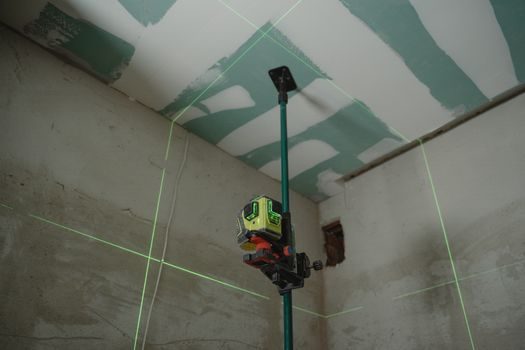
Total station EDM accuracy is typically quoted as ±(2 mm + 2 ppm × D) for prism mode and ±(3 mm + 2 ppm × D) reflectorless, with the angular contribution usually dominating at short range. Laser distance meters quote a single fixed accuracy (commonly ±1.5 mm or ±2.0 mm) valid only under the ISO 16331-1 protocol — strong target, 25 °C ambient, defined ambient light — and degrade noticeably on dark, wet or hot surfaces. Buyers comparing the two must convert the laser's "±1.5 mm" against the total station's range-dependent ppm spec, because at 50 m the total station's prism error is around 2.1 mm total while the laser meter is still 1.5 mm — at that short distance the laser wins on raw distance precision, even before the angular component is added. [S1]
For the laser class itself, IEC 60825-1 governs the emitted laser safety classification (Class 2 visible red for almost every handheld meter). Surveying instrument environmental testing falls under ISO 9022 for atmospheric effects and IEC 60529 for IP rating — the micro LM-100's IP54 claim is an IEC 60529 designation meaning dust-protected and splash-proof from any direction [S5]. Total stations generally quote IP54-IP66 depending on housing, and high-end motorised units often pair IP66 with a MIL-STD-810 vibration profile for machine-control mounting.
Use-Case Gate: Total Station, Laser Meter, or Both
For control-traverse work, cadastral boundary, topographic mapping above 150 m sight, bridge deformation monitoring and machine-control guidance, the total station is the only credible answer; its angular data is non-negotiable. The FOIF RTS-372 R10 fits the construction-layout and topographic niche where R10 angular resolution is acceptable and 2 mm + 2 ppm prism EDM is sufficient [S2]. For a one-person interior fit-out take-off, floor-area verification, façade run measurements and short-range as-built sketches, a laser distance meter cuts time per point by an order of magnitude; the Accud TM1200 even adds tilt-based height measurement where tripod work is impractical [S1].
Hybrid workflows are now common: a total station sets control and shoots long sight lines while a laser distance meter sweeps the interior detail. The earlier in a project the split is defined, the cleaner the data flow between the two instruments — particularly when both feed the same CSV or DXF pipeline.
Cost Bands, Sourcing Channels and Lead Time

Entry-level R6 total stations from Chinese OEMs (Laisai, FOIF, South, Ruide) land in the US$ 400-900 box price band per recent Made-in-China listings, with R2 to R6 class units bundling onboard software and Bluetooth [S3]. The FOIF RTS-372 R10 sits one tier up; mid-June 2026 trading-company listings put comparable R10 packages in the US$ 1,500-2,500 range, typically excluding tripod and prism kit [S2][S4]. A professional laser distance meter such as the RIDGID micro LM-100 retails around US$ 80-120, and OEM-branded Chinese units ship as low as US$ 30-60 on Alibaba listings with comparable ISO 16331-1 specs [S5][S6].
Sourcing from trading companies in Nanjing — including CETU's export arm — remains the dominant cross-border route, with 5-employee minimal-MOQ storefronts common on Made-in-China [S4]. Lead time on Chinese-made total stations from PO to EU port runs 25-40 days for stocked R6-R10 models and 45-75 days for custom R2 configurations. The bigger procurement risk on laser meters is calibration drift on cheap unbranded units: insist on an ISO 16331-1 test certificate and a traceable serial number before any bulk buy.
Selection Criteria Compared
Stacked against four buyer criteria, the split between the two instrument classes becomes a hard decision rather than a preference. A total station with a tripod crew, R10 angular resolution and ±(2 mm + 2 ppm) prism EDM reaches 5 km and closes traverse loops, but takes 10-20 minutes to set up and costs 10-20× more per unit than a laser meter. A laser distance meter with 0.05-150 m range, ±1.5 mm accuracy, IP54 housing and a 200 g body sets up in zero seconds and fits in a pocket, but records no angle, sees 1/30th the distance, and fails in heavy dust or fog. For surveyors buying for boundary and topographic work, total station is non-negotiable; for MEP, fit-out and façade trades doing solo take-off, the laser meter is the only rational purchase; for mixed practices the answer is a 1:2 or 1:3 total-station-to-laser-meter fleet ratio that lets each instrument stay on the work it is best at [S1][S2][S5].
Looking forward through the second half of 2026, two signals are worth tracking: continued R-class compression in mid-tier total stations (R6 and R10 now ship in the same R8 housing as 2024's R6 platforms), and the spread of Bluetooth-LASER + cloud-CSV pipelines that let a laser meter feed the same coordinate list as a total station with no manual transcription. Either development pushes the two instruments further into complementary roles rather than competitors, which is the procurement structure most cost-aware contractors are converging on.
For component-level specifications, see laser distance sensor.