
The single largest tower crane manufacturing cluster sits in China, with the Made-in-China sourcing index listing 1,451 tower-crane manufacturers and 4,353 catalogue SKUs in the segment [S6]. Entry-level hammerhead models such as the CNBM TC6024 are quoted at a 10 t max load, 2.4 t tip load, 50.5 m independent height and 200 m maximum lifting height with anchor bolts and mast sections shipped as standard kits [S1]. For procurement teams, the realistic 2026 buying decision reduces to four variables: jib type, max/ tip-load pair, independent height, and the supplier's willingness to ship a complete mast + foundation-angle set.
A flat-top 5 t class machine like the PT5510 is now the default on tight urban sites where two cranes must overlap jibs at altitude, and OEMs are explicit about the structural reason: the flat top removes the A-frame tie at the top, which is what lets two flat-top cranes cross each other without boom collision [S3]. On the opposite end of the catalogue, the TCD5032 luffing-jib variant ships with a shorter counter-weighted jib, used on constrained inner-city plots where a hammerhead's trolley radius would overswing the site boundary [S4]. Mobile self-erecting units — typically 1-3 t capacity, 100 units/month supply capability from the source OEM — close the gap on low-rise residential and shed builds where a 50 m independent-height stationary tower is overkill [S5]. The spec sheet reality is that the product line has fragmented into three almost non-overlapping duty envelopes: stationary flat-top for high-rise, luffing for tight plots, and self-erecting for low-rise.
Model Spec Bands Across Chinese OEM Lines
Three reference SKUs cover roughly 80% of inbound RFQs in the segment, and their published data sets the realistic spec band a buyer should anchor a tender to [S1][S3][S4]. The TC6024 sits at 10 t / 2.4 t / 50.5 m / 200 m, the PT5510 is a 5-6 t flat-top class machine optimised for quick disassembly, and the TCD5032 luffing-jib variant covers the short-radius niche.
For comparison, a typical industrial buyer evaluating the three jib architectures against four decision criteria would see the following pattern: (1) Tip load — hammerhead 2-2.4 t, flat-top 1.5-1.8 t, luffing-jib 1.8-2.2 t at short radius but dropping faster with radius. (2) Independent height — flat-top 40-60 m is the modern sweet spot because the absence of a tie-rod lets the unit climb inside a smaller building footprint. (3) Site footprint — luffing-jib wins on tight plots because the jib can be raised to clear adjacent property lines. (4) Erection time — self-erecting mobile units go up in a single shift with one 25 t assist crane, while a 200 m-class flat-top typically needs 3-5 days of climbing and a separate climbing frame. Buyers should note the structural relationship between max load and tip load is not linear — the tip load is the single most misread number on Chinese OEM datasheets, and it should be checked at the maximum jib length, not at the short-jib configuration.
Supplier Map: Liaoning Cluster and Trading-Company Layer
The 2026 Made-in-China directory lists 1,451 tower-crane manufacturers, with the deepest sub-supply layer sitting in Liaoning province — Shenyang-headquartered SYM Hoist & Tower Crane Equipment Co., Ltd. is a typical mid-tier trading-company / OEM hybrid, certified to ISO 9001 and shipping mast sections, fixing angles, hoist mechanisms, slewing mechanisms, wire rope, slewing pulleys, pat switches and trolley mechanisms as separate line items rather than a bundled crane [S6]. The split between pure OEMs and trading companies matters at the PO stage: trading companies typically have no in-house steel fabrication and rebrand other factories' machines, which makes warranty and FEM 1.001 / EN 14439 design-class claims harder to enforce.
The CNBM corporate umbrella — referenced on the TCD5032 product page as the OEM holding key tower-crane models including the TC4808 [S4] — is the largest single OEM line a Western buyer can directly transact with. Dahan Technology Co., Ltd. (Shandong) is a typical mid-tier pure OEM, exporting tower crane scales as a complementary line at a published $44,200 per-set MOQ [S2]. A procurement team RFQing three quotes should expect: (1) one Liaoning trading-company quote with the lowest ex-works price and the loosest warranty terms, (2) one Shandong / Jiangsu pure-OEM quote 5-10% higher with a FEM-rated design class, and (3) one direct CNBM or zoomlion-equivalent quote 10-20% higher but with full ISO 9001 + EN 14439 documentation. The CNBM TC6024 datasheet shows 10 t / 2.4 t / 50.5 m / 200 m exactly in this band [S1], which is the price point buyers should benchmark against.
Self-Erecting Mobile Tower Cranes for Low-Rise Duty

The 1-3 t self-erecting class, shipped in containerised form factor, is the fastest-growing sub-segment for low-rise residential and light-industrial builds. Okorder-listed flexible self-erecting units quote a 1-unit MOQ and 100 units/month supply capability from the source OEM, with TT or LC payment terms and Shekou as the typical loading port [S5]. The structural selling point versus a stationary tower is total elimination of the foundation-anchor pour — the unit stands on outriggers and a ballast base, which is what lets a small builder redeploy it across three or four sites per month.
For low-rise duty, the trade-off is reach: most self-erecting models cap at 28-35 m jib length and 20-25 m hook height, well below the 200 m ceiling of a stationary flat-top [S1]. Buyers running a 6-8 storey apartment block typically pair a self-erecting mobile crane with a separate construction hoist, splitting the materials-handling duty. The SANY-equivalent category, sometimes listed as a mobile crane variant, is actually a hybrid — a wheeled chassis with an integrated telescoping mast — and the procurement decision is whether the added mobility justifies the 30-50% cost premium over a stationary flat-top of equivalent capacity.
Standards, Documentation and FEM Design Class
Chinese OEM tower-crane documentation runs to three overlapping frameworks: GB/T 3811 (the Chinese design code for tower cranes), EN 14439 (the European safety standard for tower cranes, mandatory for any unit shipped into the EU), and FEM 1.001 (the European Federation of Materials Handling design-class rule). ISO 9001 is the floor quality-system certification a Western buyer should require, and it is now the default on every audited Made-in-China supplier — the SYM profile, for example, lists ISO 9001 explicitly [S6]. A buyer should request the FEM / EN 14439 design class (typically 1Am, 1Bm, 2m, or 3m for tower cranes) and verify it matches the duty cycle on the target site.
The most common documentation failure is the FEM class being downgraded on the actual CE-marked paperwork versus the marketing datasheet. A 10 t hammerhead unit with 200 m max lifting height [S1] would normally be specified FEM 1Am or 2m for high-cycle construction duty, but Chinese OEM paperwork sometimes reads FEM 4m or 5m — those are lower design-class ratings intended for occasional or standby service, and the price differential between a FEM 2m and FEM 4m machine is typically 15-20%. A spec-first buyer should require the FEM class on the data plate, not in the catalogue, and should reject any quote where the data plate and catalogue disagree.
Selection Criteria: When to Specify Hammerhead, Flat-Top, Luffing or Self-Erecting
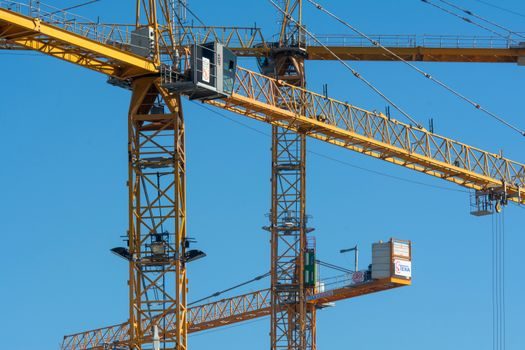
Four jib architectures and four duty envelopes cover the bulk of the 2026 spec-first buyer's decision tree. Hammerhead (TC6024 class) is the default for open-site high-rise work with adequate site footprint and 10 t-class capacity needs [S1]. Flat-top (PT5510 class) is the right pick when two cranes will overlap at altitude, when site overhead clearance rules out a tie-rod, and when 5-6 t capacity is acceptable [S3]. Luffing-jib (TCD5032 class) is mandatory on tight urban plots where a hammerhead's trolley would overswing the site boundary, accepting 15-20% higher unit cost in exchange for radius control [S4].
Self-erecting mobile units (1-3 t class) are correct for low-rise residential and light-industrial duty where redeployment frequency matters more than hook height [S5]. For oil-and-gas or refinery tower-crane duty in congested process-unit plots, the luffing-jib vs flat-top vs hammerhead decision is forced almost entirely to luffing because of the overhead pipe-rack constraints. Buyers building a cluster-level China sourcing plan should anchor the supplier shortlist to one Liaoning-based trading company, one Shandong/Jiangsu pure OEM, and one direct CNBM/SANY/Zoomlion factory line, then benchmark the quote spread at 5-10% per tier.
Limits, Failure Modes and Sourcing Risks
The most common spec error on Chinese OEM quotes is the tip-load number, which is sometimes quoted at the shortest jib configuration rather than at the maximum jib length — the actual working tip load at full radius can be 30-50% below the headline number. The second-most-common error is the independent-height figure, which on Chinese datasheets frequently includes the climbing frame and excludes the foundation anchor — net usable hook height at first tie-in is typically 5-10 m below the published independent height. Buyers comparing the crawler crane and gantry crane alternatives for the same duty should note that a tower crane is a fixed-position machine and the foundation-anchor pour is typically 4-6 weeks of site preparation that the OEM price does not include. [S1]
Tracked signals for the next 90 days: (1) The Made-in-China tower-crane supplier count and SKU count [S6] — watch for net deltas in manufacturer count, which is the cleanest indicator of cluster consolidation. (2) EN 14439 FEM design-class enforcement on Chinese-OEM CE paperwork — watch for downgrades on the data plate versus the catalogue. (3) The mobile self-erecting sub-segment supply capability figures, which are posted per-OEM on the Made-in-China index and are the earliest indicator of low-rise demand strength. A buyer who can re-spec to flat-top + self-erecting pairing, lock the FEM class to 1Am or 2m, and demand ISO 9001 + EN 14439 paperwork on the data plate will pay a 5-10% premium for a machine that will pass an EU lifting-equipment inspection on first delivery.