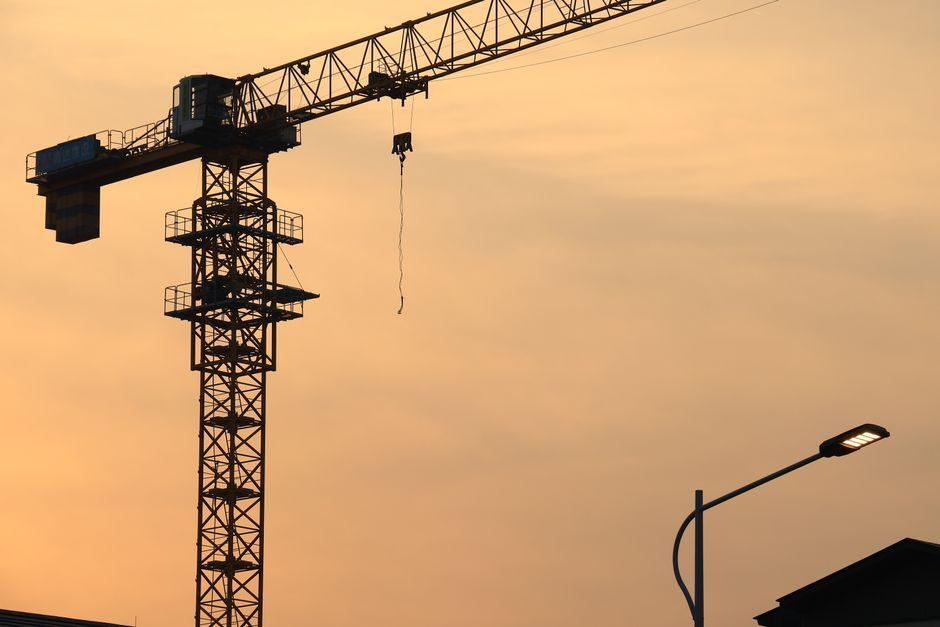
For upstream and midstream oil and gas sites, the working "best" tower crane is a luffing-jib model in the 8-40 t class at 30-80 m working radius, paired with a base unit carrying a published module wind-class chart and a slewing-ring traceable to a single OEM part number [S4][S5].
Oil and gas lifting covers three distinct duty envelopes: (1) module / structural steel on green-field plants (10-40 t at 20-45 m), (2) live maintenance on operating refineries and LNG tanks where the boom must slew over live process pipe (3-8 t at 30-60 m, tight footprint), and (3) pipe-rack / flare-stack erection on wind-exposed pads (5-15 t at 40-80 m, high in-service wind). Each envelope maps to a different jib geometry, not just a different capacity [S4].
Jib Geometry Comparison Against Lifting Decision Criteria
Luffing-jib tower cranes dominate refinery and LNG live-plant work because the luffing boom lifts vertically through a smaller arc, dropping the slewing radius envelope below adjacent pipe racks and hot equipment — a 25 m radius hammerhead cannot physically fold into the same footprint as a 25 m radius luffing-jib [S4]. On a 2026 jobsite in the US South-Central region, Big B Crane's oil-and-gas fleet lists luffing-jib units as the default over flat-top for revamp work, with the boom geometry itself listed as the procurement line item, not the chart capacity [S4].
Flat-top (cat-head-less) tower cranes win on green-field EPC sites with multiple cranes in air, where the absence of the cat-head and pendant lines lets two or three units overlap jibs safely; oil-and-gas EPC contractors typically spec flat-top when the count is three or more in a tight cluster, and luffing-jib when the count is one or two on a constrained revamp pad [S4].
Capacity, Radius and Wind-Load Bands for the Three Envelopes
Module / structural steel on green-field plants maps to 10-40 t at 20-45 m radius with out-of-service wind ratings of 20-25 m/s and in-service wind ratings of 12-15 m/s — values consistent with the spec sheets published by the oil-and-gas crane providers active in 2026 [S4][S5].
Live maintenance on operating refineries and LNG tanks maps to 3-8 t at 30-60 m radius; the limiting factor is usually slewing-ring moment under continuous in-service wind of 12-14 m/s, not chart capacity. The slewing-ring selection logic — single-row ball, double-row ball, or three-row roller — is the same gate that slewing-ring bearing selection guidance covers for crane-class loads (where the matching oil seal spec on the ring sits inside the same procurement gate), and it is the first sub-assembly to demand a part-number-level datasheet, not a generic "slewing ring" line [S4].
Pipe-rack / flare-stack erection on wind-exposed pads maps to 5-15 t at 40-80 m radius with the in-service wind rating driving the chart more than the radius; oil-field crane providers serving the Permian and South-Central US advertise wind-rated packages specifically for this duty as of 2026 [S4][S5].
Power, Foundation and Hook-Path Constraints
Oil and gas sites run on diesel genset or shore power at 380-480 V 50/60 Hz, not on a grid-friendly 400 V 50 Hz only; the tower-crane OEM must publish a power-pack that accepts the wider 380-480 V band, and the slip-ring assembly must be rated for the higher inrush of a soft-start hoist (typically 1.6-2.0x FLA for 3-5 s) [S4].
Foundation is usually a reinforced concrete pad with anchor cages designed for the combined overturning moment and the in-service wind shear; the OEM must publish a base-reaction table keyed to the specific jib length and counter-jib configuration, not a generic "max reaction" number — a single base-reaction envelope across all configurations is a procurement red flag [S4].
Hook-path height (the distance from ground to the highest safe hook position with full chart load) is the spec that drives tower height; oil-and-gas EPC projects typically need 40-80 m under-hook, and the tower section selected (1.6 m, 2.0 m, or 2.5 m pin pitch) must be the one the OEM actually certifies for that hook-path in the specific jib configuration — not a generic "freestanding" or "tied" label [S4].
Standards and Compliance Gates That Drive Specification
For oil and gas work the crane must carry, at minimum, FEM 1.001 / ISO 4301-1 classification documentation and a wind-load chart per EN 13000 for European builds, with the in-service and out-of-service wind speeds called out as separate numbers on the same page of the OEM's load chart supplement [S4].
For ATEX / IECEx zoned sites (hydrogen, LNG, refinery process units), the tower crane's electrical enclosures, hoist motor brake resistors, and cab heater must carry the zone rating — the same ATEX zone logic that governs fixed gas detector placement on the adjacent process unit; specifying a non-rated crane into a Zone 1 or Zone 2 envelope is the single most common rejection cause flagged on 2026 oil-and-gas crane RFQs [S4].
The hoisting-rope, slewing-ring, and hook-block assemblies must each carry a serial-numbered mill cert and an EN 10204 3.1 inspection certificate; the OEM must hand over these certs per assembly, not per crane, for the record book the end-client (operator, EPC, third-party inspector) needs to keep on file for the full service life [S4].
Selection Criteria, Decision Matrix and Sourcing Reality

Spec the jib geometry first, the capacity second, and the OEM third. The selection gate for an oil-and-gas tower crane is: (1) jib type (luffing / flat-top / hammerhead) matched to the site envelope above, (2) max load at max radius under in-service wind, (3) ATEX/IECEx zone rating for the electrical package, (4) base-reaction table for the specific jib configuration, (5) slewing-ring part number with a published moment curve, and (6) FEM/ISO classification sheet per the working duty class [S4][S5].
Compare three candidate configurations against four decision criteria: (a) luffing-jib 16 t at 45 m for a refinery revamp — wins on footprint and live-plant safety, loses on per-tonne cost and cycle time; (b) flat-top 25 t at 60 m for a green-field EPC — wins on multi-crane interlock and erection speed, loses on overhead-clearance revamp work; (c) hammerhead 12 t at 70 m for flare-stack / tank-farm — wins on per-tonne cost and outer radius, loses on tight-slew envelopes and tie-in height [S4].
Sourcing reality in 2026: US South-Central oil-and-gas crane providers carry luffing-jib, flat-top, and hammerhead fleets and rent by the month with a site-engineering visit included; oilfield-specific crane vendors also list picker-truck and rough-terrain units for the support fleet, but the tower-crane segment remains a specialist rental with engineering support, not a commodity purchase [S4][S5]. For truck-mounted support units on the same site, truck-mounted crane sizing guidance covers the load/reach/axle gates, and the broader truck-mounted crane supplier map documents the 2026 capacity bands and OEM clusters.
Failure Modes, Limitations and Trackable Signals
The most common oil-and-gas tower-crane failure mode is not hook capacity — it is slewing-ring fatigue under sustained in-service wind when the crane is left free-slewing for months between lifts. The signal to watch is a non-OEM slewing-ring retrofit or a slewing-ring without a published moment curve, both of which invalidate the FEM/ISO classification [S4].
Trackable signals for the next 6-12 months: (1) ATEX/IECEx-rated electrical packages on luffing-jib models entering the US South-Central rental fleet — listed individually per crane on the provider's spec page, not as a generic option; (2) module-by-module wind-class charts that name the wind speed at the jib tip separately from the wind speed at the tower top, since oil-and-gas sites are windier at the tip than the European 10 m reference height; (3) base-reaction tables keyed to the specific jib / counter-jib / tower-height combination, which the OEM can issue only when the configuration is locked at RFQ stage, not at delivery [S4][S5].