A tower furnace is the stronger choice for centralized aluminum melting because shaft melting can reach approximately 5,000 kg/h and separates on-demand melting from holding capacity [S4].
A reverberatory furnace fits bulk melting and holding, with stated holding capacities from 3,000 to 300,000 lb, while wet-hearth and dry-hearth configurations can be combined in the same furnace [S4].
Architecture and heat transfer
A reverberatory furnace is a rectangular, refractory-lined steel box with one or more burners mounted in the roof, sidewall, or end wall. It isolates the charge from direct fuel contact, but not from combustion gases, and uses convection, conduction, and radiation to transfer heat [S1][S3].
The burners heat the refractory roof and walls, which re-radiate heat into the aluminum bath. Molten aluminum has a stated surface emissivity of 0.004–0.055, but its oxide layer raises the effective value to 0.11–0.19 and restricts heat transfer [S1]. The common bath-to-melt ratio is 10:1, with 8:1 identified as the minimum, so the furnace requires substantial bath area relative to hourly melting rate [S1].
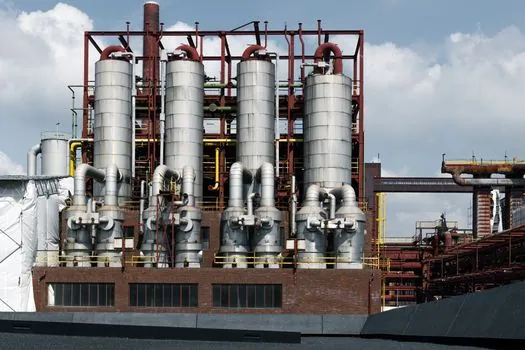
A tower furnace uses a shaft rather than a broad reverberatory bath. The shaft category is identified as the most efficient fuel-fired melting option, with an approximate melting limit of 5,000 kg/h or 11,000 lb/h [S4]. This design separates melting performance from holding performance, reducing the bath capacity needed solely to buffer metal demand [S4].
Decision comparison
Compare the designs on four criteria: throughput, holding flexibility, charge handling, and plant integration. A tower furnace offers the higher practical option for on-demand melting, with approximately 5,000 kg/h capacity, on-demand supply, extensive automation potential, and lower holding inventory, but it is the most complex furnace system [S4].
A reverberatory furnace provides the larger holding range, 3,000–300,000 lb, supports wet-bath or dry-hearth melting, and can use natural gas or oil; smaller units can use electric radiant heating [S4]. Its efficiency varies with utilization and the selected melting style, while a tower furnace offers the stronger combination of fuel-fired efficiency, automation, and capital payback for sustained centralized demand [S4].
Charge flexibility also differs. A wet-hearth reverberatory furnace can separate ingot, sow, and returns in a charging well, while a dry-hearth arrangement melts charge directly on the hearth [S1][S4]. The selection should therefore be based on the actual charge mix, required alloy sequence, and delivery rate rather than nominal furnace capacity alone.
Operating envelope
A reverberatory aluminum melting furnace has a charging well and is commonly designed with a bath-to-melt ratio of 10:1, and a minimum of 8:1. The wet well can be separated from the main bath by a submerged refractory archway or a powered vertical skimmer door, and the charge enters the molten heel [S1].
Radiant-roof and convective-sidewall designs represent the two principal burner arrangements for a reverberatory furnace. The burner arrangement must be matched to the physical furnace envelope, charge method, and expected production schedule.
Do not size either furnace to its theoretical maximum output. Cleaning, maintenance, holding periods, batch operation, and other downtime reduce realizable melting rate, so several smaller furnaces can provide more operating flexibility than one oversized unit [S5]. The plant should document daily metal demand, operating hours, charge composition, alloy changes, transfer methods, and dispatch pattern before accepting a vendor rating.
Best-fit applications
Use a tower furnace for a high-tonnage, single-alloy central melt operation with steady hourly demand and automated handling. Shaft melting is most efficient among the fuel-fired options listed, supports on-demand supply, and can be integrated extensively with material and molten-metal handling systems [S4]. For further scope, compare gas-fired aluminum melting furnace designs.
Use a reverberatory furnace when the operation needs a large thermal buffer, holds more than one practical operating condition, or alternates between wet-hearth and dry-hearth charging. Reverberatory furnaces are bulk melting and holding furnaces.
Neither design is the best small-footprint choice for frequent alloy changes. For lower-volume foundries, a crucible furnace can provide easier alloy changes, a small installation footprint, and aluminum melting rates up to approximately 900 kg/h, compared with the reverberatory design's much larger holding role [S4].
Operating constraints and failure modes
Oxide-covered melt is the principal heat-transfer constraint identified for reverberatory furnaces: the oxide layer raises emissivity to 0.11–0.19 and produces poor transfer characteristics [S1]. A furnace with too little bath area relative to melt rate compounds this problem, which is why the common bath-to-melt ratio is 10:1 and the minimum is 8:1 [S1].
Oversizing creates a different penalty. A furnace sized to melt 30% more than required can materially increase energy costs, especially for tower or reverberatory systems [S5]. Excess capacity also ties up capital and inventory while reducing utilization-dependent efficiency [S4]. A tower furnace adds mechanical and controls complexity, whereas a reverberatory furnace adds large-bath heat-storage and alloy-sequence constraints [S4][S5].
The metal-handling decision must be included because furnace selection is incomplete without it. A reverberatory furnace can discharge through a manual tap-out block and plug, molten-metal pump, pneumatic dispensing pump well, gravity launder, or hydraulic tilting into a transfer ladle [S1]. These alternatives affect floor space, backpressure, contamination control, and transfer-cycle time.
Specification and procurement basis
Issue the furnace specification around seven engineering criteria: furnace efficiency, energy cost, molten quality, melt loss, molten-metal handling, safety, and environmental requirements [S5]. Include the alloy, charge mix, required kilograms per hour, ladle size, holding temperature, heating system, operating hours, central versus point-of-use location, and available footprint [S4].
Require the vendor to state whether each performance figure represents theoretical melt rate, sustainable melt rate, holding capacity, or bath-to-melt ratio. A tower proposal should disclose shaft geometry, charging and discharge method, burner arrangement, controls, redundancy, and handling interfaces [S4]. A reverberatory proposal should disclose dry-hearth or wet-hearth configuration, bath area, bath-to-melt ratio, burner position, refractory arrangement, and all five discharge alternatives [S1][S4].
Compare installed operating cost over the same production basis rather than comparing burner input alone. For a trial installation, the operating sequence, charge ratios, recovery performance, and metal-transfer interfaces should be documented in a separate tower versus reverberatory furnace comparison only if that evaluation includes the required gas-fired operating cases.
The next procurement decision is measurable: capture the hourly demand histogram, charge proportions, alloy schedule, and transfer-cycle time, then require each bidder to demonstrate sustainable melt rate and energy consumption at those exact conditions.