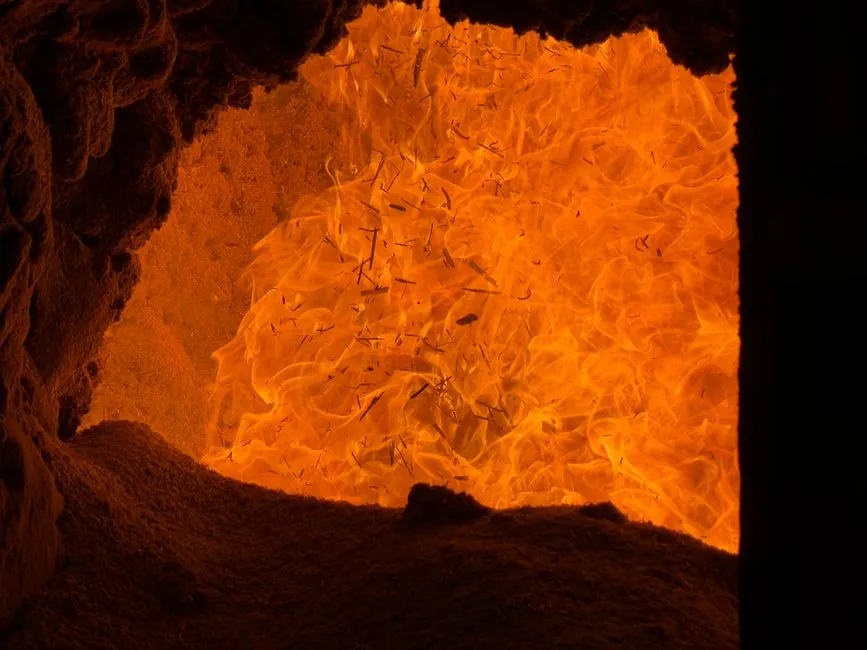
Gas-fired reverberatory aluminum melting furnaces commonly operate at approximately 20–45% thermal efficiency, while direct-immersion electric resistance heaters can achieve about 99% heating efficiency with melt loss below 1% [S1].
The comparison applies to aluminum production, including foundry, casthouse, die-casting, extrusion support, scrap recycling, chip remelting, and research duties, where melt rate, charge form, utility capacity, and operating schedule determine the practical choice [S3].
Thermal efficiency gap and its operating meaning
The efficiency gap is substantial: a 20–45% gas-fired reverberatory furnace leaves a large share of fuel energy unused, whereas an electric direct-immersion system can approach 99% thermal efficiency [S1]. The comparison is not between two identical furnaces, because gas-fired reverberatory furnaces transfer heat through refractory radiation and some convection, while direct-immersion electric resistance heaters heat the melt by conduction and convection [S1].
A 2025 gas-fueled metal melting furnace prototype achieved about 22% efficiency, compared with 18% reported for comparable aluminum melting setups [S6]. This confirms that combustion equipment can improve on a weak baseline, but it does not close the gap to the approximately 99% figure reported for direct-immersion electric resistance heating [S1][S6].
The distinction between heat-source efficiency and total system cost is critical. Electricity is not inherently cheaper, and gas is not automatically more efficient. Utility prices, demand charges, service capacity, ventilation, combustion air, exhaust, maintenance, controls, and the production schedule all affect the result; plant-specific calculations are required [S5].
Gas, electric resistance, and induction compared
Gas-fired systems offer strong heat input and remain relevant for high-volume melting, but they require burners, valves, combustion controls, combustion air, and exhaust arrangements [S3][S5]. Electric resistance systems add elements, contactors, power controls, and electrical-service requirements while supporting clean operation and more precise control where adequate electrical capacity exists [S5].
Induction equipment uses a copper coil to generate a magnetic field that induces currents in the aluminum charge, without direct flame contact [S3]. Published system ranges include 50 kW to 10,000 kW and 50 kg to 20 tons of melting capacity, although actual performance depends on furnace configuration, charge material, production duty, and site utilities [S3].
For the principal decision criteria, gas-fired equipment rates highly for immediate heat input and utility accessibility, but less favorably for energy efficiency, combustion isolation, and local emissions. Electric resistance equipment rates highly for thermal efficiency, temperature control, clean operation, and melt cleanliness, but electrical demand, service capacity, and standby losses require review [S1][S4][S5].
The difference between resistance and induction should not be blurred. The 99% figure applies to the direct-immersion electric resistance arrangement described for the DOE ITM project, not automatically to every resistance furnace or induction system [S1]. The broader aluminum melting furnace category includes several heat-transfer designs, so procurement decisions need furnace-level data rather than a generic electric label.
Metal quality changes the comparison

A Berkeley comparison melted primary A356 aluminum in silicon carbide crucibles, brought both gas-fired and electric resistance melts to the same pouring temperature, degassed them with ultra-dry nitrogen, skimmed them, and poured them into green-sand and permanent molds [S4]. Hundreds of test bars were pulled and statistically evaluated, which is more useful for a quality decision than comparing furnace names alone [S4].
Tensile strength, yield strength, and elongation were almost uniformly superior in the electrically melted samples regardless of the type of mold used [S4].
Clean heating alone does not replace good foundry practice. Both trial melts required equal pouring temperature, ultra-dry nitrogen degassing, and skimming, so the result supports the heating-method comparison under a controlled process rather than proving that electric equipment compensates for poor melt treatment [S4].
Production schedule changes the economic answer
One-shift operation cannot be compared economically with continuous production by applying the same energy rate to full-load hours. Batch size, heat-up time, holding time, alloy changes, idle periods, cleaning stops, maintenance windows, and downstream pauses all change the useful heat denominator [S5]. A furnace comparison should therefore track melt time, temperature overshoot, idle time, and alarm events rather than rely only on monthly utility bills [S5].
Gas equipment can suit sites without a large electrical service, while electric systems can fit plants that already have reliable power and demand-control capability [S5]. Demand charges can be material for high-power equipment; combustion ventilation and exhaust can add operating cost to gas systems [S5]. The economically relevant unit is therefore cost per acceptable kilogram of cast product, including energy, demand, maintenance, contamination loss, and downtime.
For a foundry that needs to benchmark its own duty against crucible economics, natural gas crucible furnace cost per kg of aluminum melted provides a useful operating-cost framework rather than a universal tariff assumption.
Application fit and procurement criteria
Gas-fired furnaces remain essential for high-volume melting, while electric resistance furnaces provide stable, clean operation in controlled environments and are selected where electrical capacity is available [S3]. The gas aluminum melting furnace fits large thermal duties and plants with practical access to gas infrastructure, but its combustion system, refractory heat transfer, emissions, and melt surface need explicit evaluation.
Direct-immersion electric resistance heating is suited to large-scale operations that can provide suitable electrical infrastructure and require controlled melt delivery. The ITM design uses two independent heat sources: high-heat-flux immersion heaters for melting and a moderate-heat-flux refractory panel system for holding [S1]. That architecture separates high-intensity melting duty from controlled holding duty.
The ITM project also developed transportable electric ladles for remote casting operations. Its smaller conduction-heated holding vessels used less than 10 Btu/hr-lb, compared with 30–40 Btu/hr-lb for typical industrial holding furnaces, and the integrated system was estimated to save more than 85% of energy against conventional melting, gas-burner-preheated ladles, and on-site holding practice [S1].
For procurement, specify melt capacity, aluminum grade, scrap type, production volume, available electrical supply, gas availability, preferred configuration, installation limits, and auxiliary equipment before selecting a furnace [S3]. The physical check is equally important: bin size, scrap geometry, charge method, ceiling height, door clearance, floor traffic, and finished-product handling affect configuration [S5].
Failure modes and measurable acceptance criteria
Gas-fired systems can suffer combustion-gas ingress, uneven melt-surface heating, dross formation, and higher local emissions, while poor burner or exhaust maintenance can increase operating cost [S4][S5]. Electric systems can be constrained by maximum demand, insufficient service capacity, electrical losses, element or contactor maintenance, and standby consumption [S5]. Neither technology is maintenance-free.
Acceptance testing should measure more than fuel or electricity. The operating record should include energy per accepted kilogram, melt loss, temperature stability, alloy-change time, idle consumption, alarm frequency, maintenance labor, and scrap-to-cast yield [S5]. For gas equipment, combustion-air and exhaust operation also require review. For electric equipment, demand peaks, element condition, and power-control performance are critical.
For direct-immersion electric resistance heating, the reference benchmark is about 99% thermal efficiency and less than 1% melt loss [S1]. For conventional gas-fired reverberatory furnaces, the reference range is approximately 20–45% thermal efficiency [S1]. These figures should be treated as configuration-specific benchmarks, then verified against furnace drawings, test data, utility invoices, and production logs.
The next decision point is a site-specific heat balance covering one year of operating hours, utility rates, demand charges, gas and electrical availability, alloy mix, and expected output; the gas-versus-electric choice should follow that calculation and the required casting quality.